February 10, 2026
Selecting the top iGaming software provider in 2026 is a strategic commercial choice as well as a technological one. Revenue, reputation, and scalability are all impacted. If you have experience working with platforms or are thinking about starting your own project, you are aware that choosing the best iGaming and sportsbook software supplier in 2026 may help you succeed more quickly.
The demand for live casinos and betting services is rising, rules are tightening, and an increasing number of users are moving to mobile devices, all of which are causing the iGaming business to change quickly. This implies that selecting a supplier involves considering both long-term responsibilities and features.
What Is an iGaming Software Provider and Why the Choice Matters
What is a gambling software development company? It is a business that develops or provides technology to start online bookies, casinos, and other gambling businesses. They can provide whole platforms, game content, integration modules, or specific services (such as KYC or payment gateway integration). Why is picking the correct one important? Because it has an impact on:
- user safety;
- compliance with regulatory requirements;
- the ability to easily add new games and services;
- scaling to other countries.
In 2026, competition is intensifying, so it is important to understand that not all providers are equally useful for your specific business model.

Key Factors When Choosing an iGaming Software Provider
Before choosing an iGaming platform provider, it is useful to consider several key factors. These points will help you systematize your choice and avoid mistakes at the start. Below is a list of the main criteria that you should evaluate together with your team:
- licenses and regulatory support;
- technical capabilities and scalability;
- payment support (including crypto);
- security and compliance with standards;
- reputation in the market.
These factors not only help you choose the best iGaming software provider but also reduce the risks when entering new jurisdictions or expanding your business. Before making a decision, it is worth asking yourself a few important questions:
- Does the provider support regulation in the countries where you plan to operate?
- Is it easy to integrate new services and content?
- Does the provider have its own games, or does it work through an iGaming content aggregator?
These answers will give you an initial idea of strategic compatibility.
Business Model, Strategy, and Target Markets
Your business plan should match what the provider offers. If you are targeting a single country with strict requirements, then the iGaming software solution must fully comply with local regulations. If your goal is to operate on an international scale, then platform flexibility and the ability to easily add new modes, languages, and payment methods are important.
It is equally important to understand your target players. For example, younger audiences are more likely to use cryptocurrencies, so supporting such payments can be a competitive advantage. In addition, some players are attracted by a wide selection of free games. If you are interested in how these games generate revenue and why it works, read our blog.
Licensing, Compliance, and Supported Jurisdictions
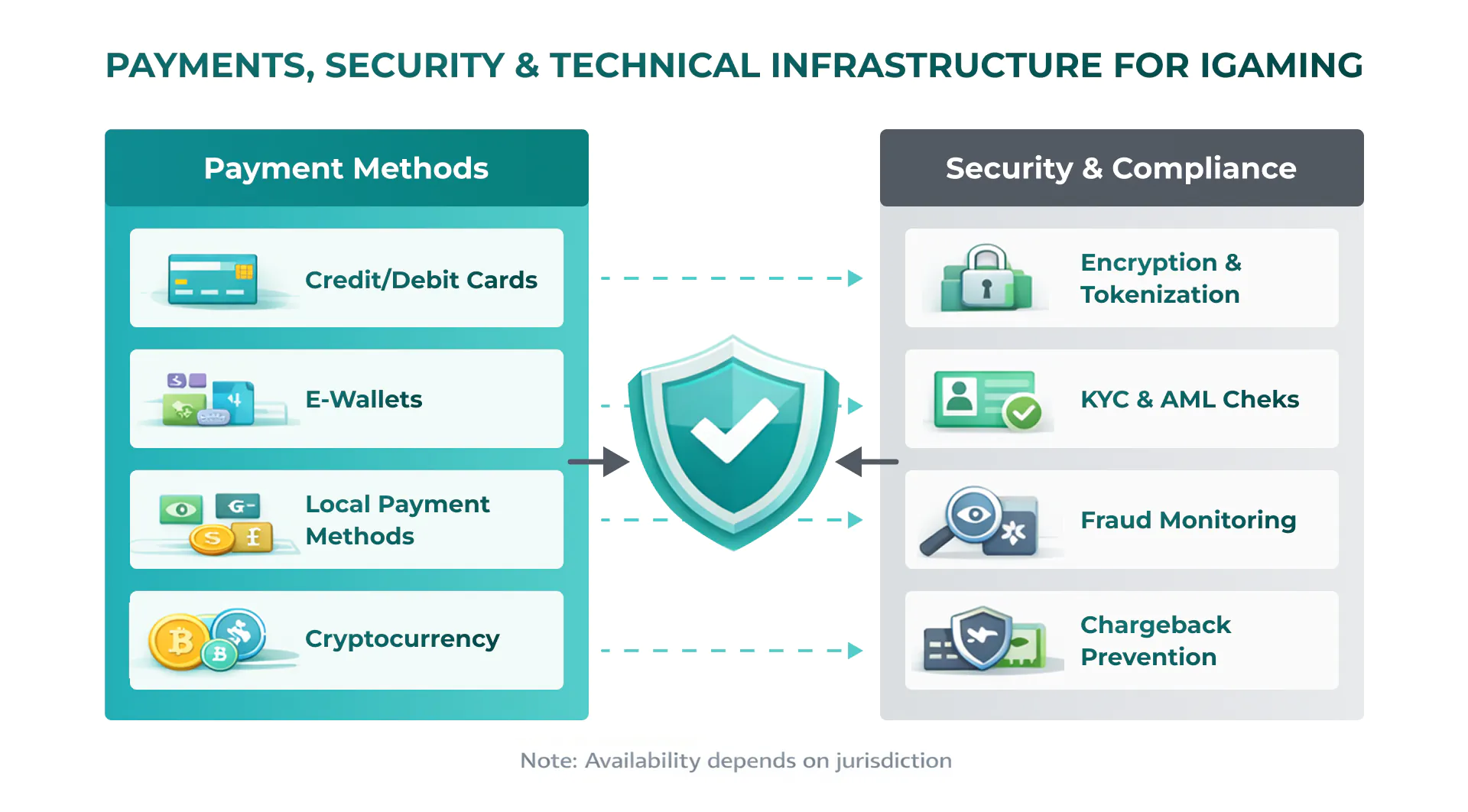
One of the first things you should always check before choosing an iGaming software provider is their licenses. Without the right licenses, your platform may be subject to sanctions by regulators or even blocked in key countries. This sounds obvious, but many teams initially “skip” this step — and then run into problems when launching operations in a particular jurisdiction. When comparing providers, pay attention to the following:
- which jurisdiction issued the license;
- whether the licenses you need are supported;
- whether the provider assists with the process of obtaining or renewing licenses.
These points are important because regulations vary from country to country. In one place, certification from the MGA or UKGC may be sufficient, while in another region, a local regulator or separate modules for KYC/AML processing may be required.
It is important to remember that iGaming licensing compatibility must be clearly defined at the supplier selection stage. If you are unsure whether the selected provider meets the requirements of your market, it is better to clarify this before signing the contract than to deal with the consequences after release. Some providers have licenses in several major jurisdictions. This is a big plus when your business is planning to expand.
White Label vs Custom iGaming Software Solutions
After licensing, another important question arises: which solution to choose — white-label iGaming software or custom iGaming platform? Both approaches have their advantages, but also nuances that can significantly affect launch times and further scaling.
White-label iGaming software is a ready-made solution that already has basic infrastructure, integrated services, games, and often basic payment support. It saves time and effort on developing from scratch, but may have limitations in terms of customization. Advantages and disadvantages:
| Pros | Cons |
| quick start;lower initial iGaming software costs;more frequent support for updates. | limited ability to adapt to unique business processes;often impossible to completely change the UX/UI. |
At the same time, a custom iGaming platform gives you complete control over functionality and design. If your product has unique requirements or special integrations, a custom solution is simply a must. This is not an easy decision — each option has its own “logic,” and it is important to choose the one that fits your business strategy.
Game Portfolio, Platform Features, and Customization
When it comes to iGaming software solutions, one of the most important issues for a future platform is its game portfolio and functionality. It is important not only how many games are supported, but also how easy it is for the provider to add new games, including games from third-party providers. Casino game providers’ integration should be simple, fast, and without unnecessary technical obstacles. What to evaluate:
- the availability of a wide range of games (slots, table games, live games);
- the ability to add content from top studios;
- how easy it is to customize features for your audience;
- UX/UI adaptation to your style.
It’s not always a question of “the more, the better.” Sometimes, a carefully selected set that is specifically targeted at your audience works more effectively than a huge catalog that no one uses.
Also, the integration of third-party modules should be planned. For example, sometimes platforms require special solutions for mobile users or integrated bonus mechanics — make sure that the chosen provider allows you to do this flexibly. If you plan to expand into other iGaming segments in the future, such as social games or eSports, it is worth checking the platform’s potential now.
Payments, Security, and Technical Infrastructure
Once you have chosen an iGaming software provider, it is important to think about one of the most sensitive parts of the platform – payments and security. In 2026, payments are no longer just “another module”. Today, it is the heart of commerce, on which player comfort, return rates, fraud levels, and even your legal risks depend.
Even if you have great gaming functionality and a large-scale strategy, if payments are slow or do not meet security standards, users will run to competitors. Therefore, when choosing an iGaming platform provider, be sure to evaluate how the provider addresses these issues.
Payment integrations: what is important to check
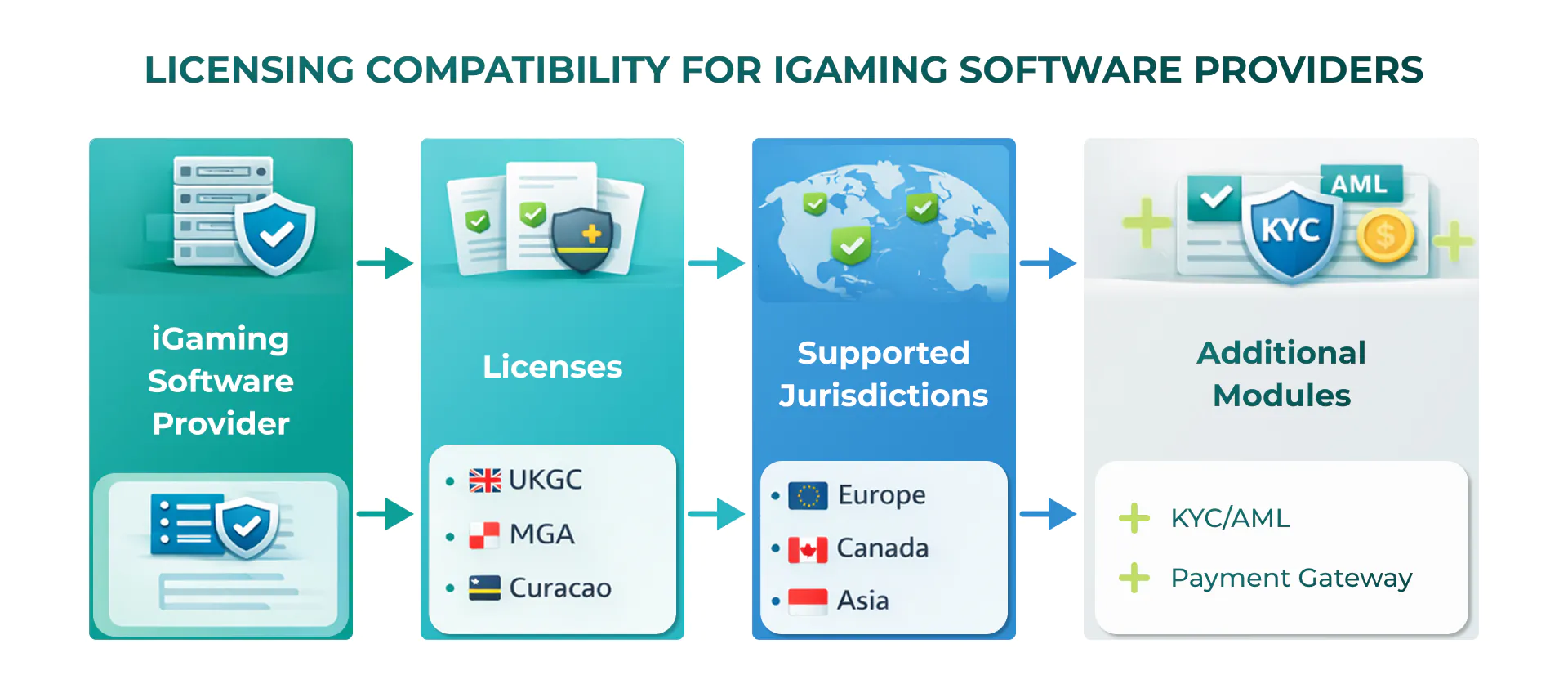
Perhaps the first thing is to make sure that the provider supports a wide range of payment methods. It is not just cards and IBAN. Good solutions include digital wallets, bank transfers, local payment methods for specific markets, as well as cryptocurrencies, if this is relevant to your audience. But simply “supports” is not enough. Payment modules should work quickly, without failures, and meet compliance standards. This often means:
- Ensuring transaction security. The payment gateway for gambling platforms should encrypt data, support tokenization, and meet modern security standards.
- Compliance with KYC and AML requirements. User verification processes should work together with payment modules so that the system does not accept suspicious transactions. This is important not only for regulators but also to protect the business from fraud.
- Multi-currency and local adaptation. The wider the list of currencies and local payment methods, the more audiences you can reach without additional technical barriers.
Such things may seem technical, but they directly affect how quickly a player can deposit funds or withdraw winnings. And this is what many users will decide whether to stay on the platform for a long time.
The platform should work in such a way that no third parties can access player data or funds. Today, providers focus not only on standard protection mechanisms, but also on real-time transaction monitoring.
It would be good if the provider offers:
- anti-fraud protection;
- automatic blocking of suspicious payments;
- tools to reduce the number of chargebacks;
- secure processing of user data.
These are not trifles, but part of the technical infrastructure that can really affect the operational stability of your project.
Managed Services, Support, and Ongoing Maintenance
Choosing an iGaming software provider is not a one-time purchase. It is a long-term partnership, as the platform requires support, updates, and technical support. A good provider offers not only a product, but also full-fledged managed services for iGaming so that you can focus on growing your business, not solving technical problems. Before signing a contract, be sure to clarify:
- level of technical support;
- is there an SLA (Service Level Agreement) with guaranteed response times;
- how quickly issues of failures or errors are resolved;
- is there 24/7 support, especially if you plan to work in international markets.
This is important because in the iGaming industry, user expectations for uninterrupted operation are very high. If the platform crashes during peak traffic or transaction processing is delayed, this is not only results in lost revenue but also risks losing player trust.
Pricing Models and Total Cost of iGaming Software
The cost of iGaming software often comes as a shock to those who are unprepared. Not because the market deliberately sets high prices, but because many people have no idea what they are dealing with before negotiations begin. Therefore, it is better to understand what the bill consists of and what pricing models are offered. It is not just about ‘cheap or expensive’. The main thing is to understand what you are paying for and the real value of each payment in the long term.
Before signing a contract, it is important to know what exactly you will be paying for. Here are the main models:
- Fixed licence per platform. You pay for the product itself, like for a programme. This is often suitable for projects with a clearly defined set of features.
- Revenue-based model. This is often a percentage of your iGaming business revenue. This is how many white-label solutions work.
- Hybrid models. A combination of a fixed fee and a percentage of profits.
Each model has its pros and cons. If you plan to scale up or expect high traffic, it is worth comparing not only the starting price but also the potential costs for the following years. When discussing the price with a potential iGaming software provider, ask yourself and your partners the following questions:
- What exactly is included in the initial cost?
- What are the additional payments for integrations or new features?
- Are there fees for updates and technical support?
- How will the cost change when expanding into new jurisdictions?
Providers usually offer a document with a complete list of costs. Read it carefully, as sometimes additional modules can significantly affect the final budget.
Common Mistakes When Choosing an iGaming Software Provider
When choosing an iGaming platform provider, avoid the following mistakes:
- Choosing based on price alone. A low price may mean low-level support or outdated modules.
- Ignoring regulatory requirements. This can lead to blockages or fines in specific markets.
- Ineffective support. Without prompt technical assistance, every failure can become a serious problem.
- Lack of a scaling plan. If the platform is not adapted for growth, you will have to change providers after a while.
These are things that often ‘sweep away’ projects that had potential. Therefore, it is important to look beyond the price tag and think about the long-term viability of the platform.

Final Checklist Before Selecting an iGaming Software Provider
Before signing the contract, complete the supplier assessment using this checklist. It is a kind of final ‘checklist’ that will help you understand whether you are ready to move forward or whether you need to clarify something. Here’s what to check:
- Licences and jurisdictions fully comply with your markets.
- The platform supports the necessary payments and gambling platform security standards.
- The pricing model is clear and predictable.
- There is a clear roadmap for product development.
- Technical support works quickly and with realistic SLAs.
- You understand how to add new services and growth features.
- The contract includes provisions for updates and support without any additional surprises.
If the answers are positive and straightforward, the chances of making the right choice are much higher.
FAQ
How long does it take to integrate the platform?
It usually takes from a few weeks to a few months, depending on the complexity of the settings and features.
Can I change the platform later if it doesn’t work out?
Technically, yes, but it can be expensive and time-consuming. Therefore, it is better to approach the choice carefully.
Is it necessary to choose a white-label solution?
No. White label is suitable if a quick launch is important. If you need unique solutions, custom is better.
How can I assess whether a provider supports local payments?
Ask for a list of integrated payments and specify which ones work in your target regions.
More Article