April 22, 2026

Choosing between stylized vs realistic art isn’t purely a creative call — it’s a business decision with direct consequences for production cost, release cadence, platform performance, and player retention. In casino and slot game development specifically, visual style shapes everything from how a game reads in a lobby thumbnail to how long a player stays through a bonus round. Get it right and it compounds. Get it wrong and no amount of mechanic polish recovers the loss.
This article breaks down realistic vs stylized art from a production and commercial standpoint, with a focus on what actually matters in iGaming: speed to market, visual clarity, scalability across multiple titles, and fit with player expectations.
What Is Stylized Art in Games?
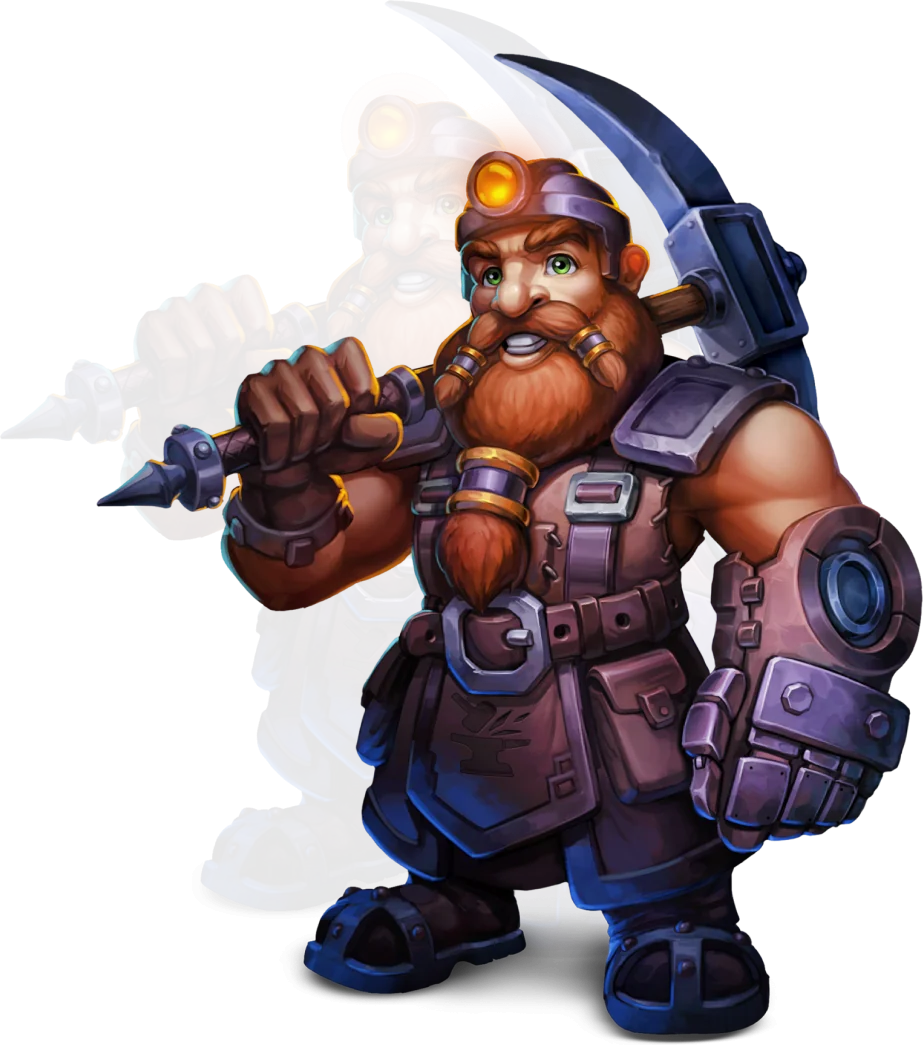
The stylized definition in art centers on intentional departure from realism. Rather than replicating the world, stylized visuals simplify, exaggerate, and reinterpret it — trading photographic accuracy for expressive clarity. In games, that means bold color palettes, strong silhouettes, exaggerated proportions, and motion that reads in a fraction of a second.
In slot development, the stylized art style is the industry standard for good reason. Fruit machines, fantasy epics, mythology-themed grids, cartoon characters, neon-drenched arcade callbacks — nearly all of these work because stylization allows each symbol to communicate instantly at thumbnail scale, survive compression on mobile displays, and retain visual hierarchy when six reels are firing simultaneously.
From a pipeline perspective, stylization techniques in digital art are about establishing and enforcing a visual language. A team defines how scatter symbols differ from base symbols, how win animations escalate across payout tiers, how UI chrome complements rather than competes with the reels — and then applies those rules consistently across every asset. That consistency is what creates a recognizable game identity, and it’s what makes the pipeline repeatable across multiple titles.
In practical terms for an iGaming studio, stylized graphics deliver faster iteration cycles, cleaner adaptation across themes, stronger readability on small screens, and a safer baseline for performance across device tiers. For games built around rapid spins, frequent micro-rewards, and near-miss tension, this visual immediacy is a functional requirement, not a stylistic preference.
What Is Realistic Art in Games?
A realistic style sets out to replicate real-world visuals: accurate lighting models, physically grounded materials, high-resolution texture work, and proportions that align with actual reference. In AAA console development, this is a full pipeline commitment. In iGaming, realism is deployed far more selectively — and that distinction matters.
In slot and casino contexts, full-spectrum realism is rare. What studios actually use is selective realism: photorealistic gemstone renders, metallic finishes that catch light convincingly, high-end table felt and casino interior environments — deployed to communicate luxury, heritage, or brand authenticity rather than as a blanket art direction.
Technically, realism in 3D modeling and texturing demands a heavier pipeline. Physically Based Rendering (PBR) workflows require high-resolution texture sets — albedo, normal, roughness, metallic, ambient occlusion — for every significant asset. Lighting rigs need to be built carefully, because inconsistent light sources immediately break the illusion. Post-processing layers add atmosphere but also add rendering cost. For a studio shipping six to twelve titles per year, that overhead is a genuine constraint.
In casino development, realistic treatments are typically justified when the product is positioning itself in one of three areas:
- premium or VIP-focused experiences where higher perceived production value is part of the proposition;
- branded or licensed content where accuracy to real-world IP is contractually required;
- specific thematic contexts — luxury resort environments, archaeological settings, historical reproductions — where realism earns player trust in a way stylization cannot.
Key Differences Between Stylized and Realistic Art
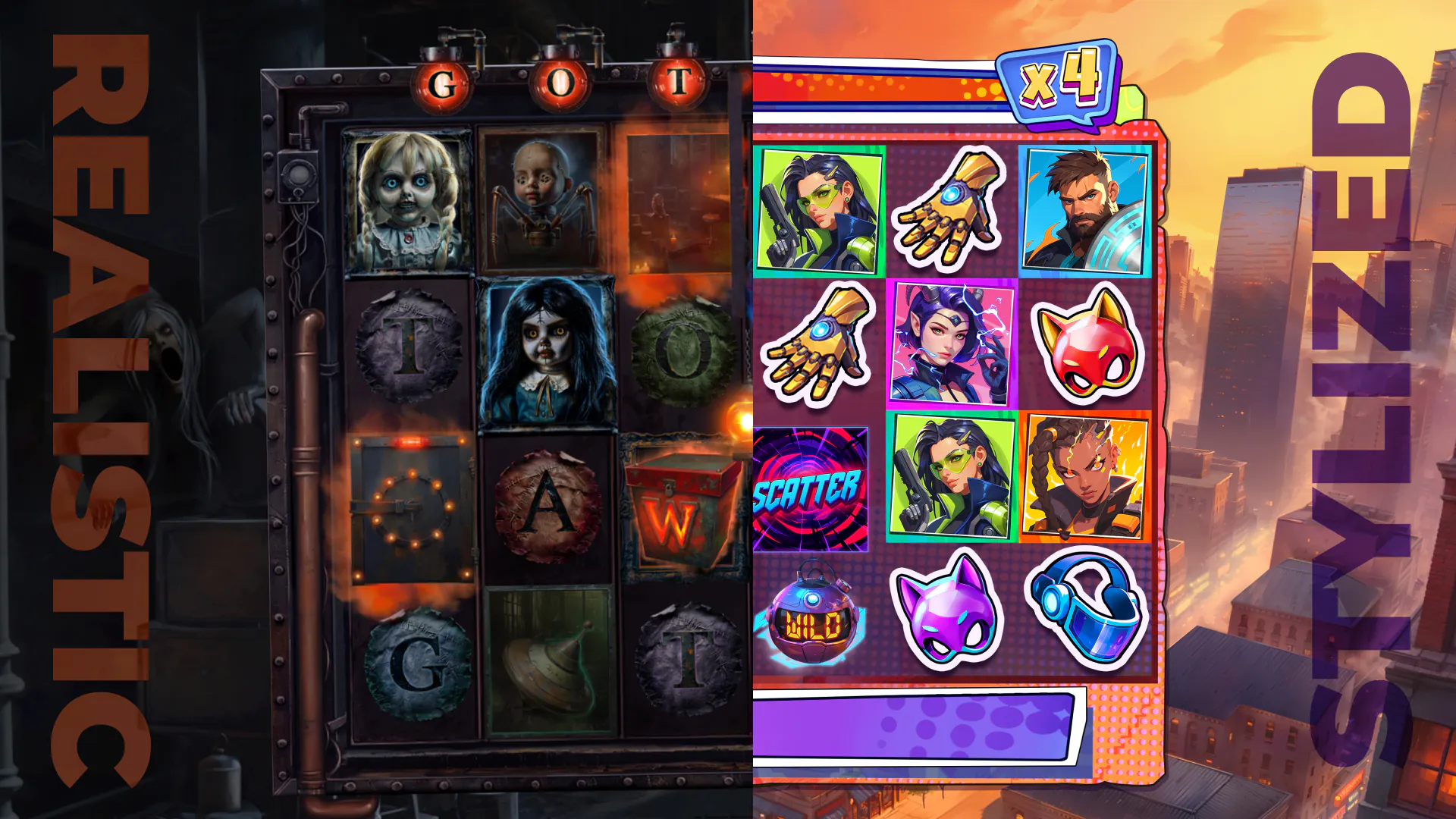
Visual Style and Aesthetics
The difference between stylized graphics and realistic visuals comes down to where the art’s communicative energy is directed.
Stylized art prioritizes readability, emotional tone, and expressive exaggeration — everything is designed to be understood quickly and felt immediately. A winning combination on a stylized slot doesn’t just pay out; it erupts. That visual escalation is legible because the art was designed around it from the start.
Realistic art prioritizes accuracy, material depth, and environmental immersion. The communication is slower and more atmospheric. A realistic slot is more like entering a room than pressing a button — which can be genuinely compelling, but it requires the player to invest attention that they may not have in a fast-session mobile context.
From an art direction in video games standpoint, stylization gives art directors considerably more creative latitude. Proportions can be pushed, palettes can be saturated beyond real-world limits, and animation can break physics entirely in service of feel. Realism, by contrast, keeps the work anchored to real-world reference at every stage — a constraint that slows iteration and raises the cost of creative pivots.
This isn’t a judgment about quality. It’s a judgment about fit. In a slot lobby where a player is scanning twenty thumbnails in under ten seconds, stylized visuals win that scan. In a premium live-casino environment where the goal is sustained presence and perceived exclusivity, realism has a real argument.
Development Time and Cost
This is where the stylized vs realistic debate becomes financial.
Stylized pipelines run faster for several structural reasons. Assets require fewer texture maps. Geometry can be lower-poly without looking wrong, because exaggeration is the point. Style guides, once established, enable junior artists to produce on-spec work more reliably. Iteration is faster because there are fewer physical references to honor and fewer consistency checks to run.
Realistic pipelines scale in the opposite direction. A single high-quality character or environment in a PBR workflow requires significantly more hours to produce, review, and integrate than a stylized equivalent. More critically, realistic assets are harder to modify after the fact — adjusting a character’s costume or a symbol’s material requires returning to the full texture set, not just repainting a diffuse layer.
For studios managing multiple simultaneous releases — a common model in iGaming — this difference compounds quickly. A practical example from real production: when a slot title with strong performance metrics needs a visual refresh, the fastest path is often a full reskin of the art while preserving the underlying mechanic. That process — updating symbols, backgrounds, and UI while keeping symbol counts, naming conventions, and grid layouts intact — is substantially more manageable in a stylized pipeline. Realistic assets resist reskinning because their visual integrity depends on the entire system, not just the surface layer.
Technical Requirements and Performance
Performance optimization in game art matters more in iGaming than in almost any other game sector, because the player base is extraordinarily broad and the device range is enormous. A high-spending player on a flagship Android device and a casual player on a three-year-old mid-range phone may both be playing the same title simultaneously.
Stylized art handles this range better. Lower polygon counts and simpler shading models reduce GPU load. Texture atlases are more compact. Animation complexity can be kept high for visual reward without requiring advanced rendering techniques.
Realistic art presents real performance risk if not managed carefully. Rendering techniques in modern games — PBR, screen-space reflections, real-time global illumination — are designed for hardware environments far more controlled than a mobile-first iGaming deployment. Bringing those techniques into a slot without aggressive optimization often means either compromising visual quality or compromising device compatibility, neither of which is acceptable in a regulated, accessible commercial product.
The practical implication is that realistic elements need to be specifically justified in a mobile-first context, with performance budgets established before production rather than optimized after the fact.
Target Audience and Market Fit
Player perception of game visuals is shaped by context as much as by quality. A player who drops into a casual slots session during a commute is primed for quick, high-contrast, immediately readable visuals. A player deliberately selecting a premium title in a VIP lobby has different expectations and a higher tolerance for atmospheric, slower-reading visuals.
Stylized art style maps cleanly onto the broadest segment of the slot market: mobile-first casual players, players in short sessions, players who prioritize entertainment over immersion. It also performs better in the visual identity in game design sense — stylized games differentiate more clearly in crowded lobbies, because their visual personality is stronger and more immediately distinctive.
Realistic art tends to perform better in niche contexts: high-value players, table game extensions, branded slots where the license carries its own visual expectations, and products positioning as premium alternatives to the mid-market.

When to Choose Stylized Art
Stylized art style is the right call when clarity, speed, and scalability are the driving priorities — which describes the majority of commercial slot development.
Choose stylization when you’re targeting mobile-first audiences or broad demographic segments; when your release cadence is high and your pipeline needs to stay lean; when the game concept is driven by theme, emotion, or entertainment energy rather than immersive world-building; and when you plan to support the title through reskins or sequel mechanics that share underlying architecture.
Stylization is also where creative direction in game projects has the most room to operate. Fantasy, mythology, Americana, retro-arcade, horror-comedy, ancient civilizations — virtually every major slot theme works in a stylized register because the conventions of the genre have been established and refined over decades. Players know what a cartoon dragon or a glowing wild symbol is supposed to do. Stylized art leans into those conventions and exaggerates them, which is exactly what the genre rewards.
From a game art production pipeline standpoint, stylized projects are also far more compatible with distributed team structures. Art style guides travel well. Outsourced contributors can match an established style more reliably than they can match a bespoke realistic pipeline, which reduces QA overhead and revision cycles significantly.
When to Choose Realistic Art
Realistic art earns its higher cost and complexity when the product is specifically targeting segments where perceived production value is a competitive differentiator.
The clearest use case in iGaming is the premium or VIP-oriented product — a title designed to command higher bet limits and retain high-value players through an experience that feels elevated compared to the standard library. Here, realism in 3D modeling and texturing isn’t just aesthetic; it’s part of the value proposition. The weight of a realistically rendered gold bar, the shimmer of light on a chip stack, the depth of a casino floor environment — these communicate quality in a register that stylization deliberately avoids.
Branded and licensed slots represent the other strong case. When a game is built around a property — a film franchise, a sports brand, a celebrity IP — the license often carries visual expectations that can’t be stylized away without breaking the association. Realistic or semi-realistic treatment preserves the connection to the source material and justifies the license cost.
The risks are real, though. Inconsistency is far more damaging in realistic art than in stylized work. A stylized symbol that’s slightly off-model reads as a style variation. A realistic asset with an incorrect material, a mismatched light source, or a texture seam reads as a production error — and that kind of detail breaks player trust in a way that’s hard to recover from. Quality control requirements are fundamentally higher, and teams need genuine expertise in realism in 3D modeling and texturing rather than general art skills.
Hybrid Approach: Combining Stylized and Realistic Elements
The hybrid approach deserves more attention than it typically gets, because in practice it’s where the most interesting and commercially successful work is happening.
The structure is consistent: realistic materials and environments for tone, stylized symbols and characters for communication, clean stylized UI for clarity. A premium slot might use PBR materials for the background while keeping reel symbols bold and flat-lit. Win animations might use physics-accurate particles while the jackpot character performs a thoroughly exaggerated victory sequence.
This works because it segments visual work by function — each layer has a different job, and the art style should serve that job rather than match a single global aesthetic. From a game art outsourcing considerations standpoint, hybrid approaches distribute well: realistic environments to specialist teams, symbol and character design kept where the brand language lives.
Choosing the Right Art Style for Your Game
There’s no universal answer, but there is a structured way to reach the right one.
Start with the player experience and work backward. Fast, session-based gameplay with frequent reward loops almost always favors stylization. Deep immersive experiences built around sustained engagement may justify realism — but only if the audience, platform, and budget all support it.
Then apply the production constraints. What is your timeline? What is the team’s existing expertise — because trying to build a realistic pipeline without senior artists who have done it before is a recipe for expensive iteration. What platforms are you targeting, and what are the performance implications? Is this a standalone release or the first in a series that will require reskinning?
Character design style differences and environment design approaches in games compound across a portfolio: a stylized symbol set adapts across a dozen themes with manageable effort, while a realistic one locks you into the original execution’s visual commitments. Level of detail in game graphics follows the same logic — stylized assets are forgiving across device tiers; realistic pipelines need explicit LOD planning from day one.
Visual storytelling through game art and long-term commercial model should anchor the final call, not aesthetic preference alone.
Conclusion
For the majority of commercial iGaming titles, the framework points strongly toward stylization: faster to produce, easier to scale, more reliable on mobile, and better aligned with how broad player segments actually engage with slots. Realistic art has genuine value in premium and licensed contexts, but half-committed realism is more damaging than confident stylization — players forgive exaggeration, they don’t forgive inconsistency. The hybrid model, realistic environments paired with stylized symbols and clean UI, is currently where the strongest visual work in the sector sits.
At Inkration, art direction and technical production share the same roof — which means the stylized meaning in art vs realism decision gets made with actual pipeline data behind it. If you’re developing a new slot title, refreshing a high-performing mechanic, or scaling a themed series across multiple releases, we can help you find the right visual direction and execute it without compromising production efficiency. Talk to the Inkration team to release your newest casino game at its best appearance within realistic timelines.
FAQ
What is the main difference between stylized and realistic art in games?
Stylized art style simplifies and exaggerates visuals to maximize clarity and expressive impact. Realistic style aims to replicate real-world appearance with accuracy. In iGaming, stylized art dominates because it reads faster and performs better across devices.
Why is stylized art more common in slot games?
Slot gameplay is built around rapid visual feedback — spins, wins, near-misses, bonus triggers. Stylized graphics communicate these states instantly, even on small screens, without demanding heavy rendering resources. Realistic art can deliver the same information, but more slowly and at higher technical cost.
Is realistic art better for player engagement?
Not as a general rule. Realism enhances immersion in sustained-session experiences, but in fast-paced slot contexts, stylized vs realistic usually resolves in favor of stylized — because clarity of reward communication matters more than environmental depth.
Can you combine stylized and realistic art in one game?
Yes, and the best examples in the market do exactly this. Realistic backgrounds and material treatments establish quality and tone; stylized symbols and characters handle communication and entertainment. Clear style documentation is what keeps the hybrid from becoming inconsistent.
How does art style affect game development costs?
Stylized art style is generally more cost-efficient — simpler asset pipelines, faster iteration, and better compatibility with distributed development. Realistic pipelines require more specialized labor, longer production cycles, and more expensive quality control. The gap widens significantly at scale.
What should studios consider when choosing an art style?
Target audience, platform, release cadence, team expertise, and long-term scalability. The stylized meaning in art is deliberate departure from realism in service of clarity and expression — and in iGaming, that trade-off pays off commercially far more often than the alternative.