May 20, 2026
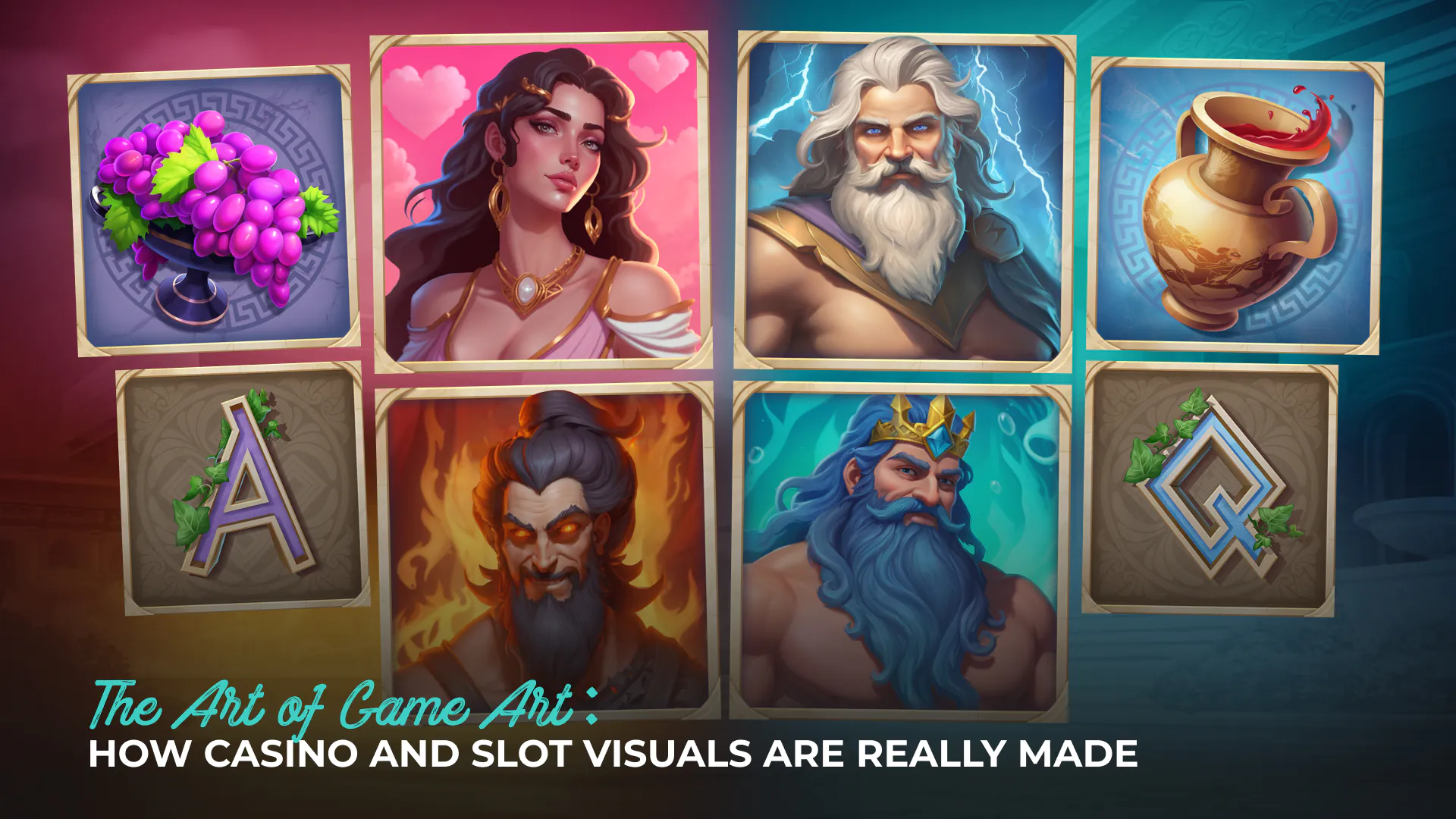
Game art is a strange discipline. On the surface, it looks like illustration; look closer, and you’ll find it sitting at the crossroads of design, animation, player psychology, and production engineering. Whether you’re crafting stylized characters for a mobile RPG or polished symbols for a slot machine, what players see on screen shapes how they feel — and whether they come back.
For studios in casino and mobile game production, art is first and foremost the product. Clear silhouettes improve usability. Polished effects reinforce rewards. A cohesive visual direction separates a game that converts from one that gets scrolled past on an app store shelf.
This is our take on how to draw game art — not as a classroom exercise, but from the perspective of a full-cycle game art studio that lives inside the iGaming production world daily.
What Is Game Art, Really?
Game art covers every visual element in a game: characters, environments, UI, icons, effects, animations, symbols, and promotional illustrations. But unlike standalone illustration, digital game art has to work inside an interactive product. Every asset carries both an artistic and a practical job.
Characters need readable silhouettes during fast gameplay. UI elements must remain clear across wildly different screen sizes. Effects need to communicate reward and feedback, not just look pretty. Symbols have to convey meaning in the fraction of a second a reel takes to stop.
In casino game development specifically, every drawn asset has a very specific purpose and set of rules. Players are scanning symbols, reacting to animations, and processing reward feedback in loops that repeat hundreds of times per session. Casino game illustrations don’t get the luxury of being admired — they have to perform.
Foundations: What All Strong Game Art Shares
No matter the genre or style, professional game art is built on a few universal principles. Getting these right is what separates work that looks good in a portfolio from work that actually ships and holds up in production.
Shape and Silhouette
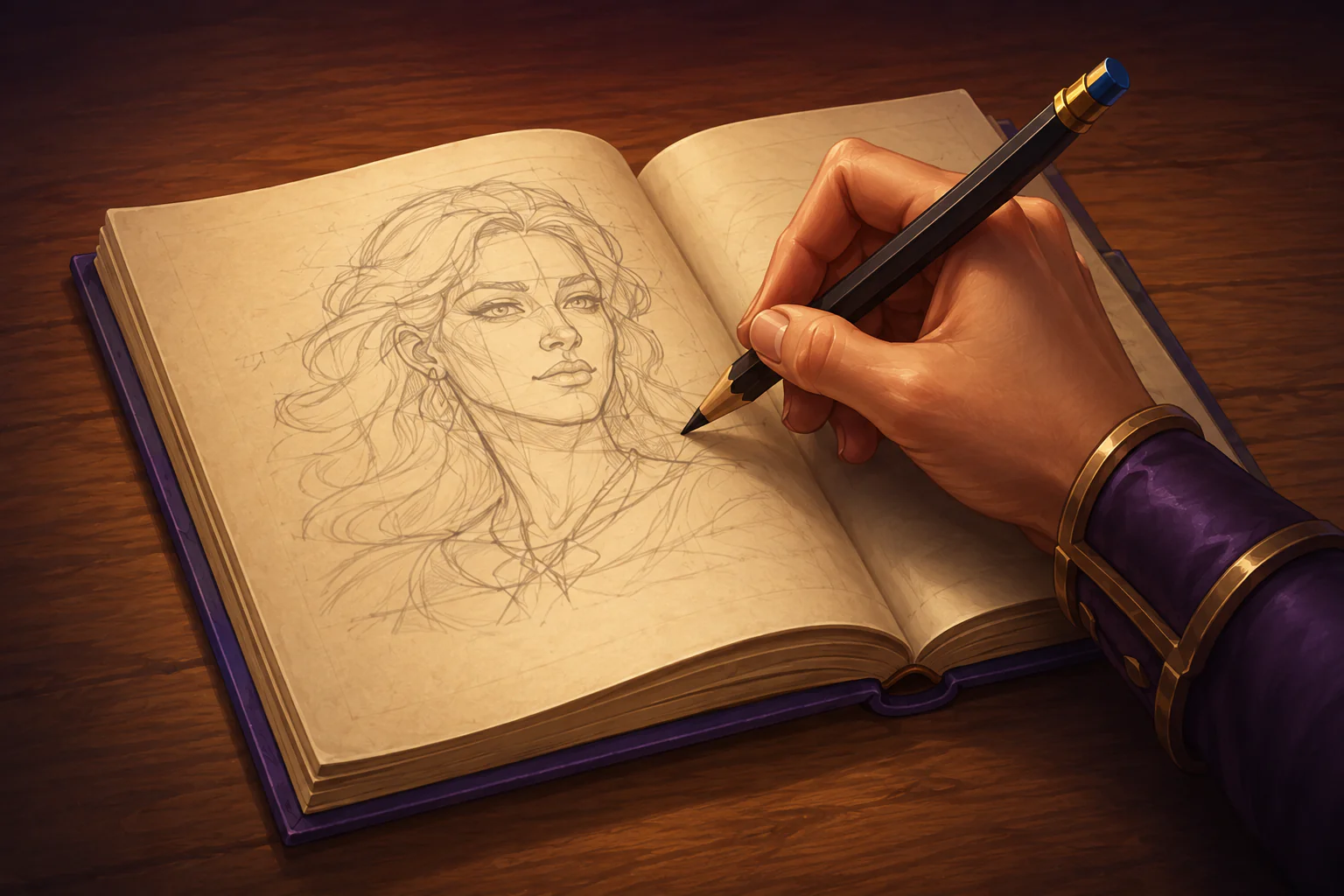
Players read shapes before they read details. A strong silhouette is what makes a character recognizable at 64 pixels, or a slot symbol readable mid-spin. This is especially critical in mobile game visuals and slot symbol design, where the window for visual communication is tiny.
Slot machine symbols are a perfect example. Coins, gems, crowns, bonus icons — they all survive on exaggerated forms and simplified structure, because nobody’s studying them at leisure. When creating characters, professional artists think in shape language from the start: circles suggest warmth and friendliness, squares read as strength, triangles carry tension. It sounds abstract until you apply it, and then it becomes one of the most practical tools in the room.
Color and Lighting
Color does the heavy lifting of directing attention, establishing mood, and reinforcing what matters. Understanding color theory for game art isn’t about aesthetic preference — it’s about making sure foreground separates from background, that players know where to look, and that reward moments feel like reward moments.
In casino and slot games, this is especially loaded. Gold tones signal premium value. Bright neon contrast makes bonus features feel electric. Overly realistic lighting, on the other hand, can actively hurt gameplay clarity — particularly on mobile, where visuals need to stay readable across a wide range of screens and conditions.
The professional approach tends to be controlled saturation, high-contrast focal points, simplified shadows, and stylized highlights. It’s not about realism; it’s about clarity at speed.
Composition and Readability
Beautiful art placed poorly is still bad game art. Composition determines how players visually navigate the screen — and in game production, functional hierarchy matters as much as aesthetic quality. Buttons need to read on small screens. Slot reels can’t feel visually crowded. Backgrounds should support gameplay, not compete with it.
Professional environment concept art walks a careful line between detail density and breathing room. Important areas get stronger contrast and focus; secondary regions stay quieter. In a casino interface where players are constantly processing information, that balance is what keeps the experience from tipping into chaos.
How to Draw Game Characters, Environments, and UI
Character Design
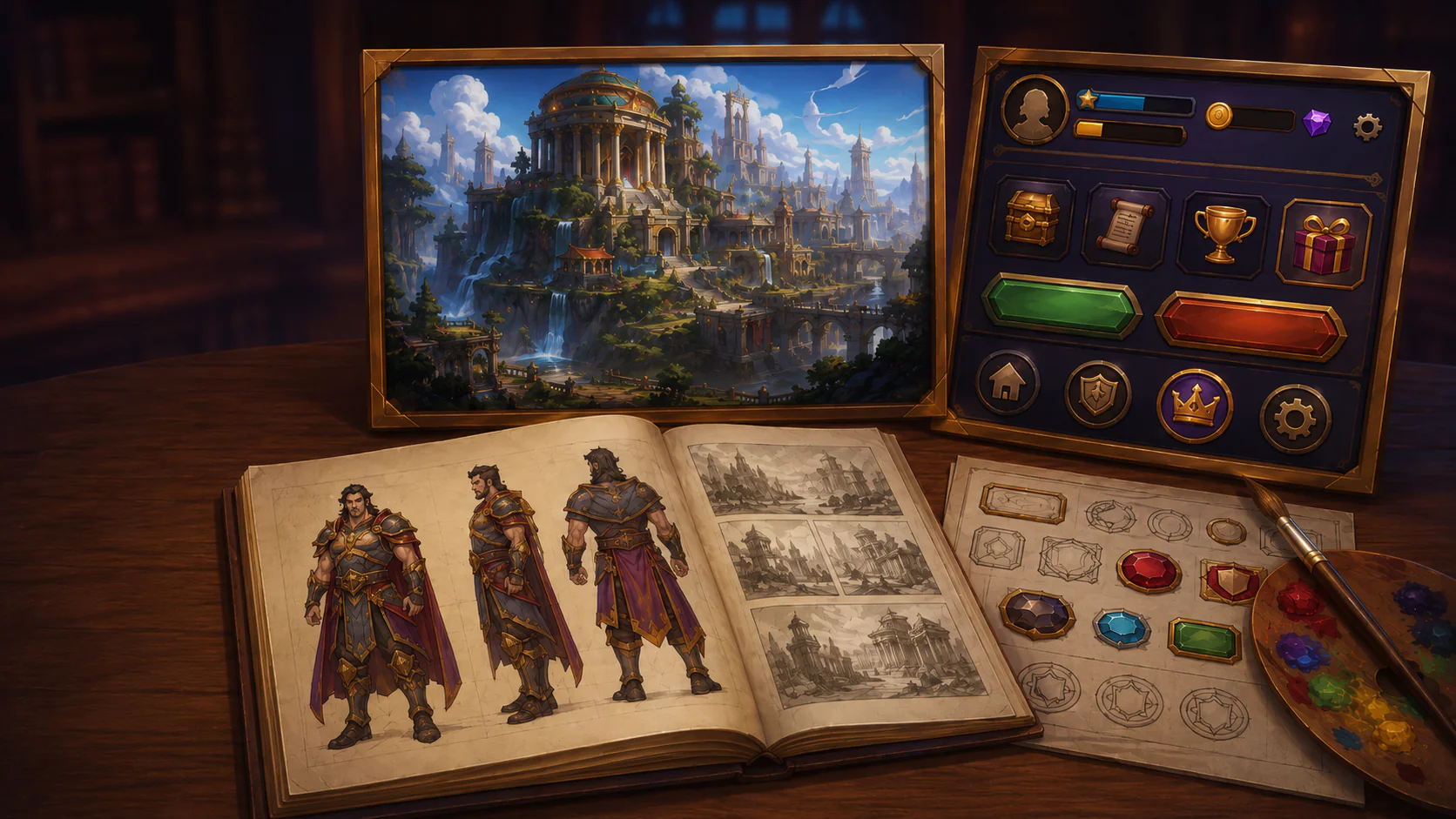
When artists think about drawing game characters, the final polished render is almost the last thing that gets made. Concept exploration, shape iterations, costume and silhouette variations, expression sheets, color studies — the pipeline is front-loaded with thinking before rendering begins.
Good character design communicates personality at a glance. Exaggerated proportions improve readability. Strong accessories reinforce theme. Limited color palettes help memorability. In casino production, characters typically serve recognizable archetypes — adventurers, mythological figures, royalty, treasure hunters — designed to feel visually compelling while remaining legible at smaller interface scales.
For artists building game portfolios, it’s worth noting that studios don’t just value rendering quality. They value production thinking. Showing workflow, iteration, and usability awareness can be the difference in a hiring review.
Environment and Background Art
Drawing game backgrounds is a different mindset from character work. Environment artists are thinking about depth, atmosphere, and navigation before they’re thinking about beauty. A background that pulls focus away from gameplay isn’t doing its job, regardless of how well-rendered it is.
In mobile and casino development, layered compositions with simplified distant elements, controlled contrast, and atmospheric perspective are standard. The background is a theatrical stage — it reinforces the game’s world without competing with the reels, UI, or reward mechanics happening in front of it.
UI Elements and Icons
UI art is the most underestimated discipline in the stack. Players interact with buttons, menus, reward popups, icons, and counters constantly, and bad UI immediately degrades the experience — sometimes without players being able to articulate exactly why.
Strong game UI artwork means consistent visual language, clear iconography, high contrast, proper spacing, and typography that integrates rather than collides. In casino games, this is especially weighted, because monetization systems, reward loops, and progression mechanics all depend on visual feedback being immediate and legible. Professional UI artists in this space work at the intersection of illustration, usability thinking, motion design, and branding consistency.
How to Draw Slot Game Art: A Different Discipline
Slot game art deserves its own conversation, because it operates by a different logic than traditional game illustration. The artwork has to feel thrilling without becoming chaotic. Every visual decision is a bet on player attention.
Slot Symbols
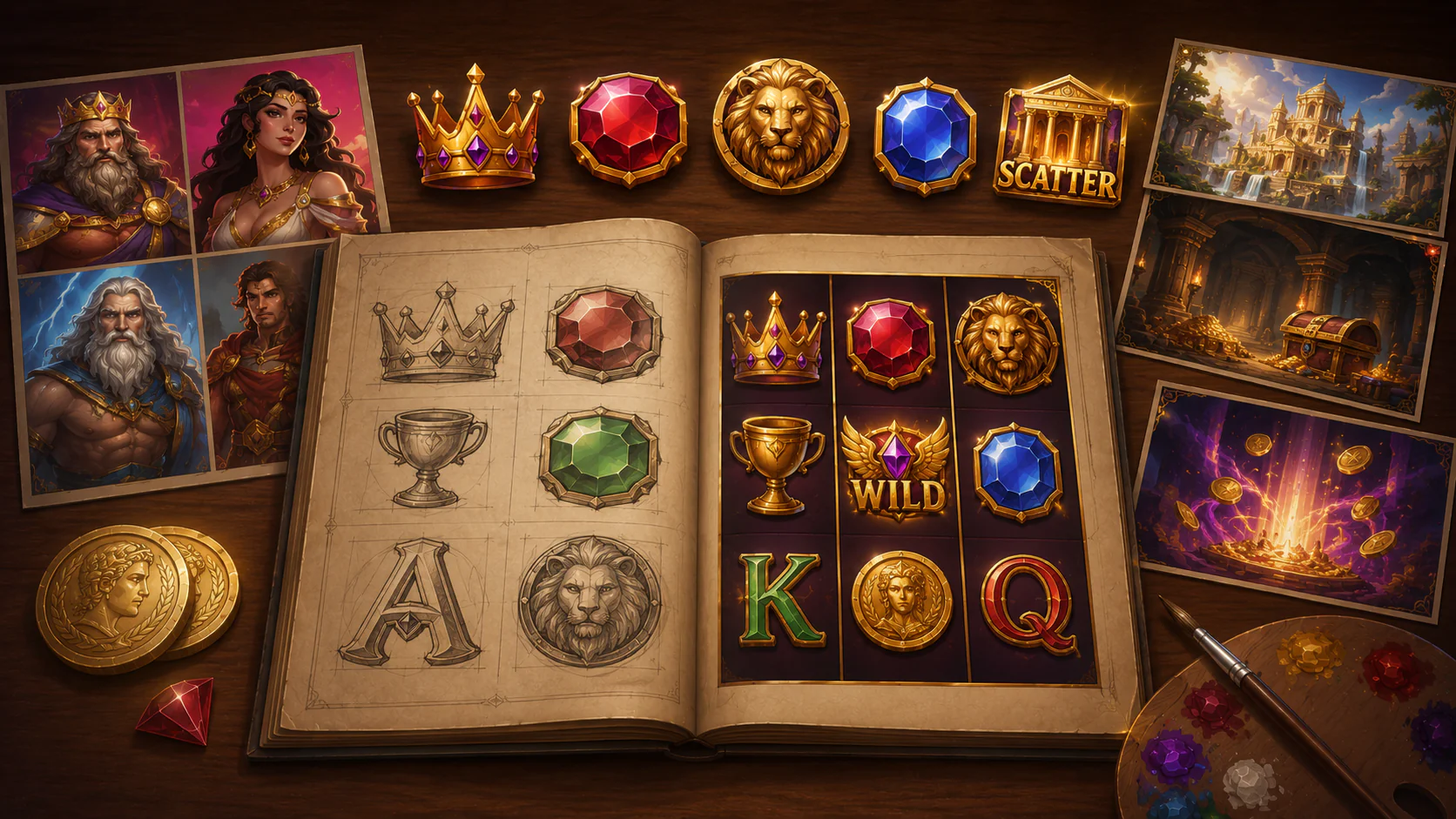
Symbols are the core of the visual system, and effective slot symbol design lives or dies on immediate readability. Strong shape language, high contrast, clean outlines, and consistent style aren’t stylistic preferences — they’re requirements.
Most slot symbols fall into recognizable categories: coins and gems, letters and numbers, character portraits, treasure objects, wild symbols, and bonus icons. Artists exaggerate reflections, glows, and outlines because the symbols are in motion and need to register before the eye has fully processed them. Coins and premium symbols lean on reward psychology — metallic textures, warm lighting, gem-like materials — to reinforce a sense of value before a single line has paid out.
Casino-Themed Illustrations
Many casino games are built around established fantasy worlds: Ancient Egypt, mythology, pirates, Asian folklore, neon futures, luxury and royalty. Creating strong casino themed graphics means honoring those themes while keeping visual clarity intact.
The look is typically dramatic — rich palettes, cinematic lighting, decorative framing, highly polished materials. Because casino games compete heavily on first impression, illustration quality is a real commercial variable. Many studios outsource to specialized production pipelines for exactly this reason, partnering with experienced 2D art services teams who can maintain stylistic consistency across symbols, characters, UI, and promotional assets at scale.
Bonus Effects and Visual Style
If symbols are the language of slot art, bonus moments are the punctuation — the visual equivalent of the crowd going wild. Explosions, glow bursts, particle systems, and transitions all reinforce reward feedback, and they require a different skill set: timing, motion clarity, color emphasis, layer separation, and knowing exactly where to stop before it overwhelms.
Modern casino production increasingly blends 2D illustration, motion graphics, animated overlays, and real-time effects into hybrid pipelines. Getting that balance right — exciting without chaotic, polished without heavy — is one of the more technically demanding things casino art studios do.
The Tools Behind the Work
The best tools are the ones that fit your workflow, but several programs define modern digital painting techniques and game art production.
Photoshop remains a standard for illustration and asset work.
Clip Studio Paint is widely used for stylized linework.
Procreate handles sketching and ideation.
Blender supports 3D blockouts, lighting, and hybrid workflows.
Figma drives UI systems, while Spine and After Effects handle animation and VFX integration.
Professional studios increasingly combine 2D and 3D workflows not because 3D is more prestigious, but because it accelerates production: 3D blockouts improve perspective accuracy, lighting passes speed up rendering, and reusable assets create real efficiency at scale.
For anyone researching how to become a game artist, the tool choice matters less than the fundamentals. Studios prioritize readability, composition, design thinking, production awareness, and adaptability. Strong fundamentals transfer across any software stack.
Conclusion
Learning how to draw game art means learning how to solve visual communication problems inside an interactive product. Every character design, every UI element, every slot symbol is doing a job — supporting gameplay, guiding attention, reinforcing reward, holding aesthetic quality under real production conditions.
In casino and mobile game development, art is directly tied to player experience and retention. The difference between a slot that performs and one that doesn’t is often visible before a single spin — in the quality of the symbols, the polish of the effects, the clarity of the interface.
At Inkration, we build casino and mobile game art from the inside out — combining illustration expertise with hands-on experience in iGaming production pipelines, UI systems, slot symbol design, and scalable content creation. From initial visual direction to production-ready assets, we know what it takes to make art that performs.
If you’re scaling a project or looking for a long-term art partner, let’s talk.
FAQ
How do beginners start learning game art?
Most beginners start with drawing fundamentals — anatomy, perspective, composition, and color theory — before moving into specialized game production workflows. Studying shipped games and practicing asset creation builds practical skill faster than theory alone.
What software is best for digital game art?
Photoshop, Clip Studio Paint, Procreate, and Blender are the most commonly used tools. The right choice depends on your workflow and specialization — there’s no single correct answer.
What makes slot game art different from regular game art?
Slot game art is built around readability, reward psychology, and polished visual feedback. Symbols, bonus effects, and animations need to stay visually exciting while remaining legible during fast gameplay — which is a harder balance to strike than it looks.
How important is UI art in game development?
Extremely important. Players interact with menus, icons, and gameplay systems constantly, and poor UI degrades the experience in ways that are felt even when players can’t name them. Strong UI directly supports usability, retention, and monetization.
How do studios create consistent art styles?
Through style guides that codify shape language, color, lighting, rendering rules, and UI standards — giving multiple artists a shared framework to maintain consistency across large-scale productions.
More Article