September 10, 2026
In September 2026, five studios that built their entire business producing exclusive games for Stake.com spun off into an independent supplier. The new company, Juice, launched with more than 100 titles and an estimated $12 billion in combined Stake turnover behind it – proof that Stake Engine isn’t a side experiment for game studios anymore. It’s a real production pipeline with its own economics.
That’s just the latest signal. Over the past 12 months, games built on Stake Engine generated $3.31 billion in turnover, and more than 6,000 developers have signed up to build on the platform. Three Stake Engine games – Jawsome, Serpentina, and Samurai Dogs Unleashed – ranked among Stake’s top 50 titles by total bets in a recent quarter. For a platform that only opened up publicly in 2025, that’s a fast trajectory.
Scale is part of the explanation. Stake’s own infrastructure handles well over a million bets per second across its casino and sportsbook products, and the company counts more than 20 million players worldwide. Plugging a new title into that kind of existing audience is a very different proposition from launching a game and then spending the next year trying to get operators to notice it.
So what is Stake Engine, and why are studios – from solo creators to established providers – building on it instead of, or alongside, the traditional route? This guide breaks down what it actually is, how its math, frontend, and RGS layers work together, who it’s built for, what kinds of games it supports, and how Stake Engine game development compares to the traditional casino game development process.
Why Is Stake Engine Gaining Popularity in Casino & Slot Development?

This kind of growth isn’t happening in a vacuum – it’s a direct response to how slow and expensive the traditional path to publishing a casino game has become. A handful of factors explain why so many studios are choosing this route:
- Permissionless publishing. There’s no pitching to a publisher or waiting on a distribution deal – developers submit through the Stake Engine RGS’s own review process, and Stake has said games can be reviewed and approved within 24 hours.
- A transparent commercial model. The royalty is a flat 10% of GGR, paid monthly, with no hidden fees layered on top – a simpler structure than the tiered publisher, aggregator, and platform cuts that can stack up in legacy deals.
- Direct access to an existing audience. Games published through this route reach Stake’s player base directly, rather than needing a separate operator-by-operator rollout before anyone can play them.
- No template restrictions. Developers aren’t locked into a single game format – slots, crash-style instant games, card mechanics, and original IP are all fair game, which suits both indie experimentation and established studios refreshing a catalogue.
- Proof that the model scales. Within just a few quarters, Stake Engine games had already reached Stake’s own top-50 leaderboard, and five studios behind that success judged the channel solid enough to spin off into an independent supplier.
None of this means Stake Engine has replaced traditional publishing routes – aggregator deals still offer reach across many operators at once, which this platform doesn’t attempt to replicate on its own. But for developers who want to build, test, and monetize a game without months of vendor negotiation, it’s become a credible primary channel rather than a side bet.
What Is Stake Engine, Exactly?

Stake Engine is Stake’s own Remote Gaming Server (RGS) – a developer-facing platform that lets independent studios and established providers build, test, and publish casino games directly on the Stake platform. You’ll sometimes see it referred to informally as the Stake game engine, though that undersells it slightly – it’s a full remote gaming server, not just a math or rendering engine.
It bundles together three things that are normally handled by three separate vendors: a Python-based math framework for defining game logic and simulating outcomes, a frontend toolkit for building the player-facing game, and the Stake Engine RGS itself, which connects both to Stake’s platform, wallet, and player base.
In practical terms, it replaces what used to be a multi-vendor, multi-month integration process with one connected pipeline: build the math, build the frontend, package both for the RGS, test inside Stake’s own environment, and publish. There’s no separate certification lab, no separate publisher negotiation, and – because outcomes are pre-simulated and weighted rather than generated live – no black box between what was tested and what players actually see.
How Does Stake Engine Work?
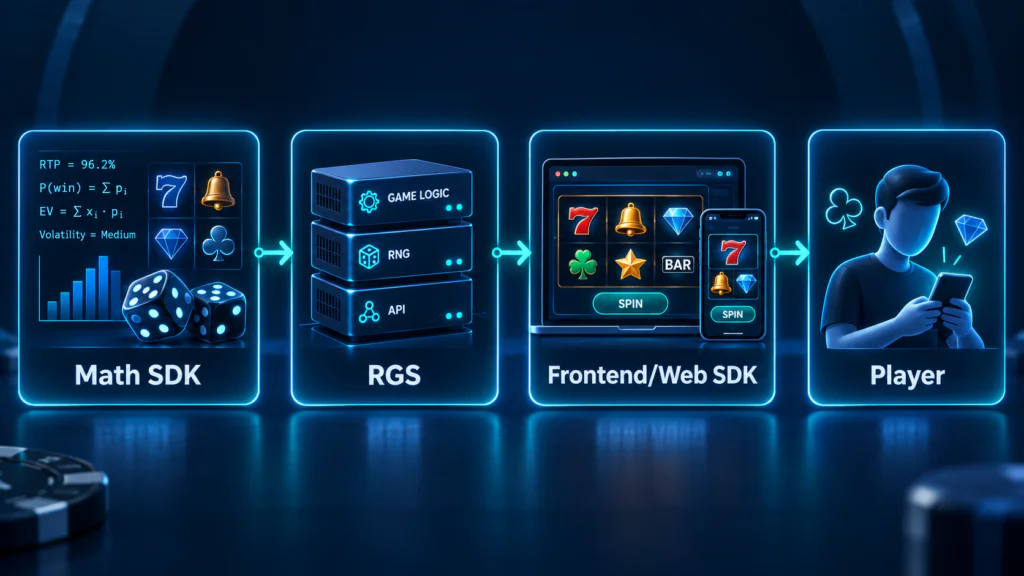
Underneath the pitch, Stake Engine is built from three connected layers. Each is documented publicly, and each can be worked on somewhat independently before everything comes together at publishing time.
Game Math and Outcomes
Game math on this platform is built with the Stake Engine SDK‘s Math SDK, a Python-based framework for defining game rules, simulating outcomes, and optimizing win distributions. Rather than generating results live during play, the math layer runs large-scale simulations – often millions of rounds – during development, and stores every possible outcome as a weighted entry in a lookup table.
Each entry carries a probability weight and a payout multiplier. When a player spins, the RGS doesn’t calculate a fresh result on the spot – it selects one of these pre-simulated outcomes according to its weight and sends the corresponding instructions to the frontend. It’s a shift from calculating an outcome live to verifying one that was already modeled and tested, which is also why Stake Engine games can publish known RTP, volatility, and hit-frequency figures before a single real player spins them. Developers use this stage to tune payout distribution, hit frequency, and max-win potential until the math behaves the way the design calls for.
In practice, this is usually the slowest and most iterative part of the whole build. A first pass at the math rarely lands on the intended volatility or hit rate on the first simulation run, so teams cycle through adjusting bonus trigger frequency, multiplier tables, or symbol weightings and re-running the simulation until the results sit inside the target range across every bet mode the game supports. Getting this stage right before moving to frontend work matters, since a late math change can force reels, animations, or bonus visuals to be reworked to match a new outcome set.
Remote Gaming Server (RGS)
The Stake Engine RGS is the layer that turns a finished math model and a finished frontend build into an actual live game. It packages the math output – books, lookup tables, and configuration files – together with the frontend build into the exact format the platform expects, then runs the title through a built-in testing environment before it reaches real players.
That testing environment is one of the more developer-friendly parts of the stack: it supports instant toggling between currencies, languages, and device types, along with wallet balance simulation, so developers can test how a game behaves under different conditions without standing up a separate staging setup. Round requests, settlement calls, and session data all move through this same layer, and once a game is live, the Stake Engine RGS also feeds real-time analytics back to the developer.
Game Frontend
The frontend is what players actually see and interact with, and it’s built with the Web SDK, powered by Svelte 5, PixiJS 8, and TurboRepo. Developers work locally against a Storybook-style environment, building reels, animations, and UI against sample data before connecting the build to real math output. Because the frontend consumes the math engine’s pre-simulated outcomes directly, there’s no gap between what a game was tested to do and what it visually delivers – the animation is a presentation layer over an outcome that was already decided and logged.
Who Is Stake Engine Built For?
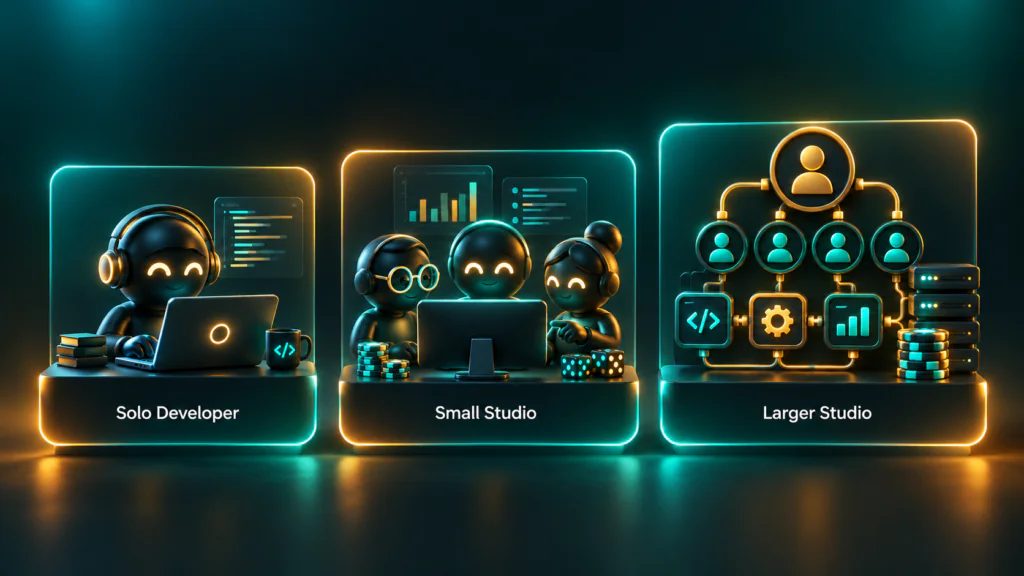
The marketing around this platform leans heavily on indie appeal, and that’s fair – a solo developer or a two-person team can genuinely take an idea from concept to a live, monetized game without hiring a publisher, a certification consultant, or a platform-integration specialist. For that segment, the pitch is straightforward: build once, test inside the same environment the game will actually run on, and publish without anyone else’s approval standing between the build and the player.
But the roster of studios actually building here tells a broader story. Recognizable names like Twist Gaming, Titan Gaming, and Massive Studios – teams with existing catalogues and production pipelines – use it alongside their other distribution channels, not instead of them. For an established studio, the appeal is less about removing gatekeepers and more about adding a fast, low-overhead channel where a title can go live in days rather than months, without pulling resources away from certified, multi-operator releases running elsewhere.
There’s a third group worth naming separately: math-focused teams and frontend specialists who don’t necessarily want to own an entire studio. Because the pipeline treats math and frontend as distinct, documented layers, it’s realistic for a math team to build and simulate a game’s logic while a separate frontend team builds the visual experience, and for a third party to handle the RGS packaging and publishing step. That separation is part of what makes it practical for outsourced or split-team production, not just single-team builds.
What Games Can Be Built with Stake Engine?

One of the more distinctive things about Stake Engine is that it doesn’t push developers toward a single template. It has been used for classic and modern video slots, Megaways-style and dynamic grid games, bonus-heavy titles built around free spins and hold-and-win mechanics, instant and crash-style games, and card-based mini-games – plus original IP and licensed concepts adapted into the platform’s format.
The differences between those formats show up mainly in how the math layer is structured. A classic or Megaways-style slot needs a reel or grid model with paylines or ways-to-win logic and cluster or cascade behavior layered on top; a crash-style instant game needs a continuously rising multiplier with a cash-out decision point instead of a fixed reel outcome at all. Both run through the same simulation-and-weighting process underneath – what changes is the shape of the outcome set the math team designs, not the pipeline that packages and tests it.
That range shows up in what’s actually shipped. Studios building Stake Engine games include names like Twist Gaming, Titan Gaming, Massive Studios, and Paperclip Gaming, with titles ranging from straightforward video slots to genre experiments like Mirror Image Gaming’s Drop the Boss, a crash game built around a political theme. The common thread isn’t a specific mechanic – it’s that math, frontend, and integration are treated as reusable infrastructure, so the format on top can vary widely without rebuilding the pipeline underneath.
This flexibility is also why Stake Engine game development attracts both ends of the studio spectrum: solo and small-team developers who want to test an original idea without infrastructure overhead, and established providers who want to add a fast, low-friction channel alongside their existing catalogue and slot game development work.
Stake Engine Game Development Process
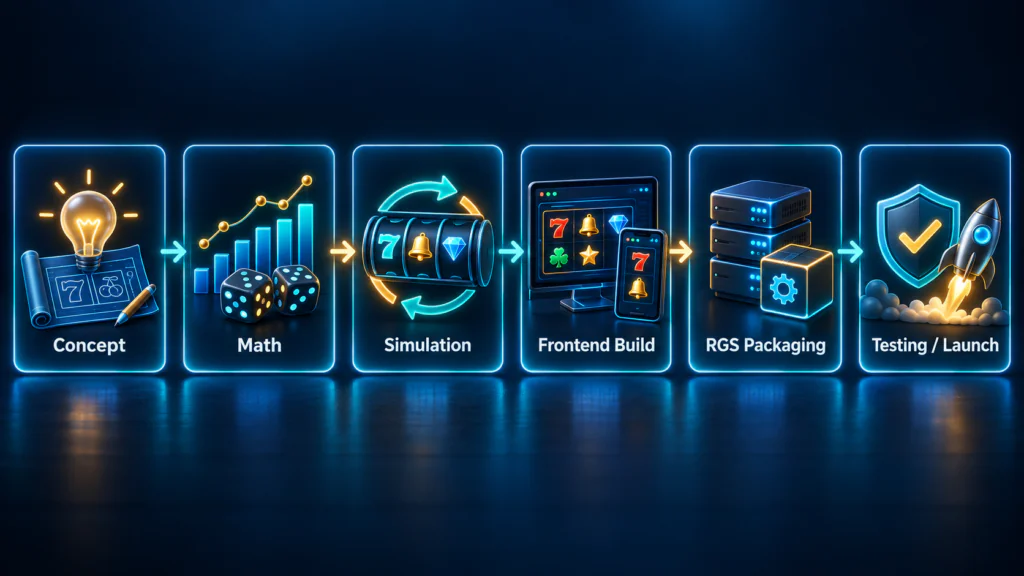
The published workflow for building here follows a fairly consistent sequence, whether a studio is building an original slot or adapting an existing one:
- Concept and rules. The game’s mechanics, volatility target, and rough theme are defined before any math or art work starts.
- Math and simulation. Using the Stake Engine SDK’s Math SDK, developers define game logic in Python, then run large-scale simulations to generate the weighted outcome tables and configuration files the RGS will need.
- Frontend build. In parallel or afterward, the Web SDK (Svelte 5 + PixiJS 8) is used to build the visual, animated experience – typically developed and previewed locally through Storybook before being connected to real math output.
- Packaging and upload. The finished frontend build is uploaded to the game’s Files page, and the math outputs are connected on the backend, tying the two together under one game record.
- Testing inside the RGS. Rather than a separate staging environment, developers launch a game session directly inside the Stake Engine RGS’s own testing environment – toggling currencies, languages, and devices, and simulating wallet balances – before anything goes live.
- Publish and monitor. Once testing passes, the game is published; live analytics then let the team track performance and revisit game balancing if the data suggests it.
Compared to a traditional casino game development cycle, the notable difference isn’t that any individual step disappears – it’s that math, frontend, and integration stay inside one connected system instead of being handed between separate vendors and a separate certification body.
Stake Engine vs Traditional Casino Game Development
It’s worth being precise about what’s actually being compared here. The figures below reflect general industry benchmarks for RNG certification and studio-to-operator integration timelines – and they describe a somewhat different starting point: building a game for one platform’s own RGS versus building a game to be certified and distributed across many operators. Both are legitimate paths; they simply optimize for different things.
| Dimension | Traditional Path (industry benchmark) | Stake Engine Path |
|---|---|---|
| Certification | Independent RNG certification via an accredited lab (e.g. BMM, GLI, eCOGRA, iTech Labs), typically 4–12 weeks | No external certification step – outcomes are pre-simulated, weighted, and tested inside the platform’s own RGS environment |
| Development timeline | 3–6 months for a mid-complexity slot, before certification and integration | Can move from build to a live, tested title in a matter of days once math and frontend are ready |
| Publishing route | Requires a publisher or platform negotiation, plus separate integration per operator/aggregator | Publish directly through Stake Engine’s review process; approval reported in as little as 24 hours |
| Commercial model | Varies by deal – publisher share, platform fee, and operator revenue share can stack | Flat 10% GGR royalty, paid monthly, with no additional fees |
| Distribution reach | Aggregator integration can expose a title to many operators at once (a separate step from development) | Direct access to Stake’s own player base; broader multi-operator reach is a separate consideration |
| Format flexibility | Often shaped by the certification body’s and aggregator’s supported game categories | No fixed template – slots, instant/crash games, card mechanics, and original IP are all supported |
The practical takeaway: none of this is a drop-in replacement for every publishing strategy, but for a studio prioritizing speed, direct distribution, and a simpler commercial model over multi-operator reach from day one, it removes several of the slowest steps in the traditional pipeline.
Should You Build In-House or Bring In a Partner?
For a studio that already has a math team and a frontend team comfortable with Python and Svelte/PixiJS, building in-house is a realistic option – the documentation and sample games are designed to get a first title through the pipeline without external help. The harder question is usually capacity, not capability: math simulation, balancing, and frontend production all take real time, and running them alongside an existing roadmap can slow both down.
That’s where a lot of studios choose to bring in a partner for one stage or the whole pipeline – math only, frontend only, or full Stake Engine game development from concept through RGS integration and testing. The trade-off is straightforward: it costs more per title than fully in-house work, but it removes the ramp-up time of learning a new framework and keeps existing internal teams focused on their current catalogue instead of a one-off platform integration.
A few questions tend to separate a good partner conversation from a vague one: Have they shipped a title through this specific pipeline before, or only similar RGS integrations elsewhere? Do they handle math and frontend under one team, or will you still be the one reconciling two vendors’ outputs? And can they show simulation results and balancing history for past titles, rather than just a finished build – since a game that looks right and a game that’s mathematically sound aren’t always the same thing until the numbers have actually been checked.
Stake engine: faq
No. While it’s become a popular entry point for solo and small-team developers, established studios use it too – Twist Gaming, Titan Gaming, and Massive Studios are among the recognizable names building on Stake Engine alongside newer teams, often as one channel among several rather than their only outlet.
Stake has described its commercial model as a flat 10% royalty on GGR (Gross Gaming Revenue), paid monthly, without additional platform fees stacked on top – a simpler structure than the layered publisher, aggregator, and operator cuts common in traditional distribution deals.
As built, a title published through Stake Engine is designed to run on Stake’s platform. Separately, some studios that built a track record on Stake Engine – most notably the founding teams behind Juice – have gone on to package their content for distribution to other operators through their own RGS, which is a different step from publishing through this platform itself.
The Stake Engine SDK is built around Python for the math layer and Svelte/PixiJS for the frontend, so familiarity with those helps. That said, the Stake Engine documentation includes sample games and a Storybook-based workflow specifically designed to get new developers oriented without needing to reverse-engineer the architecture from scratch.
Because every possible outcome is generated and weighted during the simulation stage rather than calculated live, RTP, volatility, and hit frequency are known quantities before a game goes live – they’re a property of the simulated outcome set itself, not something that has to be inferred from live play data afterward.
Both SDKs are documented publicly – the Stake Engine docs cover setup, the math framework, and the frontend build process in detail, including sample games and a full walkthrough from local testing to publishing.
For studios weighing whether to build in-house or bring in a partner who already knows the math framework, the frontend stack, and the RGS integration steps end to end, Stake Engine game development services can shorten the path from concept to a published, tested title.
More Article