March 27, 2026

Player loyalty is not a retention metric sitting in a marketing dashboard — it is one of the most direct contributors to revenue stability, operational efficiency, and long-term competitiveness. Yet many operators still treat it as a campaign rather than a capability.
The economics make the case plainly: acquiring a new player in iGaming costs anywhere from five to ten times more than retaining an existing one, and retained players generate disproportionately higher lifetime value. This is the commercial logic behind online gaming customer retention — and why leading operators have restructured entire departments around it.
This article examines how serious operators approach loyalty: the systems they build, the strategies they prioritize, and the mistakes that undermine even well-resourced programs. These are player retention strategies that go beyond bonuses and CRM automation and into how loyalty becomes a structural advantage.
Why Retention Economics Should Drive Strategy
Before exploring tactics, the financial case deserves clarity.
In a market defined by rising CPAs, saturated paid channels, and near-identical product offerings across competitors, the marginal value of a retained player compounds over time. A player who stays for 12 months instead of three does not generate four times the value — they often generate significantly more, because trust lowers friction, cross-sell rates improve, and support costs fall.
This is why operators who have shifted from acquisition-heavy models to retention-first strategies consistently report stronger unit economics. The goal is not to stop acquiring players — it is to ensure that the players you acquire stay long enough to justify the cost.
Everything else in this article is in service of that objective.
Player Lifecycle Management: The Operational Foundation

Loyalty does not happen uniformly across a player’s relationship with a platform. It has to be engineered differently at each stage of the player lifecycle gaming journey.
Operators who approach this rigorously segment their base into defined lifecycle stages — typically onboarding, activation, engagement, retention, and reactivation — and design distinct tactics for each. The interventions that convert a newly registered player are not the same ones that prevent a high-value user from going dormant.
- Onboarding: Frictionless first deposit, quick win, immediate demonstration of platform value.
- Activation: Early habit formation through relevant game recommendations and low-barrier rewards.
- Engagement: Progression systems, loyalty tiers, and personalized communication that deepen the relationship.
- Retention: Proactive identification of behavioral signals that precede churn, followed by targeted intervention.
- Reactivation: Time-sensitive, high-relevance outreach to lapsed players — not generic re-engagement blasts.
The most important shift this framework enables is moving from reactive to anticipatory management. Operators who wait until a player churns and then attempt reactivation are fighting a losing battle. Those who identify and act on early churn signals — a drop in session frequency, a shift in deposit size, reduced product breadth — can increase player retention before attrition becomes a fact.
Personalization: From Segmentation to Individual-Level Intelligence

The gap between operators who personalize well and those who do not is widening. Broad segmentation — grouping players by deposit band or game category — is no longer a competitive capability. It is the floor.
Modern platforms generate continuous behavioral signals: session timing, game selection patterns, bet sizing, feature usage, support interactions. The operators extracting the most value from this data are those who connect it directly to execution — using CRM and event-driven systems to deliver offers, messages, and experiences calibrated to individual behavior rather than cohort averages.
The practical impact is significant. Two players with identical 30-day deposit values may behave entirely differently: one prefers brief, high-volatility sessions late at night; the other plays extended low-stakes sessions across multiple products. Treating them identically wastes budget and misses engagement opportunities. Tailored interventions — the right offer, delivered when behavioral context makes it relevant — convert at meaningfully higher rates and generate less bonus abuse.
Reducing the gaming churn rate at scale requires this kind of precision. Personalization is the mechanism; data infrastructure and CRM integration are what make it operational.
Loyalty Programs: Designing for Behavior, Not Just Rewards

The traditional casino loyalty model — accumulate points, redeem for cash — is well understood by players, which is precisely why it has lost much of its differentiation. It answers the question “what do I get?” without addressing “why do I stay?”
Effective loyalty programs today are designed around behavioral psychology as much as reward economics. Specifically, they exploit three durable motivators:
Progression keeps players engaged by making advancement visible. Tier systems work not because the rewards at the top are extraordinary, but because the distance to the next level is always within reach.
Status and recognition drive behavior that pure monetary incentives cannot. A player who holds VIP or Platinum status has an identity investment in the platform that is qualitatively different from one chasing a deposit match.
Exclusivity creates perceived value that does not require operators to increase costs proportionally. Access to early game releases, invitation-only events, or a named account manager costs less than equivalent cashback but delivers stronger retention signals.
The design challenge for operators is calibrating generosity. Overly rich reward structures erode margins; weak programs fail to shift behavior. The best programs tie reward unlock points directly to the engagement patterns operators want to reinforce — not just gross wager volume, but session frequency, product diversity, and platform tenure.
Gamification: Engineering Habitual Engagement
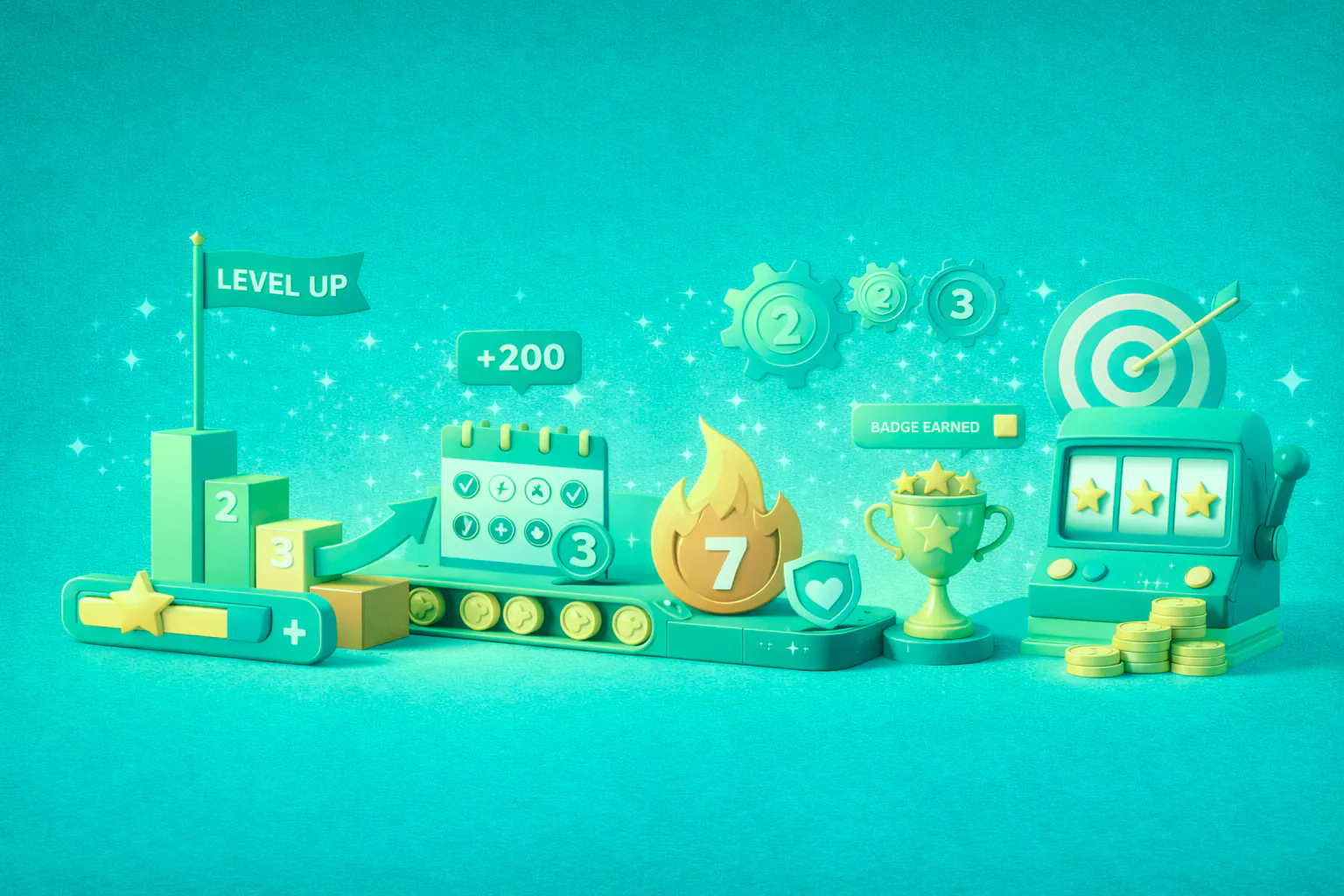
Purely financial incentives have a structural weakness: they attract players who are optimizing for bonus value rather than platform loyalty. When the bonus runs out or a competitor offers more, they leave.
Gamification addresses this by layering non-monetary engagement mechanics onto the core experience. Missions, challenges, achievement systems, seasonal events, and leaderboards create reasons to return that are decoupled from deposit incentives. The player completing a weekly challenge series is not asking whether the bonus is competitive — they are invested in finishing the progression.
The business impact of well-executed player engagement online gaming mechanics is measurable: increased session frequency, longer average session duration, and lower sensitivity to purely financial competitor offers. Gamification also gives operators structured touchpoints — mission updates, event launches, achievement milestones — that justify ongoing communication without relying on promotional messaging.
The risk is execution depth. Superficial gamification — a badge system nobody reads, missions that require no genuine engagement — generates no behavioral change. The mechanics need to be integrated into the actual play experience, not bolted on as a UI layer.
Real-Time Operations and Automation
The window in which a timely intervention can change a player’s behavior is often short. A re-engagement offer delivered 48 hours after churn signals appear is far less effective than one delivered in the moment — when a session ends abruptly, when a milestone is reached, or when behavioral patterns shift.
This is the core value proposition of event-driven CRM and automation infrastructure. It allows user retention gaming to move from scheduled campaigns to dynamic, behavior-triggered responses. The relevant examples are operational rather than hypothetical:
- A player who completes a deposit but doesn’t place a bet within a defined window receives a targeted prompt, not a generic welcome email sent the following morning.
- A VIP player whose session frequency drops below a defined threshold triggers an account manager alert, not a bulk reactivation campaign three weeks later.
- A player reaching a loyalty tier milestone receives recognition and a relevant reward immediately — before the emotional impact of the achievement fades.
Automation is what makes this scalable. No CRM team can manually manage these interactions across a player base of any significant size. The infrastructure investment is a prerequisite for competing in retention in the gaming industry at a serious level.
VIP Management: Retention Where It Matters Most

In most iGaming operations, a small proportion of players — often less than 5% — generates a majority of net revenue. This concentration means that losing a single high-value player can move a meaningful revenue line.
VIP management is, therefore, a risk management function as much as a loyalty strategy. It requires a distinct operational model:
- Dedicated relationship managers who understand individual player history and preferences
- Offers and rewards that are personalized, not templated
- Proactive outreach based on behavioral signals, not just calendar-triggered check-ins
- Service standards — withdrawal speed, support responsiveness, dispute resolution — that reflect the player’s value to the business
The failure mode most operators encounter is treating VIP as a reward tier rather than a relationship model. Players at this level are not retained by points balances. They are retained by the quality and consistency of the relationship — and they are acutely sensitive to the difference between genuine attention and scripted personalization.
One dimension often underweighted: responsible gaming considerations are more complex in VIP segments, not less. Operators building sustainable high-value player relationships must have robust frameworks for identifying and responding to problematic behavior — both for regulatory compliance and because sustainable engagement is genuinely better for long-term LTV than extractive short-term maximization.
Responsible Gaming as a Retention Asset
This point deserves more than a paragraph at the end of a section. Trust is a structural component of the gaming retention rate, not a soft value.
Players who feel that a platform is transparent about odds, fair in its treatment of disputes, and genuinely responsive when they need to manage their own behavior are more likely to stay. Not because responsible gaming tools are attractive features, but because trust reduces the friction of the decision to remain on a platform when alternatives exist.
The operators who have integrated responsible gaming tools — spend limits, session reminders, self-exclusion pathways, behavioral monitoring — as genuine UX components rather than compliance checkboxes tend to see lower involuntary churn from problem gambling-related account closures, fewer regulatory interventions, and stronger brand reputation in markets where licensing scrutiny is increasing.
Framing this only as regulatory risk management undersells it. It is also a loyalty argument.
Cross-Product Ecosystems: Increasing Stickiness Through Breadth
A player engaged across casino, sportsbook, and live dealer verticals is substantially harder to churn than one using a single product. This is not simply because they generate more revenue — it is because the switching cost increases with each product they use.
Operators with genuinely integrated multi-vertical ecosystems — unified wallets, cross-product loyalty tracking, coherent UX across verticals — are better positioned to extend player lifecycle gaming duration by offering players more ways to stay engaged through natural preference shifts. A player who cools on slots may migrate to sports betting; if they do it within the same ecosystem, the operator retains them.
The execution challenge is integration depth. Many operators technically offer multiple verticals but deliver them as siloed experiences. Cross-product promotions that feel bolted on, separate loyalty balances, and inconsistent UX undermine the retention logic. The stickiness only works if the ecosystem genuinely feels unified.
Product Quality: Retention Factor That Marketing Cannot Substitute

Loyalty programs, personalization, and gamification all operate on top of the base product. If the product experience is poor, none of them compensate adequately.
How to retain players in online games — and in iGaming more broadly — ultimately depends on whether the experience itself is worth returning to. This means game quality and variety, but also performance stability, load times, navigation logic, and the quality of the mobile experience, which for most operators now represents the majority of sessions.
Operators who treat product investment as a cost center rather than a retention driver tend to see CRM and loyalty spend deliver diminishing returns over time. Regular content updates, performance optimization, and UX iteration are retention investments — they simply sit outside the marketing budget.
AI and Predictive Analytics: Where the Frontier Is Moving

The next meaningful step-change in online gaming customer retention is not a new loyalty mechanic — it is the shift from behavioral response to behavioral prediction.
Machine learning models trained on historical player data can now identify churn probability with meaningful lead time — often days or weeks before a player’s behavior visibly deteriorates. They can also identify early signals of high-value potential in new players, enabling smarter early-lifecycle investment.
The practical applications already in deployment at leading operators include:
- Churn propensity scoring integrated directly into CRM workflows, so that at-risk players receive targeted interventions before they disengage
- Bonus optimization models that predict which offer type and value will drive the desired behavior for a specific player — reducing cost while maintaining effectiveness
- Next-best-action engines that select communication content, channel, and timing based on real-time behavioral context rather than static campaign logic
The operators building genuine capability in this area are doing so at the infrastructure level — investing in data pipelines, model development, and CRM integration rather than purchasing off-the-shelf tools that apply generic models to their specific player base. The differentiation comes from proprietary data, not from access to the same vendor solutions.
This is where the gap between technically sophisticated operators and the rest of the market will widen most significantly over the next several years.
Loyalty as a System, Not a Campaign
Player retention strategies that move the needle are never a single tactic. They are integrated systems — lifecycle management, personalization, loyalty mechanics, and real-time operations working together. When these functions operate in silos, even well-funded programs underperform.
The commercial logic is simple: a player retained for two years generates far more than twice the value of one retained for one — and costs a fraction of a new acquisition to maintain. Operators who treat loyalty as a strategic capability, not a marketing line item, end up in a stronger position across revenue, compliance, and brand.
If you’re ready to move beyond generic promotions and build engagement that actually sticks, start with the mechanics that drive habitual return. Our guide to gamification in online casinos covers the frameworks and implementation approaches operators are using to turn one-time players into loyal, long-term users — without burning margins or cutting corners on responsible gaming.
More Article