February 6, 2026
If you are planning to start iGaming business, then understanding the market and its scale will give you an advantage. The global online gambling market is expected to reach approximately $101.45 billion this year. For comparison, in 2025, this amount was $91.63 billion. And according to some forecasts, the average annual growth rate could reach 10.72%.
What is this connected with? First of all, modern iGaming trends have brought real changes to the industry. More and more players are using smartphones to play slots, and the spread of 5G improves the speed and features of live broadcasts. And these are just some of the factors that make it easier to start an online gambling business in 2026. Let’s take a closer look at how to start an iGaming business and why strong positioning and a clear focus on the product are as important as the size of the market.
Define Your iGaming Business Model
If you have decided to start a gaming business, you first need to clearly define your business model. Your choice will influence further decisions regarding licenses, platforms, costs, and marketing. The main models include:
- Online casino. This is a classic format with real money games: slots, roulette, blackjack, and games with live dealers. The peculiarity of this model is that the platform must offer a large library of games and a user-friendly interface to keep players coming back.
- Bookmaker. This is a classic platform for sports betting (football, tennis, basketball, etc.). In this case, the key features are a fast and stable line of events, real-time odds updates, and accurate statistics for customers.
- Hybrid model. It combines a casino and a bookmaker. This model allows you to reach a wider audience, but also requires more resources to launch and maintain.
- Poker/bingo platforms. These platforms offer specialized games with a loyal audience. If you want to work in a specific niche, this may be a good choice.
- Affiliate platform/marketplace. You do not run your own casino or bookmaker, but attract traffic and receive a commission. This model is less risky, but your income depends on traffic and affiliate terms.
Whichever option you choose, you should understand that each model requires a different approach to technology, licensing, and marketing. Your choice also affects costs and operational risks.
Choose the Best Jurisdiction and iGaming License in 2026
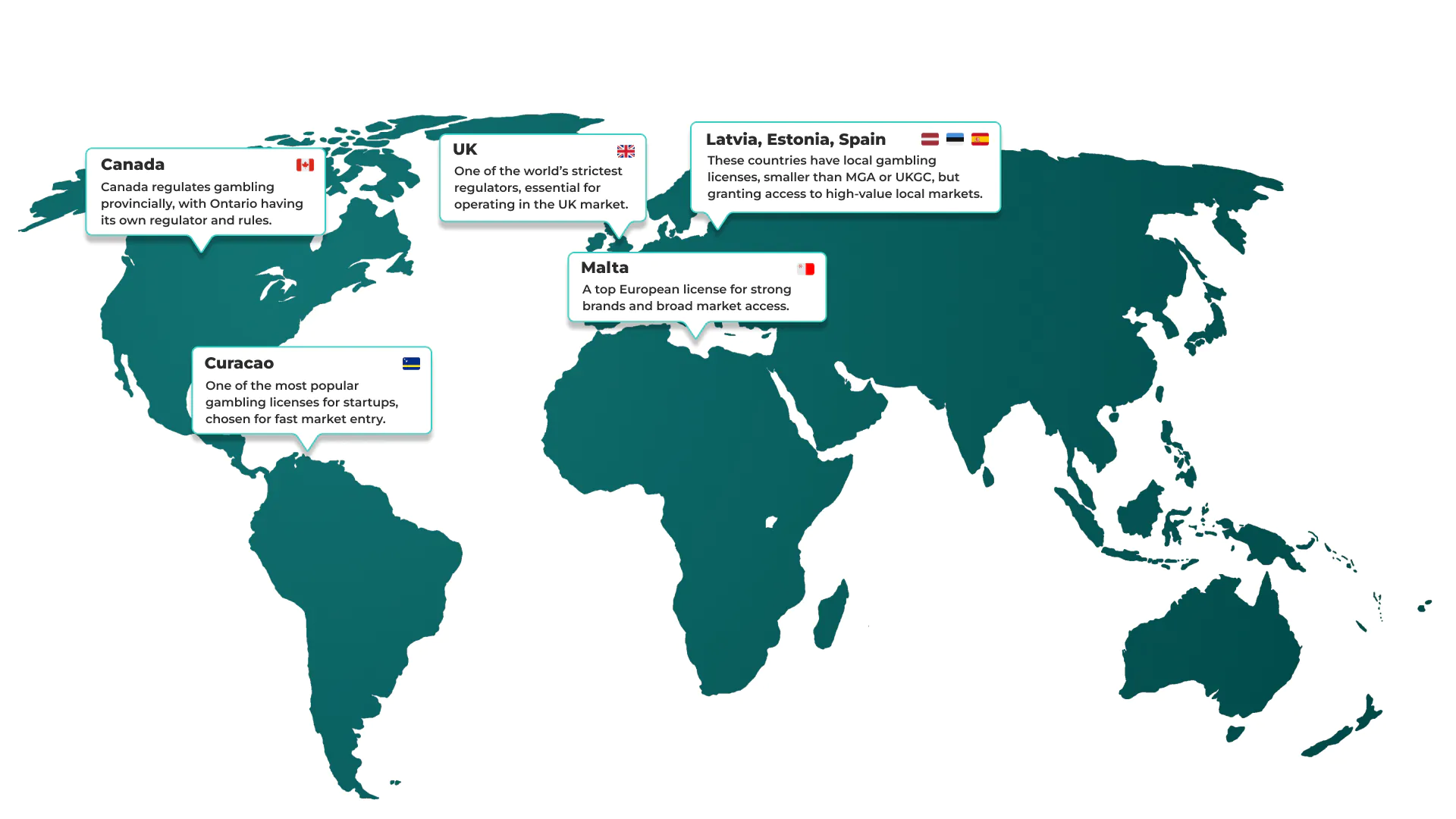
Choosing an iGaming license is one of the most important steps when starting a business. This decision determines not only the legality of your operations, but also taxes, compliance costs, access to payment solutions, and the reputation of your project. Different jurisdictions have their own conditions, requirements, and advantages. Let’s find out the main options most often used by operators.
Curacao
This is one of the most popular licenses for startups in the online gambling industry. This jurisdiction is chosen by many new operators who want to enter the market quickly.
| Pros | Cons |
| Affordable and has simple requirements for obtaining.Covers all types of games (casino, betting, poker) as standard.Allows working with cryptocurrencies.The license can be obtained relatively quickly. | In some countries, this license has a lower trust among players and partners.Limited mechanisms for player protection and dispute resolution. |
Examples of platforms with a Curacao gambling license: BitStarz Casino, 7Bit Casino, FortuneJack. They operate widely in the European, Latin American, and Asian markets, but often do not have access to regulated markets such as the UK or some European countries.
Malta Gaming Authority license (MGA)
This is one of the most well-known and respected licenses in Europe. It is chosen by operators who want to build a serious brand and have access to a large European audience.
| Pros | Cons |
| High level of trust from players and partners.Access to most EU markets.Clear requirements for security, AML, and player protection.Good reputation. | More expensive and a longer process to obtain.Strict requirements for corporate structure and financial reporting. |
Well-known operators with MGA licenses: LeoVegas, Casumo, Videoslots. These brands operate in many European countries and enjoy a high level of consumer trust.
UK Gambling Commission (UKGC)
This is one of the strictest regulators in the world. If your target market is the UK, it is difficult to develop a serious business without a UKGC license.
| Pros | Cons |
| Very high standards of responsible gaming and data protection.Access to one of the largest online markets in the world.Requirements for business integrity and transparency. | Complex and lengthy licensing process.High requirements for corporate structure, control, and reporting. |
A UKGC license allows you to work with a large part of the English-speaking audience and connect international payment solutions with fewer restrictions.
Canada (provinces, e.g., Ontario)
In Canada, gambling is regulated at the provincial level. For example, Ontario has its own regulator and clear rules for operators.
| Pros | Cons |
| Clear and predictable requirements.Access to a local solvent market.The ability to operate under regional rules. | Market restrictions in the province where the license is obtained.Sometimes more difficult to connect international payment solutions. |
Latvia, Estonia, Spain
These countries have their own regulated regimes for online gambling. Licenses here are smaller in scale than the MGA or UKGC, but provide access to local audiences with good purchasing power.
| Pros | Cons |
| Strict compliance and reporting requirements.Access to regulated markets with a high level of technical culture among users.Ability to connect local PSPs. | Each country has its own rules and requirements.It can be difficult to operate with a single license in several regions. |
What to consider before choosing
Here are some important aspects that influence your choice of license:
- Tax rates in the desired jurisdiction.
- Minimum capital requirements.
- The ability to open bank accounts and connect PSPs.
- Requirements for AML and KYC procedures.
- The level of player trust in a particular license.
According to industry reports, MGA and UKGC licenses have the highest level of trust among players and partners, but they are also the most complex in terms of requirements. The Curacao license remains the most popular among startups due to lower barriers to entry, but it is often better to combine it with additional player protection and transparency measures.
Decide Between White Label or Custom iGaming Platform
After choosing a model and jurisdiction, there comes a moment that directly affects your budget, launch speed, and future flexibility. You need to decide what your product will be built on. Usually, the choice is between a white label and a custom iGaming platform.
Both options are suitable for those planning to start an iGaming business, but they work differently. Below is a comparison that will help you better understand the difference and relate it to your goals.
| Feature | White Label Platform | Custom iGaming Platform |
| Time to Launch | Fast launch. The core system is already built and tested | Longer launch time. Development, testing, and integration take months. |
| Initial Investment | Lower upfront cost, regular payments to the provider are included in the model | Higher upfront cost due to design, development, and infrastructure |
| Technical Control | Limited control over core features and architecture | Full control over features, logic, and system structure |
| Design and UX Flexibility | Basic customization of colors, logo, and layout | Fully unique UX UI tailored to brand and audience needs |
| Game and Provider Integration | Pre-integrated games and providers | Freedom to choose and negotiate with any iGaming software provider |
| Scalability | Scales within provider limits and technical framework | Built to scale based on your own roadmap and infrastructure |
| Ownership of Technology | The platform belongs to the provider | Full ownership of code and product ecosystem |
| Ongoing Costs | Revenue share or fixed monthly fees | Maintenance, hosting, and development team costs |
| Best For | Fast market entry and testing an online casino startup | Long-term strategy, a brand with unique functionality |
Now let’s look at this decision from a practical point of view. If the goal is to get started quickly, test the market, and minimize risks at the beginning, White Label seems like a logical option. The platform already has the basic infrastructure, integrated games, back office, and payment solutions. This allows you to focus on marketing and user acquisition.
A custom approach is suitable for those who view the iGaming business in 2026 as a long-term technological product. There is more freedom here, but also more responsibility. You need to manage development, testing, security, and scaling. Before making your final choice, it is helpful to answer a few questions honestly:
- Is the speed of the casino or sportsbook business launch more important than the uniqueness of functionality?
- Are you planning to expand into new markets and verticals?
- Do you need non-standard bonus mechanics or VIP systems?
- Do you have the budget for your own technical team?
The answers to these questions will help you understand which path is more in line with your strategy. In any case, both options can form the basis of a profitable project if the choice is made taking into account real resources and goals.
Select iGaming Software, Games, and Platform Provider
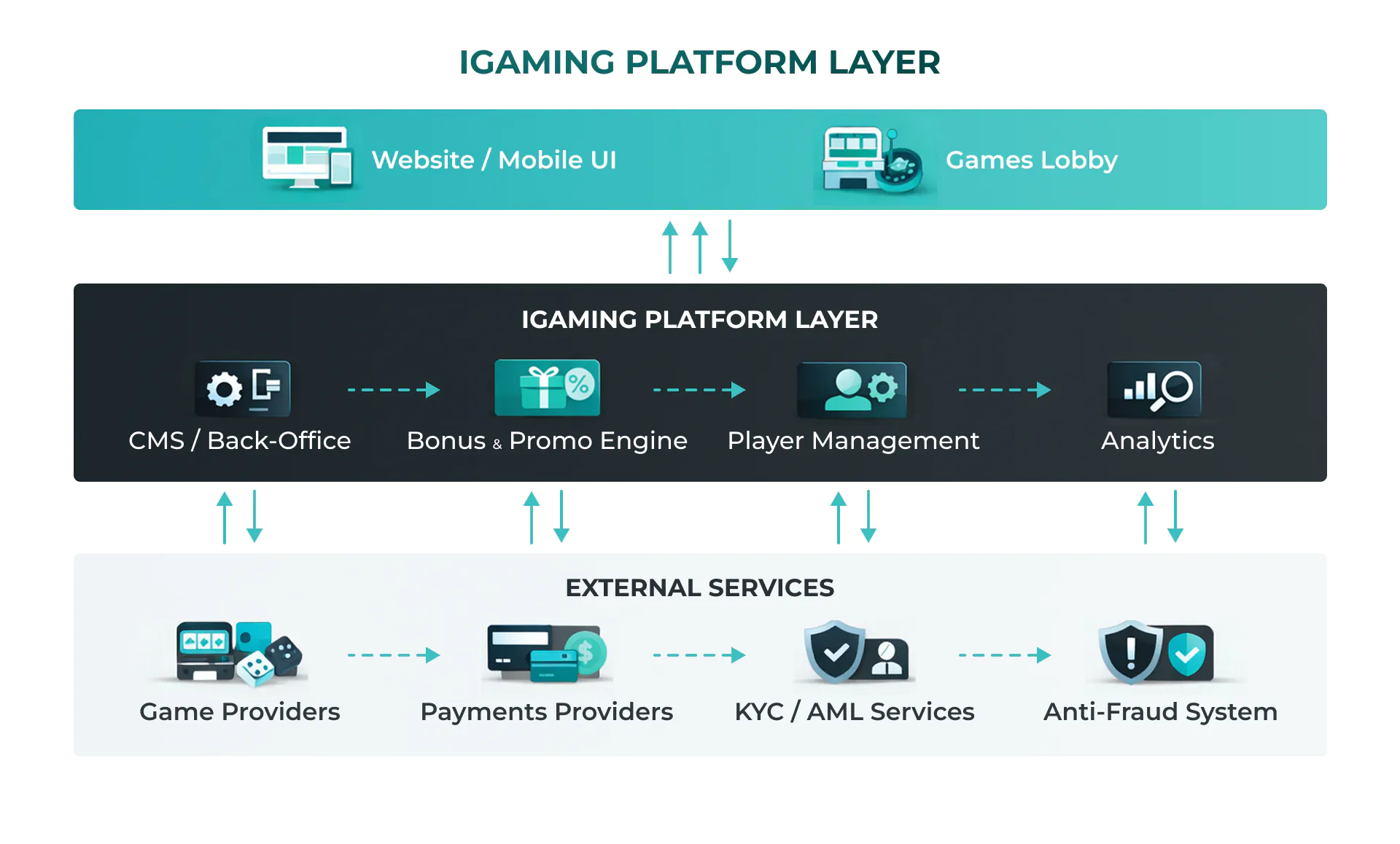
After deciding on a platform and your business strategy, it’s time to consider the features of your product. This includes bonus management, live game assistance, server components, software suppliers, gaming menus, and analytics.
This is one of the most crucial phases, as gamers’ loyalty to your website will depend on its operation and content. Let’s start by determining the parts you will require:
- content from providers;
- platform management system (CMS / Back-office);
- anti-fraud monitoring;
- analytics tools;
- Integrations;
- bonus and promo modules.
It’s useful to realize that game selection involves more than just enjoyment. It has to do with future earnings, the variety of forms, and the capacity to keep players for longer. A solid collection of slots, verified live games, traditional table games, and new categories like VR entertainment or contemporary skill games is more than simply a set; it’s a chance to connect with various audience groups.
Knowing what games your target audience anticipates is crucial when creating a list of suppliers. While some operators work toward a full-fledged portfolio, others opt for a small specialization (such as just slots). In every case, it’s important to find out how simple it is to include these games into your platform, what the license terms are, and how much of the earnings they receive. Another crucial component is the back-office administration system. It enables you to:
- manage user accounts;
- set up bonuses and promotions;
- view analytics;
- process support service requests;
- run reports for the finance department.
Since you will be using this every day, its dependability and ease of use are crucial. Finally, anti-fraud and identification technologies are important considering when it comes to software. As we shall cover later, they not only lower risks but also assist you in adhering to KYC/AML standards.
Integrate Payment Solutions and Ensure Platform Security
How players will be able to pay and withdraw money is a subject that directly impacts business outcomes once the games and software have been chosen. This is one of the main causes of launch delays and is frequently underestimated at first. Several factors are determined by the payment solution selection:
- How many users will be able to start playing right away?
- Which currencies and payment methods will be available?
- How cheap or expensive are transactions?
- How fast are withdrawals?
Here are the main areas to consider:
- bank cards (VISA, Mastercard);
- e-wallets (Skrill, Neteller, etc.);
- cryptocurrencies;
- bank transfers;
- local PSPs (for a specific country).
Remember that not every country can regulate crypto payments for gambling platforms in the same way, and that some payment methods could not be accessible or might need different certificates. Checking the regulatory standards of your particular area is crucial. User data security and payment security are closely related. This is a legal matter in addition to a technological one. The platform needs to have:
- SSL encryption for all transactions;
- protection against DDoS attacks;
- mechanisms for storing sensitive data in encrypted form;
- modules for detecting fraudulent schemes.
Although these solutions are not readily apparent to the user, they are essential for both regulatory compliance and player trust. Nobody likes to lose money or data because of vulnerabilities, and being aware of this now will help prevent a lot of issues down the road.
Calculate Costs and Profitability of an iGaming Business
It’s crucial to take a moment to discuss expenses and profitability. Although starting an online casino is often thought of as a quick method to gain money, the truth is otherwise. It is a business with high initial and continuing costs. The primary expense items are:
- licensing and legal formalities;
- platform and software;
- games and integrations;
- payment solutions and PSP commissions;
- security and compliance (KYC/AML);
- marketing and traffic;
- customer support.
You should calculate the amount of investment and estimate how quickly the business can become profitable. For example, marketing costs can account for a significant portion of the budget for the first 6-12 months, because without traffic and bets, there will be no turnover. The profitability calculation includes gross gaming revenue (GGR), which is bets minus player winnings. NGR (Net Gaming Revenue) is gross revenue minus bonuses, taxes, and payments to partners.
It’s also important to realize that chargebacks and PSP fees have a big impact on profitability. Therefore, it is important to take into account both the initial fees and ongoing commissions when assessing the cost of the iGaming platform. These numbers are not abstract. The real results might be far worse than anticipated if you set your budget without accounting for chargebacks or hefty marketing expenses.

Build Your Brand and Prepare for iGaming Launch
Now that the technical and legal foundations are in place, it’s time to think about how your project will look to players. This includes:
- name and identity;
- UI/UX designs;
- website content (FAQ, rules, support);
- bonus structure and VIP programs.
Briefings on the brand’s values, tone of voice, and essential messaging should be prepared for designers and marketers even prior to launch. It is worthwhile to create materials for partners or affiliates at this point if you intend to draw them in.
If you are interested in how free material might produce profit, there is an intriguing overview on how free games make money on the Inkration blog. This information will provide you a better understanding of how to draw viewers in with engaging content and retain them on the platform.
Marketing and User Acquisition Strategy for iGaming
Now that the product is complete and the technical components are put up, the question of how to draw in the initial players and retain them on the platform emerges, something that most novices don’t even consider beforehand. This is significant because, in the absence of users, even the finest platform is nothing more than a server and some code.
iGaming marketing is a continuous process. It is a continuous process including a variety of channels, strategies, and outcome assessments. Consider your target audience first. Choose your players. This will enable you to select the appropriate advertising channels and messaging. Traffic often passes through a few key areas:
- search engine marketing (SEO/PPC);
- social networks;
- affiliate programs (affiliate marketing);
- referral programs and bonuses for players;
- email and push notifications.
The next step is to determine which innovative ideas and messaging are most effective. New operators sometimes begin with free spins or deposit promos. However, it’s crucial to keep balance in mind. Excessively large incentives could entice players to make their first deposit, but they don’t promote sustained loyalty.
Programs for affiliates are a different matter. If properly arranged, they may become a reliable source of traffic. Give your partners rapid payments, comprehensible statistics, and explicit agreements. This will draw in high-quality traffic. The Inkration blog has a fantastic piece on how free games generate revenue if you’re curious about how they may fit into your acquisition plan. Long-term audience engagement and organic traffic are exactly what you need.
Legal, Tax, and Operational Considerations
Now it’s time to turn your attention to legal requirements, taxes, and day-to-day operations. Your idea may be interesting, your platform modern, and your marketing bright. But without the proper legal framework, your iGaming business won’t last long in 2026.
The legal part is a system of rules that allows a business to operate stably, without stopping payments and without problems with regulators. If something is overlooked at this stage, the consequences usually manifest themselves at the least convenient moment.
The key legal requirements that accompany starting an online gambling business include several mandatory areas. They form the basis for legal operation. Regulators today pay a lot of attention to transparency. The platform should not only entertain, but also control risks, financial flows, and player behavior. The main legal elements are as follows:
- Payment compliance policy (KYC AML). It is necessary to verify the player’s identity, the sources of funds in suspicious cases, and track unusual transactions. This protects the business from financial violations and regulatory claims.
- Terms of use and privacy policy. The user must clearly understand the rules of the game, bonus conditions, withdrawal procedures, and the use of personal data.
- Regular reporting to the regulator. In many jurisdictions, you need to submit financial reports, data on betting turnover, winnings, and user activity.
- Internal documents on responsible gaming. These include self-restriction policies, deposit limits, self-exclusion options, and other control mechanisms.
Particular consideration ought to be given to the subject of responsible gaming. It goes beyond only being required by law. It shows the operator’s level of commitment to long-term operation. The availability of limitations, pause features, and clear regulations are all things that players take note of. Users become more trusting when they perceive that the platform does not overlook these tools.
It’s crucial to closely monitor taxes in addition to legal requirements. Depending on the licensing nation and the countries in which the platform operates, taxes in the iGaming business model might differ substantially. It is recommended to consider the following aspects before selecting a gambling business jurisdiction:
- the amount of tax on gross gaming revenue;
- the presence of additional fees or license payments;
- financial reporting requirements;
- the complexity of opening bank accounts and connecting PSPs.
Jurisdictions with lower tax rates might occasionally cause problems for payment providers. Access to a stable and solvent market in other situations balances out high taxes. Consequently, the whole business model should be considered when making decisions, not just the rate.
The platform cannot function without this, so here are some important points to consider:
- Customer support. Players expect quick responses to payments, bonuses, and technical questions. Support directly affects audience retention.
- Transaction and security monitoring. It is necessary to track suspicious activity, prevent fraud, and control financial flows.
- Daily financial processing. Accounting for deposits, payments, commissions, and internal expenses must be systematic and accurate.
- Analytics and strategy adjustments. Data on player behavior, bonus effectiveness, and marketing channels help you make informed decisions.
These processes form the basis of stability. When each area of responsibility is assigned to specific individuals or teams, operational risks are reduced. This is especially important during the scaling phase, when the number of players and transactions is growing rapidly.
Is Starting an iGaming Business in 2026 Worth It?
The idea of launching online gambling may seem attractive. Market statistics look good, and the numbers are growing. But is it worth taking this step now? On the one hand, the market is indeed in a growth phase. Online gambling continues to evolve, and new technologies are making it more accessible. If your product is well-designed, has a clear business logic, and the right interaction strategy, it has every chance of finding its niche.
But it is a highly competitive environment. Not all models bring the same profit, and not all of them pay off quickly. It is important to approach the business with realistic expectations. And remember that you need discipline, a clear understanding of each step, and a willingness to adapt. The more time you spend planning now, the fewer surprises you will encounter in the future.
FAQ
How much budget is needed to start an iGaming business?
The exact amount of investment will be determined by the chosen model, market, and technology strategy. In general, the main costs include platform development, technology infrastructure, game content, and integrations. Separate items of expenditure include marketing and player acquisition, licensing and legal services, as well as operating costs. Thus, the basic launch can cost at least tens of thousands of dollars. Therefore, it is important to plan for a reserve for six to twelve months of operation without expecting immediate profits.
What is more important for the iGaming business in 2026, a license or technology?
iGaming is a system in which both components interact with each other. You can operate legally if you have a license. Connecting reliable payment systems, launching multi-channel advertising, and developing a sustainable brand all influence the user experience.
How quickly does iGaming business profitability become a reality?
Profitability does not appear automatically after launch. Most new operators go through a period of active investment in marketing and player acquisition. The time it takes to break even depends on several factors, namely, traffic quality, player retention, bonus spending levels, commissions, and more. In practice, many projects begin to see stable financial results 6-12 months after launch.
Do you need a separate iGaming license for sportsbooks and casinos?
This question always depends on the chosen jurisdiction. There is no universal answer that fits all. In some countries, one license covers several verticals. In others, the regulator requires separate permits for different types of gambling. If a hybrid model is planned, it is better to take this into account when choosing a jurisdiction. Reissuing a license later can cost time and money.
Is it possible to start an online gambling business without a physical office?
In today’s environment, many iGaming companies operate remotely. Technical teams, marketing, and support are often located in different countries. And while a physical office is not always necessary for day-to-day operations, a legal presence in the chosen country is often a prerequisite for obtaining and maintaining a license.
More Article