January 28, 2026
The last two years have seen many changes in iGaming. In 2024-2025, PPC advertising budgets increased, KYC rules became stricter, and SEO became unstable. This prompted companies to change their approaches to attracting and retaining users. And now, in 2026, the big players in the market will be reviewing their strategies.
The focus will now be on data and regulatory compliance, as these are the keys to success. Companies that use user behaviour analytics will retain players at a rate 15-25% higher than those that do not. This shows that data and technology are more important than ever. Therefore, it is worth finding out how they affect the industry and what trends iGaming platforms are actively implementing.
What Is iGaming? Definition & Key Segments
iGaming is an entire ecosystem consisting of games in various formats that are accessible via a browser or mobile device. Easy access, fast performance and a simple interface are what attract a wide audience. And now that the industry seems more mature, it is attracting even more players around the world.
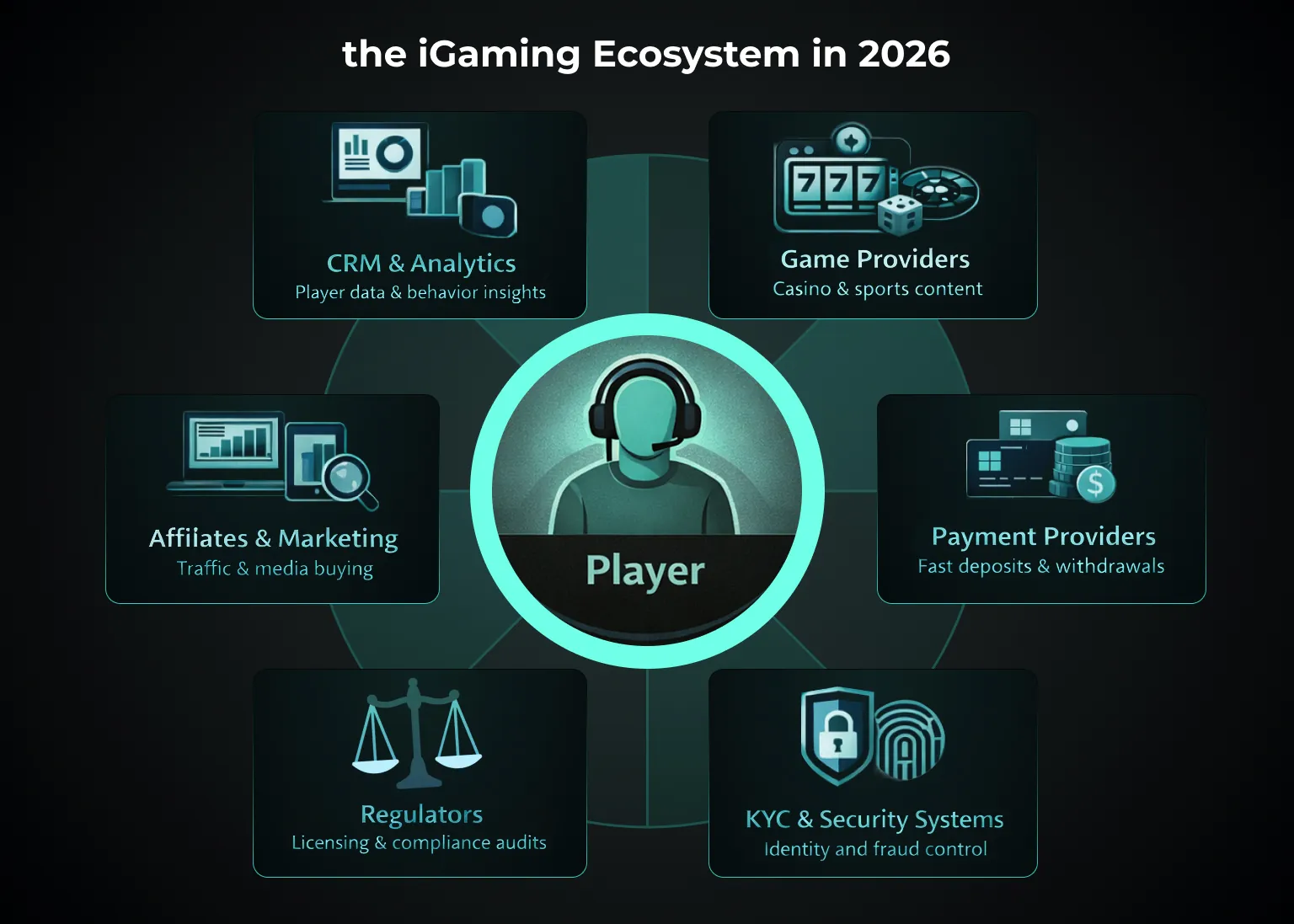
Unlike traditional casinos, online platforms offer access to your favourite entertainment 24/7. They are adapted to any device and allow you to play anywhere. So if you want to play quickly, online is exactly what you need. Just choose the format you like best:
- Online casinos with slots, table, and card games.
- Sports betting, including live bets during events.
- Live casino with dealers in real time.
- Poker and tournament games.
- Lotteries, esports, and virtual sports.
Each of these formats offers a different experience. Somewhere everything’s fast and simple, somewhere you need strategy, and somewhere the atmosphere of live gaming matters most. Thanks to such a choice, everyone can find what suits them exactly.
Global iGaming Market Overview
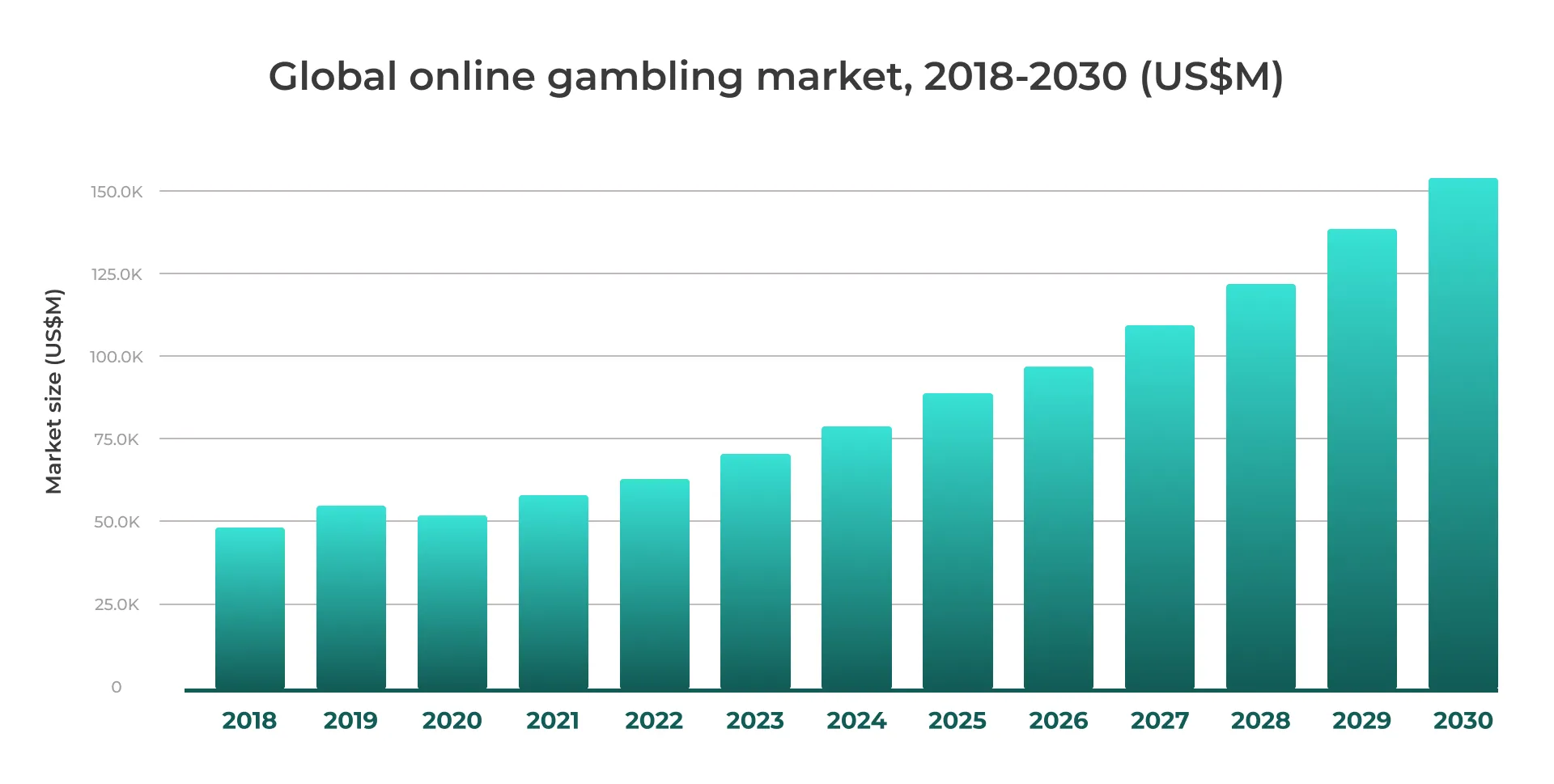
The iGaming market continues to grow despite tighter regulation and increased competition. According to analysts’ forecasts, the global online gambling market could exceed $100 billion this year. By 2030, it is expected to exceed $150 billion, with an average annual growth rate of around 12%.
Demand is growing amid the need for quick access to games and convenient service. The development of mobile gambling makes games accessible anytime, anywhere. Not to mention that the level of trust in gaming platforms increases when deposits and withdrawals work smoothly. In modern iGaming, this is much more important than a wide selection of games or generous bonuses.
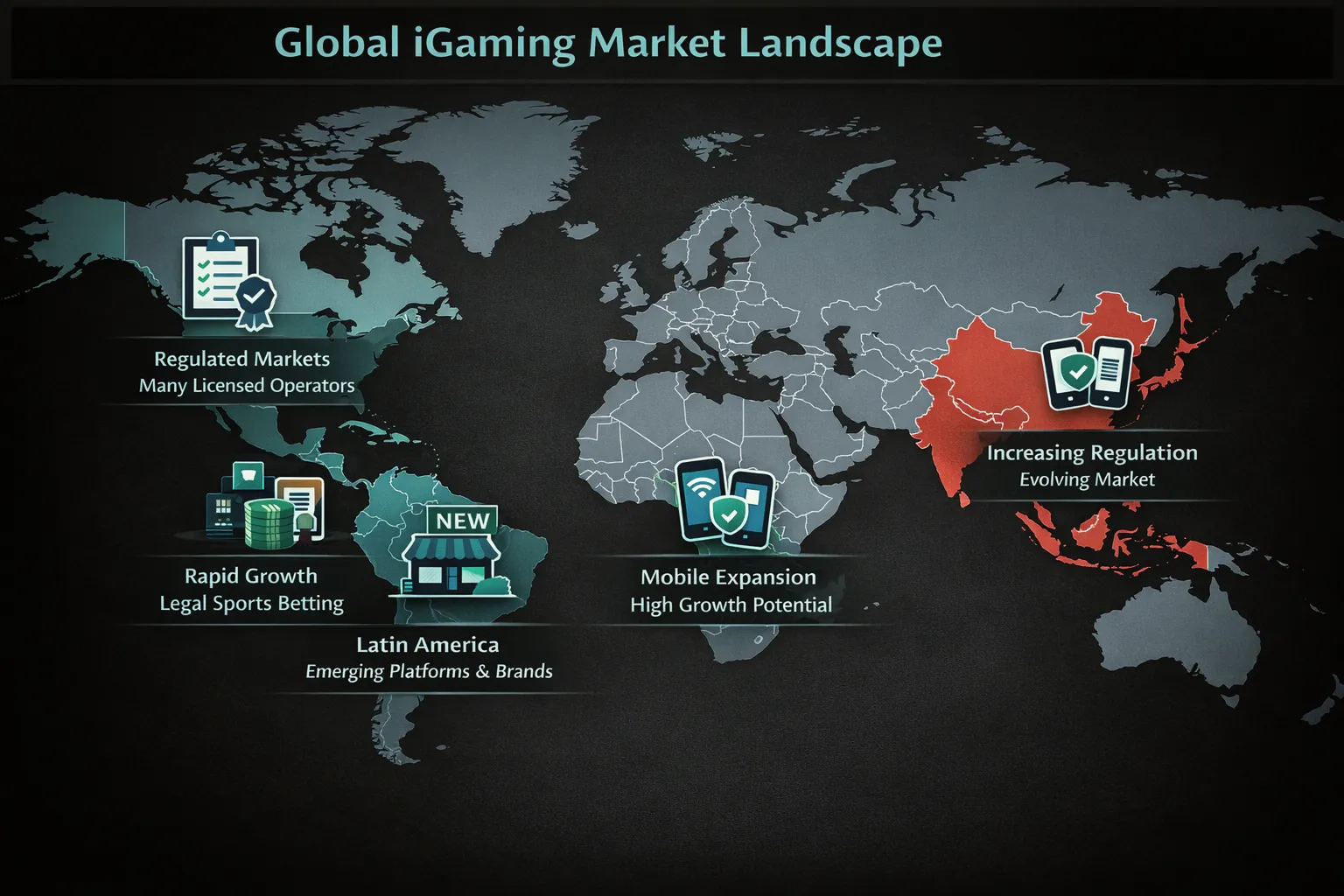
The global market forms differently in various regions:
- Europe has clear rules and many licensed operators.
- North America grows rapidly thanks to legal betting.
- Latin America attracts new brands and platforms.
- Africa forms mobile audiences with huge growth potential.
- Asia gradually moves toward more regulated solutions.
In these regions, mobile traffic grows faster than desktop traffic. Live formats become an important part of the offering. This forces operators to think not only about expansion but also about safety and regulatory compliance. Those who can combine scale and rule compliance will have significant advantages in 2026.
Key Drivers of iGaming Industry Growth
A lot of games or one-time promotions are no longer the key to success in iGaming. These days, it matters more how platforms evolve every day. Gamers want a dependable platform, easy procedures, and a feeling of security. They are interested in learning about potential flaws and the speed at which they are fixed. Technology is therefore more crucial than ever.
For instance, more than simply visuals are important for slot game development. It also refers to how fast the game loads and functions on a mobile device. Additionally, utilizing analytics makes it easier to comprehend user behavior, recommend pertinent games, and modify offers to suit their requirements. Certain platforms utilize this information to automatically choose games that you might find appealing.
Another crucial subject this year is responsible gaming. The focus is on user expectations instead of trends. They want to restrict their bets, manage their expenditure, and see clarity in the regulations. Because of this, platforms with self-control features (such as deposit caps and gaming session reminders) typically have better player retention rates and fewer customer service calls.
The market is more predictable as a result. Customers anticipate a greater role for mobile solutions and a greater use of analytics by platforms. Today’s iGaming trends are shaped by technology, and companies that understand this are better able to adjust and maintain their competitive edge.
Top iGaming Industry Trends for 2026
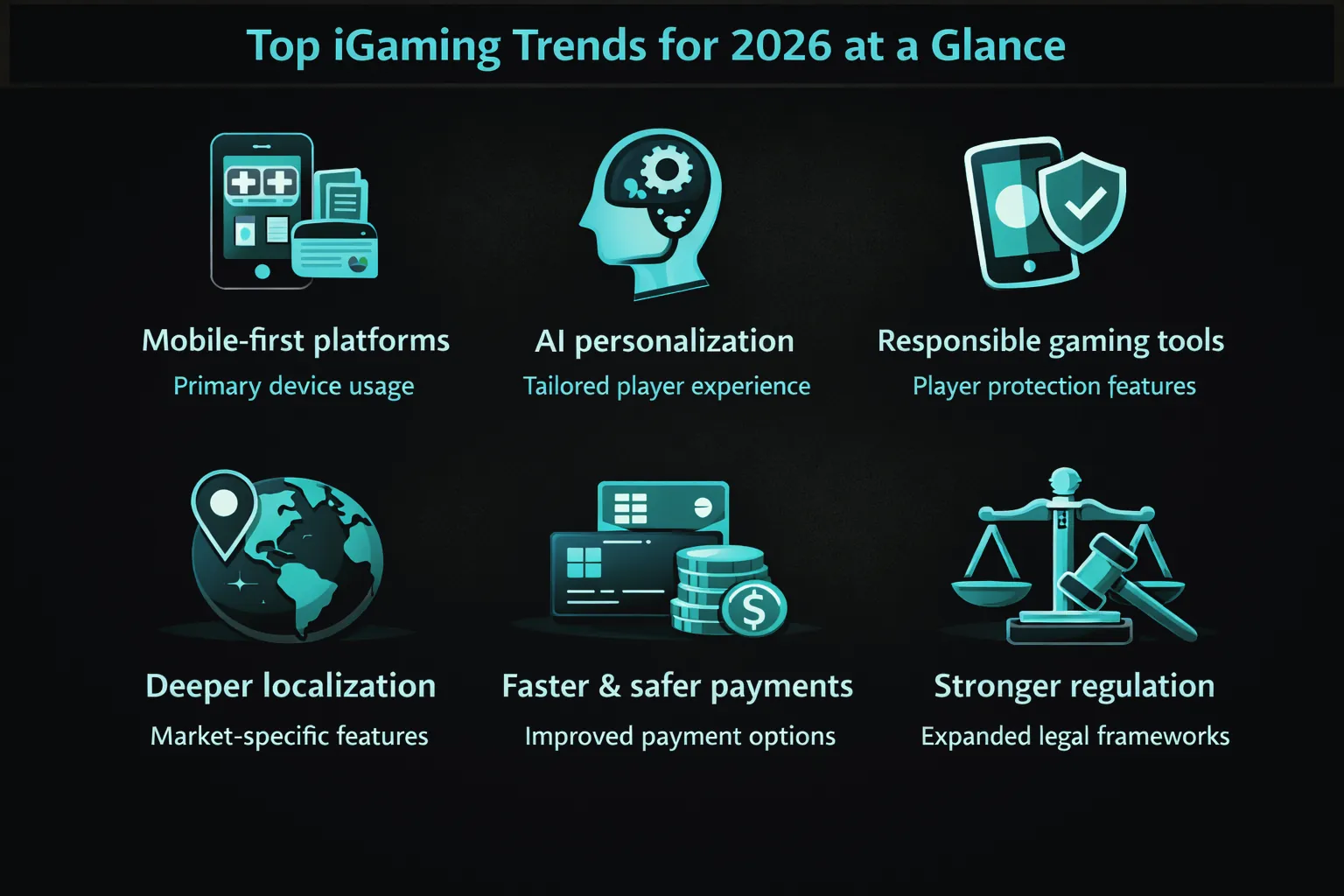
People are aware of how services operate and can quickly identify what is practical and what needs improvement. For this reason, some operators spend time enhancing the user experience. They focus more on how fast the page loads, how well the buttons function, and how simple it is to locate the appropriate part. Loud promises and ostentatious promotions are no longer as vital as stability. And if we discuss the primary tendencies, they are as follows:
- personalization;
- simple navigation;
- clear explanations of rules, bonuses, and limits.
These simple things influence the decision to stay or leave. If everything’s clear at first glance and you don’t need to spend time solving puzzles, this creates a feeling of control and trust.
Practical application of AI and the role of blockchain
By 2026, we could expect a variety of AI developments in iGaming. AI has evolved from being only a useful feature to a technology that is radically altering the way platforms function. It improves suggestions, helps analyze bad player behavior, speeds up assistance, and significantly improves the gaming experience. According to research, algorithms may increase player retention by up to 12%, and customization can increase game clicks by up to 20%. While playing the game, these changes are immediately noticeable.
Many modern iGaming systems already have these features:
- Personalized game and event recommendations based on behavior.
- Bonus offer selection according to gaming style.
- Automatic detection of potentially risky behavior.
- Support responses to frequent inquiries.
- Fraud detection and account protection.
These methods reduce the number of extra processes and improve usability. AI technology also helps with more accurate fraud detection and speeds up account verification by a few seconds.
Another new trend is blockchain. Instead of making inflated claims, this is about the real financial effect. Blockchain has the potential to increase transparency, predictability, and payment speed. Additionally, when people understand how processes work, choosing a platform becomes easier and more enjoyable.
Product evolution: mobile platforms and live formats
Currently, more than 70% of iGaming traffic comes from mobile devices. As a result, everything is changed, including the factors to take into account when choosing a partner studio or service. For a casino game development studio, it is essential to comprehend the behavior of mobile users. These days, short gaming sessions and an intuitive mobile UI are more important than complex features that are rarely utilized. People want speedy performance free from unnecessary procedures and long delays. Because of this, it’s important to pay attention to the following elements:
- fast loading;
- simple registration;
- logical navigation;
- support for local payment methods.
After your initial visit, these factors have a direct impact on your decision to continue using the site. Interest quickly decreases if the procedures are difficult or slow. UX study in the iGaming sector supports this.
Regulation and responsible gaming as part of the product
Today, regulation is a crucial part of the product. This suggests that legal duties are taken into account during the development process. If a platform violates the rules, it might quickly lose users and licenses. Responsible gaming has also become the norm. Players are starting to place more value on cost management, transparent regulations, and clear restrictions. Confidence quickly declines in the absence of these. The most often used instruments for a responsible approach include:
- ability to set personal limits;
- early detection of risky behavior;
- clear information about rules and payouts;
- quick access to support service.
Users feel in charge of their gaming when these systems function properly. This lowers anxiety and boosts platform trust. As a result, the market is growing considerably more steadily than it was previously. In 2026, iGaming will be shaped by precisely this concept.
iGaming Business Models & Monetization
How operators build their iGaming business models will be a crucial component of the market this year. The cause is the player’s changed conduct. If the platform is sluggish, the terms and conditions are confusing, and the bonuses are questionable, users will depart without hesitation. Only when it is truly feasible will they devote their time and resources.
The growth of the market demonstrates this. The global internet gambling industry reached over $105.5 billion by 2025. An annual growth rate of about 10.5% is projected in 2026, which is directly related to how platforms make money.
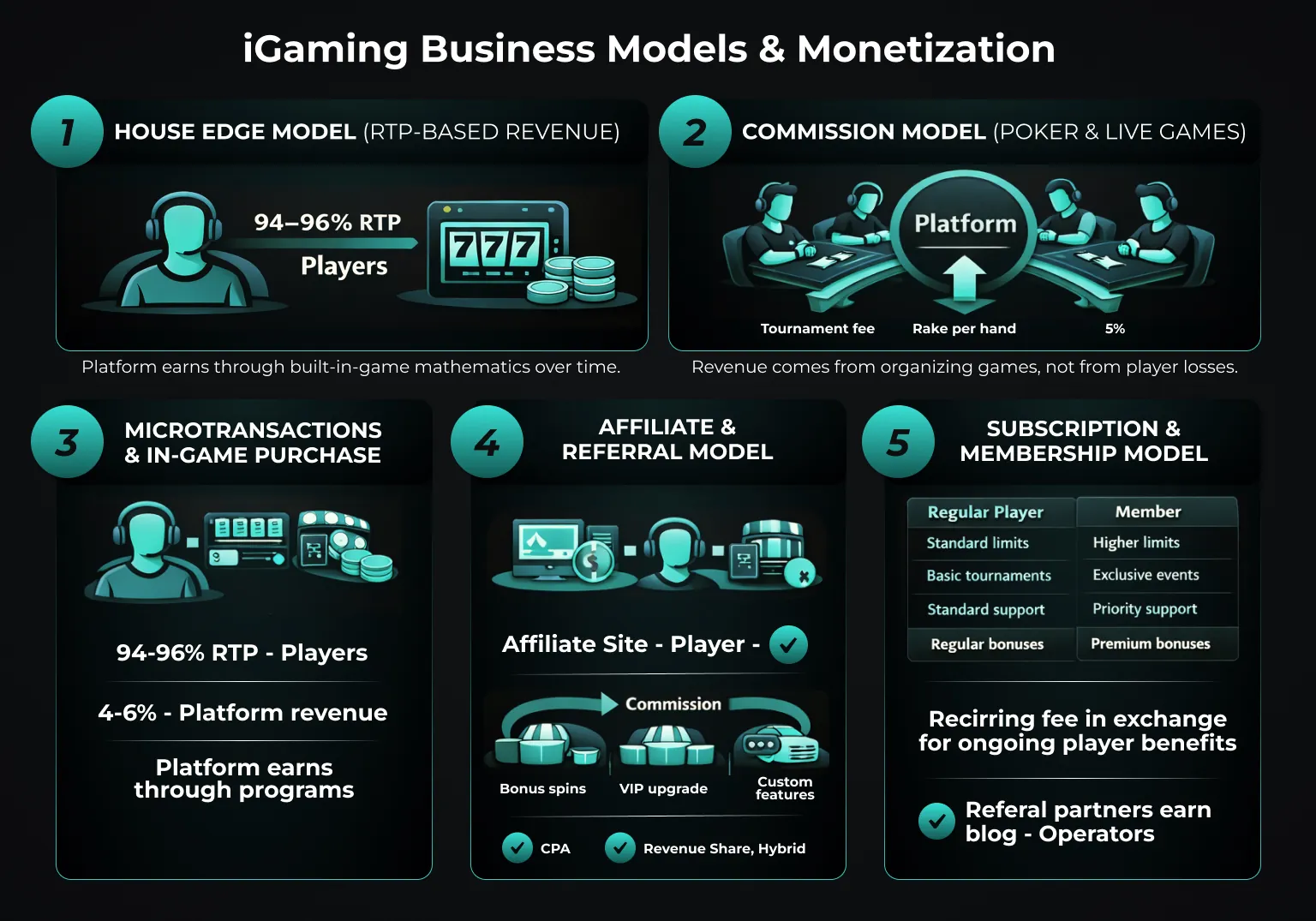
House Edge (revenue based on RTP)
Some of the revenue made by online gambling sites comes from this strategy. In every game, the platform has an inherent mathematical advantage. This does not imply that the casino “wins every time,” but rather that the system gradually approaches a steady outcome. For instance, the RTP for slots is typically 94-96%, which means that players receive about $94-96 back for every $100 wagered. The casino keeps the remainder as revenue.
Almost all big operators operate in this manner, which enables them to grow their game library and sustain steady financial performance even in the face of enormous loads. This strategy is simple to put into practice and doesn’t call for ongoing assistance. The system locks in the platform’s mathematical advantage as soon as the game launches.
Commission revenue (poker, tournaments, live dealers)
RTP is not the same as this model. In this case, game mathematics does not “win from the player” for the casino. Rather, it gets paid a predetermined fee or commission for arranging player play. Poker rooms like PokerStars are the most well-known example. There, the platform collects a predetermined entry fee from tournaments or about 5% of each hand.
There may occasionally be a commission per round in live games (live dealer). You don’t care who won a particular game; the platform always receives its fair share. This strategy is effective in areas with a large number of active players and provides revenue stability independent of player performance.
Microtransactions and in-game purchases
This model was brought to iGaming by mobile games, and it produces interesting results, especially among mobile users or in developing nations. In this case, the platform offers optional supplementary purchases that increase players’ comfort or versatility. It’s critical to understand that this isn’t about raising prices. It has to deal with opportunities for those who want particular extras. Here are a few examples of these purchases:
- buying additional bonus spins;
- VIP packages with expanded capabilities;
- custom items.
Mobile apps and gamified casinos also take advantage of this concept. In-app purchases can account for up to 15% of total revenue for mobile platforms targeting younger, active consumers, according to market data. This demonstrates that gamers are prepared to spend money on more than just basic gameplay.
Affiliate and referral model
Not many services rely only on their own games to generate revenue. Many sites employ affiliate programs to direct users to other products. Websites that assess casinos and sports betting like this. This is how it works:
- You register on a partner site.
- Go through their link to a casino or bookmaker platform.
- Partner receives commission for each deposit or revenue share.
This enables platforms to generate extra cash without creating their own games or intricate infrastructure. For instance, a lot of affiliates continue to concentrate on producing high-quality content for their audience while earning steady passive revenue.
Subscriptions and membership programs
This model is becoming more popular, even if it is still less prevalent. In this instance, the platform offers a subscription or membership fee for particular advantages. This can be intriguing to people who regularly play and appreciate special possibilities. It’s crucial to remember that although not all services use this tactic, those that do show promising results. Typical advantages include:
- increased payout limits;
- access to exclusive tournaments;
- improved support service;
- unique bonuses for club members.
When a player sees real worth in the subscription, this strategy performs effectively. This gives the player definite advantages they can experience on a daily basis and gives the platform consistent, steady revenue.
Future Outlook
In 2026, iGaming will grow more gradually and consistently. Although the market is still large and active, participants’ long-term value, stability, and risk management are more important than quick growth. Data, rules, and companies’ ability to conduct business transparently internationally are becoming increasingly important.
What works now will also be the foundation for future years. Platforms that can manage risks, protect user data, and comply with regulations have an advantage. It’s crucial to keep in mind that laws differ from country to country; local flexibility and adaptation are essential.
There will be disparate growth. Developed markets will prioritize increasing product efficiency and compliance. New areas will continue to draw investment, but doing so will necessitate a thorough comprehension of regional payment practices, player conduct, and regulatory requirements. Several distinct themes that are now affecting user interactions and determining the appearance of platforms in 2026 will propel future market development:
- mobile platform development;
- live casino format expansion;
- active AI usage;
- blockchain implementation.
The market enters a phase where stable product quality and long-term user trust become decisive.
Conclusion
The iGaming industry continues to develop into a sophisticated digital market with a substantial worldwide audience. From the standpoint of a player or partner, it is evident that safety, clear laws, and high-quality services are more crucial than the quantity of extra platforms.
The future of iGaming is significantly impacted by regulation. Laws structure the market, provide clear guidelines for operators, and enhance player safety. Countries with complex laws already established high standards, and others are gradually catching up. This lowers risks and boosts user transparency.
Users also gain from this as there is still a lot of competition in iGaming. Companies need to keep improving their products to keep players interested. At the same time, new sectors gain importance. In the expanding markets of Asia, Africa, and Latin America, localization, an easy-to-use user interface, and content catered to local audiences are especially important.
Many things are going to change. New technologies, the expansion of regulated markets, and changes in consumer behavior will all continue to influence the industry. Platforms that can swiftly adapt to these conditions and put player comfort and safety first will have the best positions in the coming years.
FAQ
What is iGaming, and how does it differ from traditional gambling?
Live poker, digital lotteries, sports betting, and casino games are all examples of online gambling. The primary difference from traditional gambling is straightforward. Technology powers everything. Platforms employ analytics, customization, and digital payments. You may play at any time and on a variety of devices. If speed and usability are crucial, iGaming provides them.
What are the main drivers of the iGaming market growth in 2026?
User expectations have a direct impact on market growth. It must be quick, easy to use, and safe. Platforms that offer this experience quicker growth than others. The following are crucial elements advancing the market:
- mobile gaming development;
- AI for personalization and risk control;
- live casino format popularity;
- regulated market expansion.
Additionally, responsible gaming tools and modern payment solutions impact growth. They increase trust and help the market grow stably, without sharp jumps.
How do iGaming operators monetize their platforms?
There are several sources in the revenue model. The basis doesn’t alter. It is a mathematical edge in games and a margin on wagers. However, that is no longer sufficient on its own. Additional tools are used by operators:
- partner and affiliate programs;
- personalized bonuses;
- tournaments and competitive formats;
- VIP levels and gamification elements.
This approach helps retain players and work with long-term value, not one-time deposits.
Is regulation slowing down the iGaming sector?
Instead of stopping the market, regulation keeps it safer. Creating new initiatives is complicated by requirements for user identification, safety, and financial transparency. However, this improves overall service quality. The market grows more stable and mature, and users are better protected.
More Article