April 24, 2026
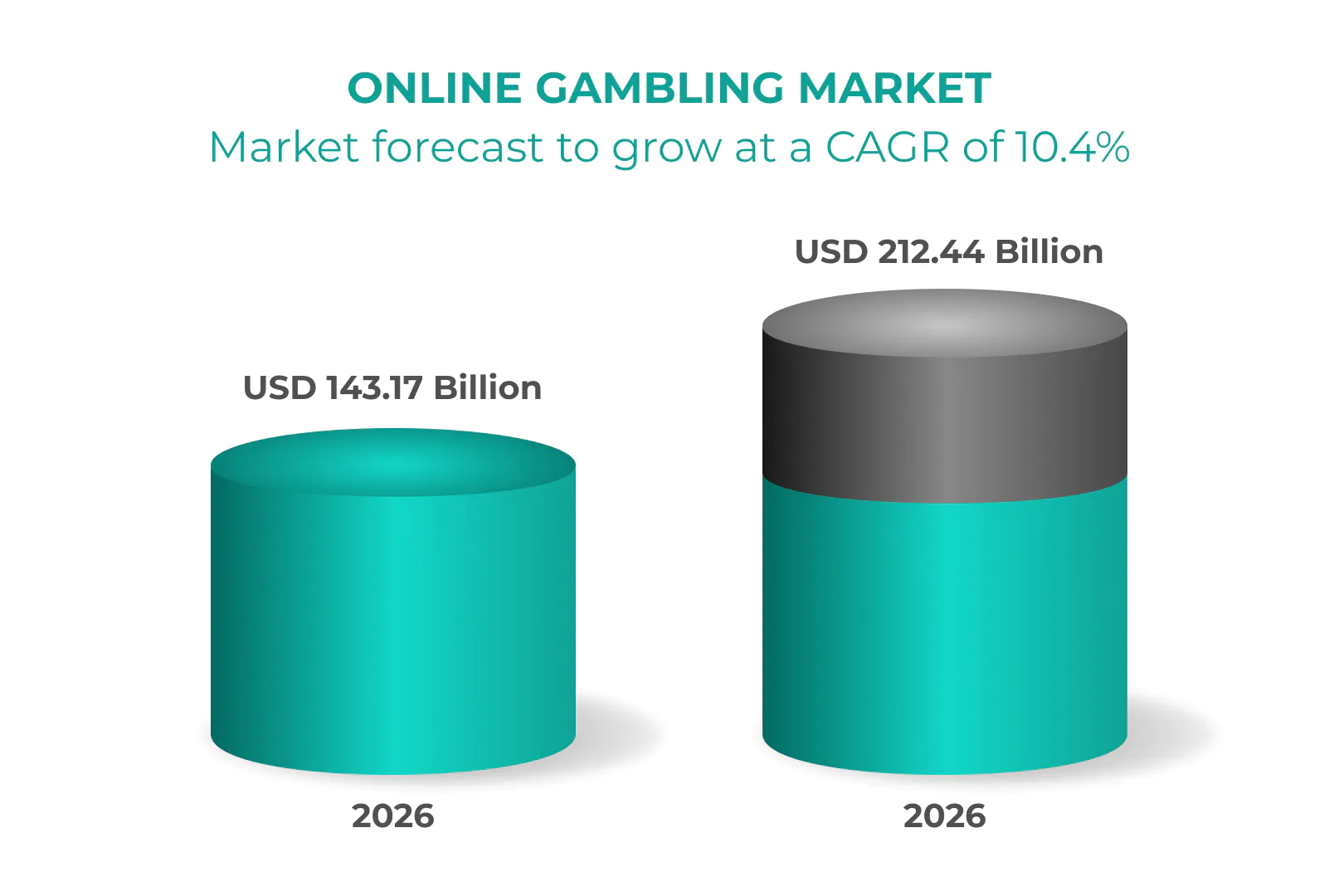
The numbers are large and they are real. According to the Online Gambling Market Report 2026, the global online gambling market is expected to reach $143.17 billion in 2026 and grow to $212.44 billion by 2030, driven by a CAGR above 10%. Other major research firms — including Mordor Intelligence and Grand View Research — put the 2026 figure somewhat lower ($101–116 billion), depending on market scope and methodology, but all converge on the same directional picture: sustained, accelerating growth above 10% annually through the end of the decade.What the headline numbers don’t show is the shift in how this growth is distributed — and what that shift demands of the studios and operators building the products players actually use. That’s what this article is about.
From expansion to maturity: the most important shift in iGaming right now
The online casino industry trends 2026 reflect a market entering a new phase. Early iGaming growth rewarded speed: get a product live, get players through the door, iterate later. That window is closing.
Today’s digital gambling industry growth is increasingly concentrated in two very different contexts: mature regulated markets where retention and product quality define competitive position, and emerging regions — particularly Eastern Europe and Latin America — where rapid regulatory reform is opening new audiences but demanding localization from day one. The U.S. continues legalizing state by state, while Brazil’s Law 14.790/2023 mandates local operator compliance and responsible gaming protocols, setting a template for emerging market regulation.
For operators building content libraries, this creates a dual brief that most content partnerships don’t address well: content must perform to the quality bar of Tier 1 regulated markets and be configurable enough to adapt across jurisdictions without full redevelopment cycles.
This is where the mismatch between market conditions and typical studio output begins to show.
Mobile gambling trends: beyond the obvious
Mobile platforms captured 53.65% of online gambling market revenue in 2025 and are projected to grow at a 13.65% CAGR through 2031 — the fastest of any delivery segment. Across multiple countries, smartphones account for nearly 80% of all online gambling users.
These numbers have moved the mobile gambling trends conversation past the “mobile-first” slogan. Mobile isn’t a design constraint anymore — it’s the product. What that means in practice is specific:
Session architecture has changed. Mobile players play in shorter, higher-frequency bursts. Players aged 18–24 — the industry’s fastest-growing cohort, posting an 11.98% CAGR beginning in 2026 — have grown up on TikTok-style interfaces and social betting pools. They expect instant feedback, touch-native controls, and UI that’s been designed for a 6-inch screen, not adapted for it.
Performance has a direct revenue line. Load time and frame rate are no longer UX concerns — they are acquisition and retention levers. A game that loads slowly loses a mobile player before the first spin.
Art and animation pipelines need to account for this from the first asset brief. At Inkration, mobile optimization isn’t a post-production pass — it’s a constraint that shapes how we scope game art, UI systems, and animation rigs from the concept stage.

Live casino market growth: experience gap is widening
Annual growth rates in the live dealer segment have outpaced RNG-based gaming by a significant margin every year since 2019. Market projections indicate a 24.7% CAGR for the live dealer segment through 2026. Live and in-play wagering now represents 53.4% of all online betting activity as of early 2026, with projected growth of 14.85% CAGR through 2031.
This is the most structurally important data point in this year’s online casino industry analysis. Live casino isn’t a premium category anymore — it’s becoming the default expectation for a large share of players.
The physical visibility of real card shuffles and roulette spins produces a level of trust and authenticity that RNG games don’t replicate — and that trust factor has proven durable. On top of that, live casino reintroduces a social dimension: player survey data consistently identifies “more fun” and “more real” as the top reasons cited for live casino preference over RNG games.
This has direct implications for online casino innovation trends and what operators need from studios. Live formats demand broadcast-quality production pipelines, multiplayer interaction layers, and UI systems that perform under the latency constraints of real-time streaming. Features like collaborative betting mechanics — where players share outcomes across a session — are increasingly common asks, and they require technical architecture that most art-only studios can’t support.
Studios that operate across both art and development can work with operators at the game design level, not just as asset suppliers. That distinction matters more as live experiences become more complex.
Personalization and player behavior in online casinos
The shift toward personalized gaming experiences is one of the more consequential casino technology trends of 2026 — and one of the most demanding for developers.
AI and personalization features gained a 46% user preference rating across platforms, according to recent market data. Platforms are using behavioral data to recommend relevant titles, dynamically adjust bonus structures, and tailor player journeys across sessions. This isn’t A/B testing — it’s continuous, real-time adaptation.
What this requires from content is flexibility. A game designed with fixed configuration parameters — bet sizes, feature frequencies, visual themes — is increasingly difficult to integrate into a modern personalization stack. Operators running AI-driven retention systems need game configurations they can tune without requesting a development build.
This reframes one of the key asks operators place on studios: don’t just deliver a shipped game. Deliver a configurable product that can be adapted without touching the core codebase. The gambling industry digital transformation is forcing this into every content contract, whether studios are ready for it or not.
Technology stack: what’s actually being deployed
The technology layer shaping gambling platform development trends in 2026 isn’t a single breakthrough — it’s an integrated stack that several major operators are already running.
AI and data analytics are embedded in player segmentation, fraud detection, and odds engines. Firms leveraging big data for responsible gaming report a 15% lower rate of high-risk player incidents than those operating without such systems — a compliance differentiator that regulators are beginning to reward with more favorable licensing terms.

Blockchain and digital payments are gaining real traction. Stablecoins — specifically USDT and USDC — are expected to account for over 70% of all crypto-betting transactions in 2026, fueling a sector valued at over $65 billion. Studios that can build transaction-layer compatibility into game architecture reduce integration friction for operators moving in this direction.
Cloud-native infrastructure is now the baseline expectation for multiplayer and live formats. Real-time data feeds, dynamic odds, and low-latency streaming all require cloud-native build approaches — not adapted on-premise code.
AR/VR/XR remain a long-term investment theme rather than an immediate product requirement. AI, VR, and AR solutions are anticipated to substantially contribute to future online gambling growth, but the near-term priority for most operators is still optimizing what players are already using daily.
For studios, the relevant question isn’t which technologies to follow — it’s whether internal pipelines and delivery formats are compatible with the infrastructure operators are building toward.
Regional dynamics and global iGaming industry forecast
The global iGaming industry forecast for 2026–2030 is not uniform. Three distinct patterns are shaping where investment goes and what content is needed:
Europe leads with approximately 49% of global market share, bolstered by supportive regulatory policies and established consumer demand. Competition in mature European markets is high, and the quality bar for content is rising accordingly.
Eastern Europe is the fastest-growing region according to the source report — regulatory frameworks are maturing, and mobile adoption is accelerating rapidly. Content entering this market needs to be localized meaningfully, not just translated.
North America is accelerating at a 15.40% CAGR through 2031, driven by state-by-state legalization. New entrants are creating demand for diverse content libraries fast.
Asia-Pacific accounts for approximately 50% of global mobile gaming revenue, driven by high smartphone penetration and new mobile technology, though regulatory fragmentation continues to limit market access in key territories.
For studios designing content with cross-regional distribution in mind, the structural requirement is the same: modular design from the start. Themes, UI language, payment integrations, and regulatory compliance layers need to be separable without triggering a rebuild.
Consolidation and what it means for content partnerships
The acquisition of Snaitech by Flutter Entertainment isn’t an isolated deal — it’s a sign of how the online casino revenue drivers are shifting at the operator level. Larger operators are building multi-channel ecosystems that combine sports betting, casino, and retail experiences under unified loyalty architectures. Scale has become the competitive moat.
M&A activity in the online casino sector rose by 29% in recent years, with the top five players accounting for 34% of market share.
This consolidation has a direct impact on content partners. As operators grow more complex, their content requirements become more specific — and harder to meet with general-purpose studio output. Operators need content that’s integration-ready for their specific platform architecture, compliant with the jurisdictions they’re entering, and visually differentiated enough to sit alongside premium branded content in their lobbies.
Studios that position themselves as platform-aware partners — rather than pure asset producers — will win a larger share of these relationships.
Security, trust, and compliance as product requirements
Security and responsible gaming compliance are becoming content specifications, not just operator concerns. Regulatory restrictions affected 41% of operators and responsible gambling compliance impacted 37% of platform features and services in recent market analysis.
As regulators in Europe and North America tighten responsible gaming mandates — from session time limits to behavioral monitoring integrations — the games themselves need to support these features technically. This is no longer something operators add after integration. It’s increasingly a condition of listing.
Studios that understand regulatory environments across key markets can design these requirements into games from the start, reducing operator integration work and shortening time-to-market in new jurisdictions.

What market is actually asking studios to become
The picture that emerges from this online gambling industry analysis is not one where studios compete on art quality alone. Art quality is the entry requirement. What differentiates a content partner in 2026 is the combination of what they deliver and how deliverable it actually is.
Operators managing multi-market, multi-platform content libraries need studios that can:
Deliver mobile-optimized game art and UI systems built for performance at scale — not adapted from desktop templates. Produce live-format-ready assets that work within the production and streaming constraints of real-time environments. Build configurable, integration-ready game products that connect cleanly to AI-driven personalization stacks. Understand regulatory requirements across key jurisdictions and design compliance flexibility into content from day one. Execute across the full production chain — from visual development through technical integration — so operators work with one trusted partner rather than coordinating across three.
The underlying shift is this: the iGaming market trends of 2026 are rewarding operators who operate with platform maturity, and those operators are selecting content partners who operate the same way.
Conclusion: the maturity gap is a studio opportunity
The online casino industry trends 2026 describe a market that has moved past early-stage growth into a phase where quality of execution determines competitive position. The global digital gambling industry growth remains strong — but the operators growing fastest are those with the most integrated, highest-performing content libraries.
For iGaming operators and platform providers who need to fill those libraries — whether you’re scaling an existing product catalog, entering new regulated markets, or rebuilding your live casino vertical — the studio partner question is now a strategic one.
At Inkration, we work across the full production chain: concept art and game design, UI/UX systems, character and environment development, technical animation, and development support through to integration. We build for mobile performance, configure for compliance flexibility, and deliver the kind of content that fits into a modern operator’s platform ecosystem — not just a standalone asset that needs months of rework to ship.
If you’re building a content library that needs to perform across markets, or you’re entering 2026 with a roadmap that demands more from your studio partnerships, we’d like to hear about it.
Sources:
- Online Gambling Market Report 2026 (primary source)
- Mordor Intelligence — Online Gambling Market 2026
- Grand View Research — Online Gambling Market
- DemandSage — Online Gambling Statistics 2026
- American Gaming Association — Commercial Gaming Revenue Tracker
- Coherent Market Insights — Online Gambling and Betting Market 2026
More Article