May 6, 2026
Animation production is no longer divided strictly between traditional 2D workflows and fully 3D pipelines. Today, many studios use hybrid animation approaches that combine the artistic appeal of hand-drawn visuals with the flexibility and scalability of modern 3D technology.
This production model — often called 2D/3D hybrid animation — has become increasingly common in films, games, cinematics, advertising, and streaming content. But it’s also quietly become one of the defining forces in casino game art and slot game development, where the pressure to deliver visually distinctive content at scale is higher than almost anywhere else in the industry.
In this article, we explore how 2D and 3D animation combined works in practice, the core techniques behind it, where it’s used across gaming and entertainment, and the production challenges studios face when building hybrid animation pipelines — including what it means for the artists inside them.
How 2D and 3D Hybrid Animation Works
At its core, hybrid animation combines 2D and 3D production methods within the same scene, sequence, or project. The goal isn’t simply mixing technologies — it’s creating a cohesive visual language that gets the best out of both approaches.
What makes 2d and 3d animation combined so powerful is how many valid forms it takes. In most cases, the workflow involves 3D environments, lighting, or camera systems combined with 2D characters, effects, or stylized rendering workflows. Studios may also reverse the process, using 3D models rendered to appear hand-drawn through non-photorealistic rendering and compositing.
2D characters in 3D environments is one of the most common setups. Placing hand-drawn or stylized characters inside fully 3D worlds gives teams dynamic camera movement, cinematic depth, reusable environments, and more flexible staging — without the cost of animating complex backgrounds frame by frame. In slot art, this translates directly: a richly animated character symbol can live inside a 3D environment that breathes and reacts, without rebuilding both from scratch every time.
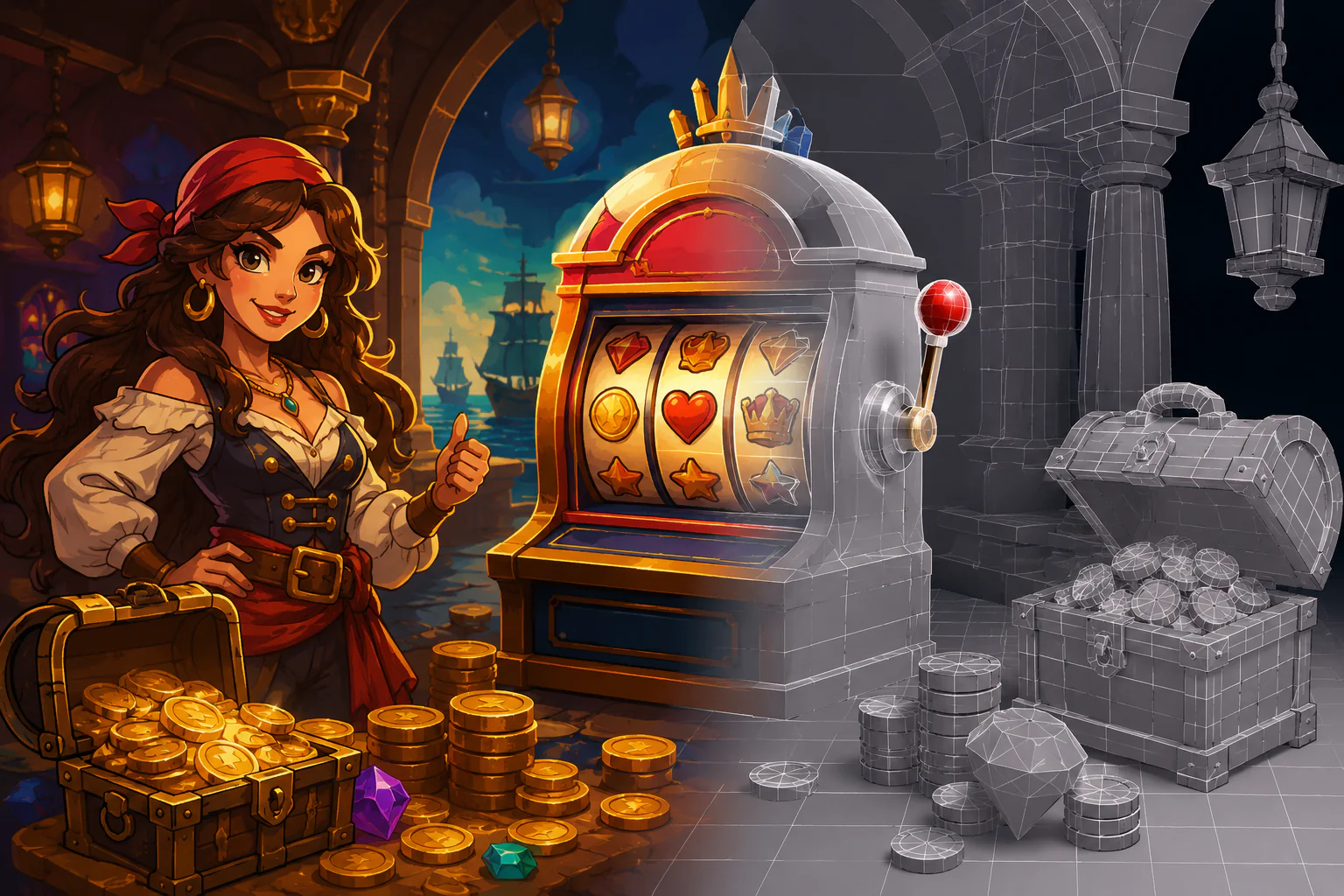
3D animation with 2D rendering styles flips the approach — fully 3D models and rigs rendered with a stylized 2D appearance through cel shading, outline rendering, reduced frame rates, and hand-painted textures. The result keeps the charm of traditional animation while benefiting from modern rigging and lighting underneath.
Combined 2D and 3D visual effects — hand-drawn explosions, smoke, motion lines, impact frames layered over 3D animation — add the kind of expressive visual energy that pure 3D often can’t replicate. This is especially visible in high-production slot game cinematics, where win animations and bonus triggers need to feel genuinely exciting.
Real-time hybrid workflows using engines like Unreal Engine and Unity have expanded what’s possible further, enabling faster iteration on lighting, tighter integration between gameplay and cinematic visuals, and new approaches to trailers and live-service content.
Key Techniques
Creating convincing 2D and 3D animation combined requires careful technical and artistic coordination. Hybrid productions rely on several core techniques to maintain visual consistency.
Cel shading renders objects with flat color regions, sharp shadow transitions, and stylized outlines rather than realistic gradients, creating the appearance of hand-drawn animation from fully 3D assets. It’s widely used in anime-inspired productions, stylized games, and increasingly in premium slot titles that want a distinctive illustrated look without the production overhead of fully traditional animation.
Non-photorealistic rendering (NPR) takes this further, simulating pencil lines, watercolor textures, ink outlines, or painterly effects. For studios with a strong artistic identity, NPR is often what makes the difference between looking distinctive and looking generic — something that matters enormously in casino game art, where originality is a real competitive advantage.
Compositing is what ties everything together. Artists combine 2D animation, 3D renders, lighting passes, effects, shadows, and post-processing into a single final image. Strong compositing is often what makes hybrid scenes feel unified rather than like two separate productions awkwardly stitched together.
Rigged 2D animation — controlling 2D assets through skeletal rigs rather than drawing frame by frame — improves scalability, consistency, and revision speed. It’s a staple of both television animation and game pipelines, and particularly valuable in slot development where character symbols and animations need to stay consistent across a full reel set.
Projection mapping places 2D artwork onto 3D geometry, enabling dynamic camera movement, parallax effects, and more cinematic scene composition when blending traditional artwork with virtual camera systems.
Notable Examples
Some of the most influential productions of recent years are hybrid productions, and they’re worth studying closely.
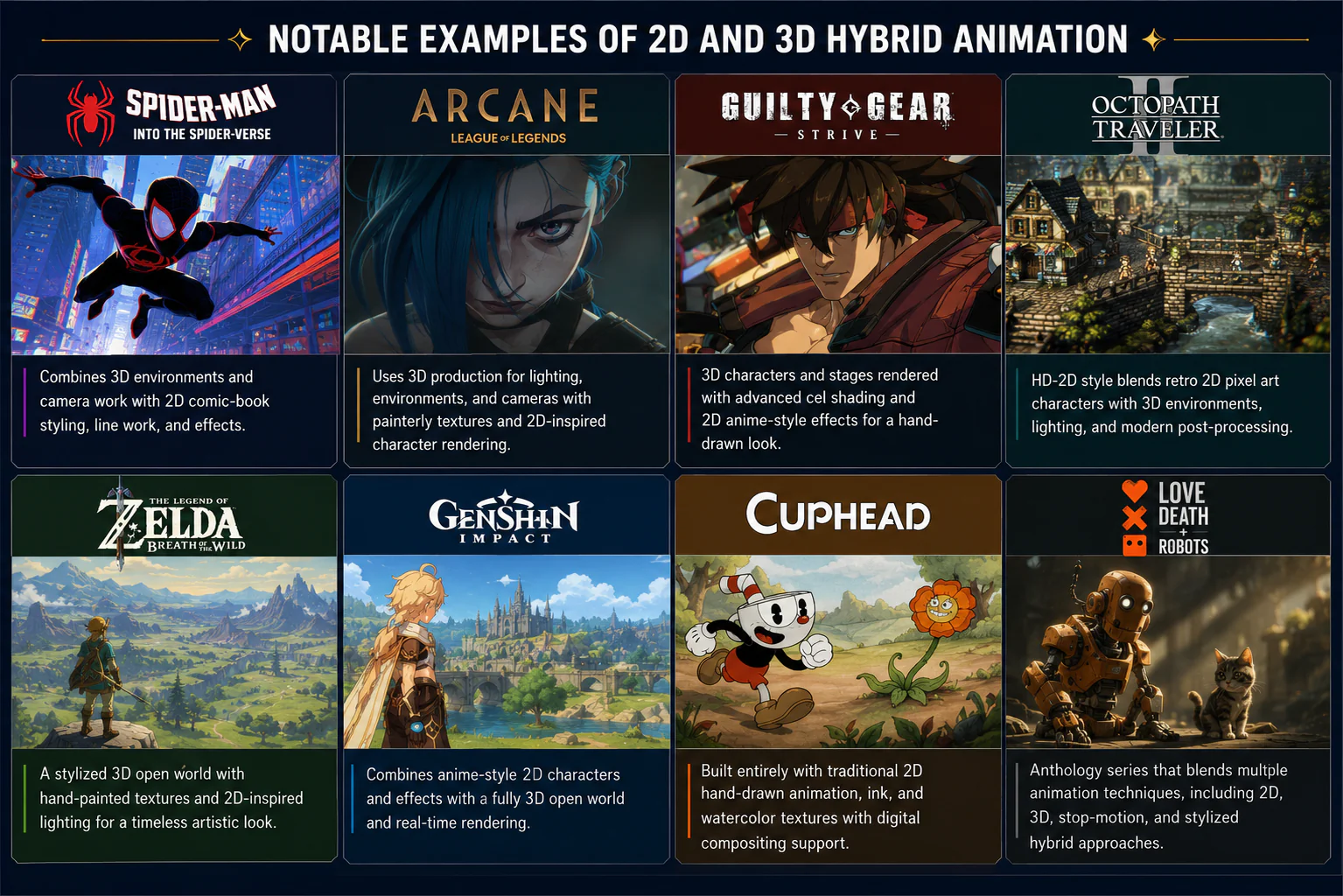
Spider-Man: Into the Spider-Verse permanently shifted the industry’s understanding of what stylized animation could look like — combining comic-inspired visual language, stylized frame timing, 3D environments, and hand-crafted effects in a way that’s still influencing game art pipelines today.
Arcane demonstrated that blending traditional and digital animation sensibilities can support premium long-form visual storytelling at scale, with painterly textures and cinematic lighting that remain genuine benchmarks.
Guilty Gear Strive showed what hybrid visual storytelling techniques can achieve in real-time gameplay. Through controlled camera angles, stylized shading, and advanced rendering, the team made 3D characters nearly indistinguishable from high-end anime animation — a result that’s become a reference point for anyone working in stylized game art.
Octopath Traveler created “HD-2D” by combining retro pixel art with modern lighting, depth-of-field, and 3D environments. It’s one of the clearest examples of how hybrid thinking can produce a completely unique visual identity rather than just a compromise between two styles.
Modern anime production has followed a similar path, with studios increasingly using 3D backgrounds and CGI support alongside traditional 2D character work to manage tight schedules and complex sequences without sacrificing quality.
Challenges to Plan For
Hybrid animation delivers a lot, but it comes with real production challenges that need to be considered upfront.
The biggest is visual consistency. When 2D and 3D elements share the same frame, lighting, perspective, motion timing, line quality, and texture detail all need to align carefully. Poor integration is the kind of thing audiences notice instinctively, even if they can’t name it — and in slot and casino game art, where every asset is scrutinized at close range by players, it’s especially unforgiving.
One underappreciated dimension of this challenge is what hybrid workflows demand from the artists themselves. 3D artists start thinking like 2D artists, developing sensitivity to line, flatness, and expressive stylization. 2D artists, in turn, have to get comfortable with shader workflows, lighting systems, and spatial scene construction. The pipeline complexity isn’t just technical; it reshapes how people on the team think and collaborate.
Pipeline complexity itself, of course, is the other major factor. Hybrid productions often require multiple software ecosystems — 2D animation tools, 3D modeling suites, compositing systems, rendering engines — working in parallel. That increases coordination overhead and demands strong production discipline. Talent follows: hybrid workflows need artists who are genuinely fluent in both traditional animation principles and modern digital tools, which remains a difficult combination to find and retain.
For games and real-time productions, there’s also the performance question. Stylized rendering effects can be technically demanding, and maintaining artistic quality while hitting frame rate and platform targets requires careful optimization of shaders, lighting, and post-processing.
Tools Studios Use
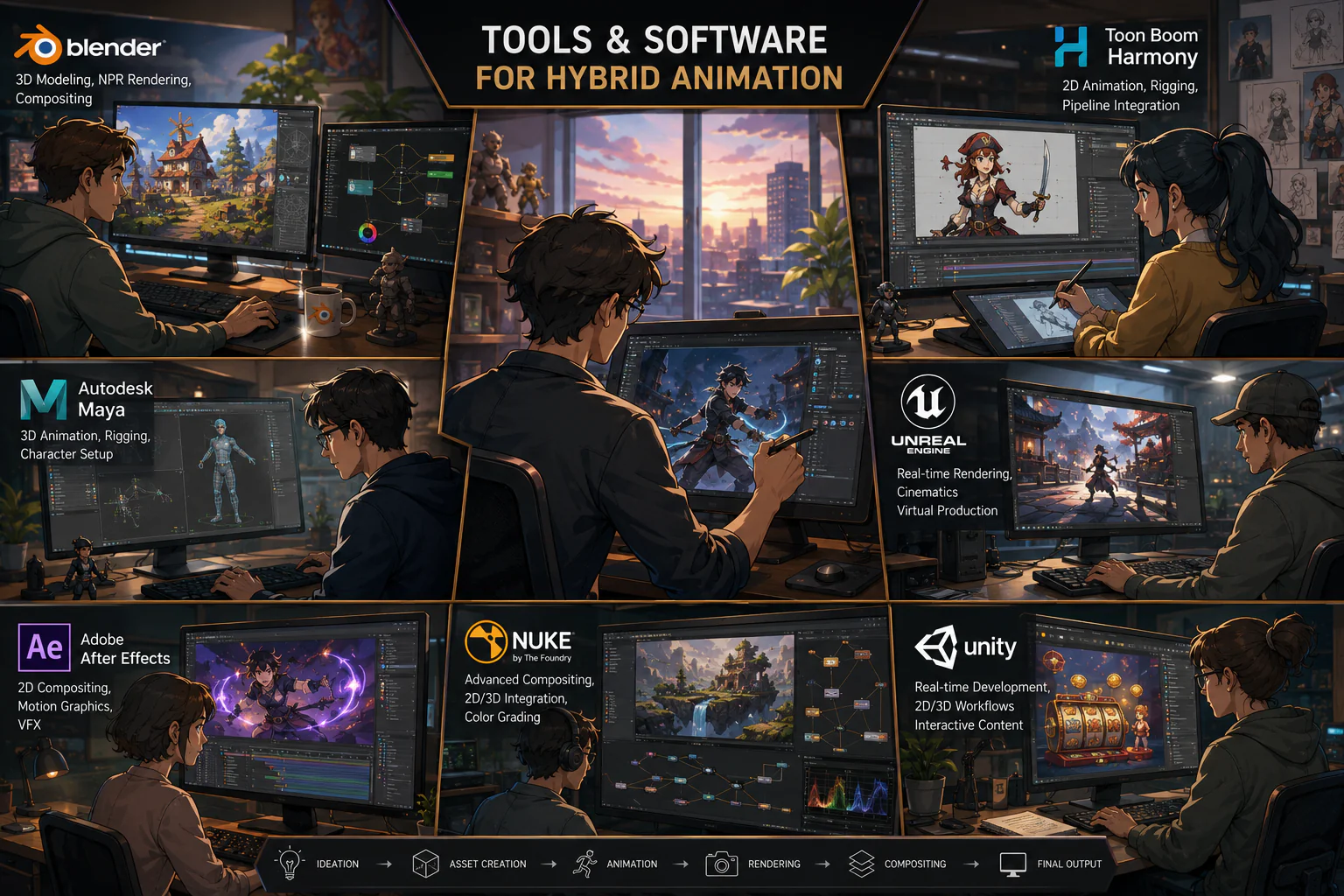
The hybrid animation toolset varies by production scale and goals.
Blender covers 3D modeling, NPR rendering, and compositing, and its flexibility makes it popular across indie and larger studios alike.
Toon Boom Harmony remains the professional standard for 2D animation with strong hybrid pipeline integration.
Unreal Engine has become central for real-time cinematics and stylized rendering with fast iteration.
Autodesk Maya continues to anchor character rigging and complex cinematic pipelines at scale.
Compositing work typically lives in Adobe After Effects or Foundry Nuke.
Where Hybrid Animation Is Used
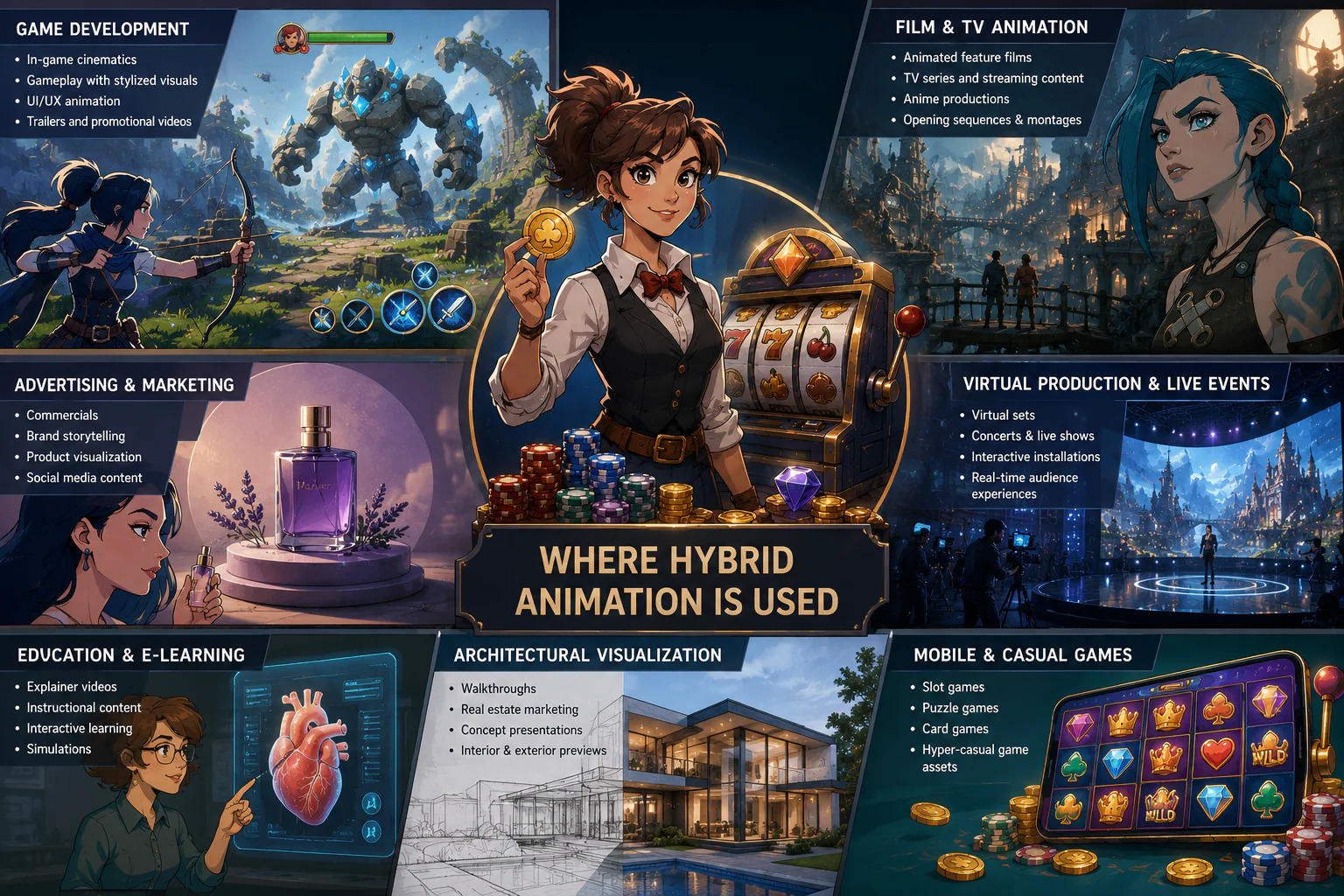
Hybrid animation is now standard across game development, film and streaming, advertising, and virtual production. In gaming specifically, it’s most prevalent in fighting games, RPGs, platformers, and narrative-driven titles — but its adoption in casino and slot game development has grown significantly, driven by the same pressures every other genre faces: audiences with higher visual expectations and a market where standing out is everything. Hybrid workflows let slot studios deliver rich, cinematic visual experiences — detailed character animations, atmospheric environments, high-energy bonus sequences — without the cost of building everything in pure 3D or the limitations of working entirely in traditional 2D. It’s a distinct visual style that players actually remember since 3D provides the volume, camera work, and lighting, while 2D brings the character, liveliness, and that handcrafted feel that pure CG rarely achieves on its own.
Conclusion
2D/3D hybrid animation isn’t really a trend anymore — it’s the natural evolution of the industry. Pure 2D and pure 3D are increasingly unable to deliver the level of stylization, flexibility, and visual expressiveness that modern projects demand on their own. That’s why more and more studios are combining approaches: 3D as the foundation for volume, camera, and light — and 2D to add character, liveliness, and that handcrafted feel that makes a visual style genuinely stick. By combining both approaches thoughtfully, studios can achieve stronger visual differentiation, scalable pipelines, and more efficient workflows without having to choose between artistic ambition and practical delivery.
As real-time rendering technologies continue to mature, hybrid animation will only become more central to how visually ambitious content gets made, whether that’s a streaming series, a AAA title, or a slot game that needs to feel genuinely premium from the first spin.
Need slot or casino game art that actually stands out? At Inkration, we’re a full-cycle game development studio with elite-level expertise in art production — including hybrid animation pipelines built specifically for iGaming. From character animation to bonus cinematics to full visual identity, we know what it takes to make a slot game look like a premium product: [email protected]
FAQ
What is hybrid animation?
Hybrid animation combines 2D and 3D animation techniques within the same production — including 2D characters in 3D environments, stylized 3D rendering, or mixing traditional and digital workflows in post.
What is 2D and 3D hybrid animation used for?
It’s commonly used in games, animated films, anime, cinematics, commercials, streaming content, and casino game art. It helps studios balance artistic style with production efficiency across a wide range of project types.
What are the advantages of hybrid animation?
Cinematic camera movement, reusable 3D assets, a distinctive visual identity, scalable production, and more efficient animation workflows overall.
What software is used for hybrid animation?
The most common tools are Blender, Toon Boom Harmony, Maya, Unreal Engine, After Effects, and Nuke — often in combination depending on project scale and goals.
Is hybrid animation more expensive?
It depends on scope and pipeline complexity. Hybrid workflows can reduce costs through asset reuse and real-time rendering, but they also require specialized expertise and integration work. The trade-off tends to favor productions that need both visual quality and long-term scalability.