June 17, 2026
Acquiring a new player costs real money — way more than keeping one you already have. That math is exactly why casino push notifications have become one of the backbone tools in modern iGaming retention strategy. They’re cheap to run, fast to deploy, and when they land right, they pull players back into the action without anyone feeling marketed to.
Push notifications work through apps, browsers, or mobile web, giving operators a direct line to players that doesn’t get buried the way email does. A promo, a tournament reminder, a nudge to a player who left mid-session — all of it shows up right on the lock screen, not three scrolls down in an inbox nobody checks.
Used well, push notifications for casinos move the needle on engagement, retention, and lifetime value. Used carelessly, they just train players to swipe and ignore — which is the part most articles on this topic skip over, and the part that actually decides whether a push strategy works.

Why Push Notifications Matter in Online Casinos
Online casino players have endless ways to spend their downtime — social feeds, other games, streaming, whatever’s open on the next tab. Even a player who genuinely likes your platform will forget it exists if nothing reminds them.
That’s the gap online casino push notifications fill. Unlike a marketing email sitting unopened next to forty others, a push notification shows up the moment it’s sent — visible, immediate, and hard to miss entirely even if it gets dismissed.
For operators, that visibility translates into a handful of concrete wins: more frequent play sessions, better visibility for new games and bonuses, stronger casino retention marketing, higher tournament turnout, more repeat deposits, and a real shot at clawing back lapsed players through player reactivation campaigns. Inside a broader casino CRM strategy, push sits right at the center — it’s the channel that keeps the conversation going between the moments a player is actually logged in.
That’s also why push has earned its spot as one of the most reliable casino communication channels available: it reaches players in real time, often at the exact moment they’re already deciding how to spend the next twenty minutes of their day.
The Notification Types That Actually Perform
Not every notification earns a tap. The operators getting real results aren’t blasting their whole database with the same line — they’re matching the message to the player and the moment.
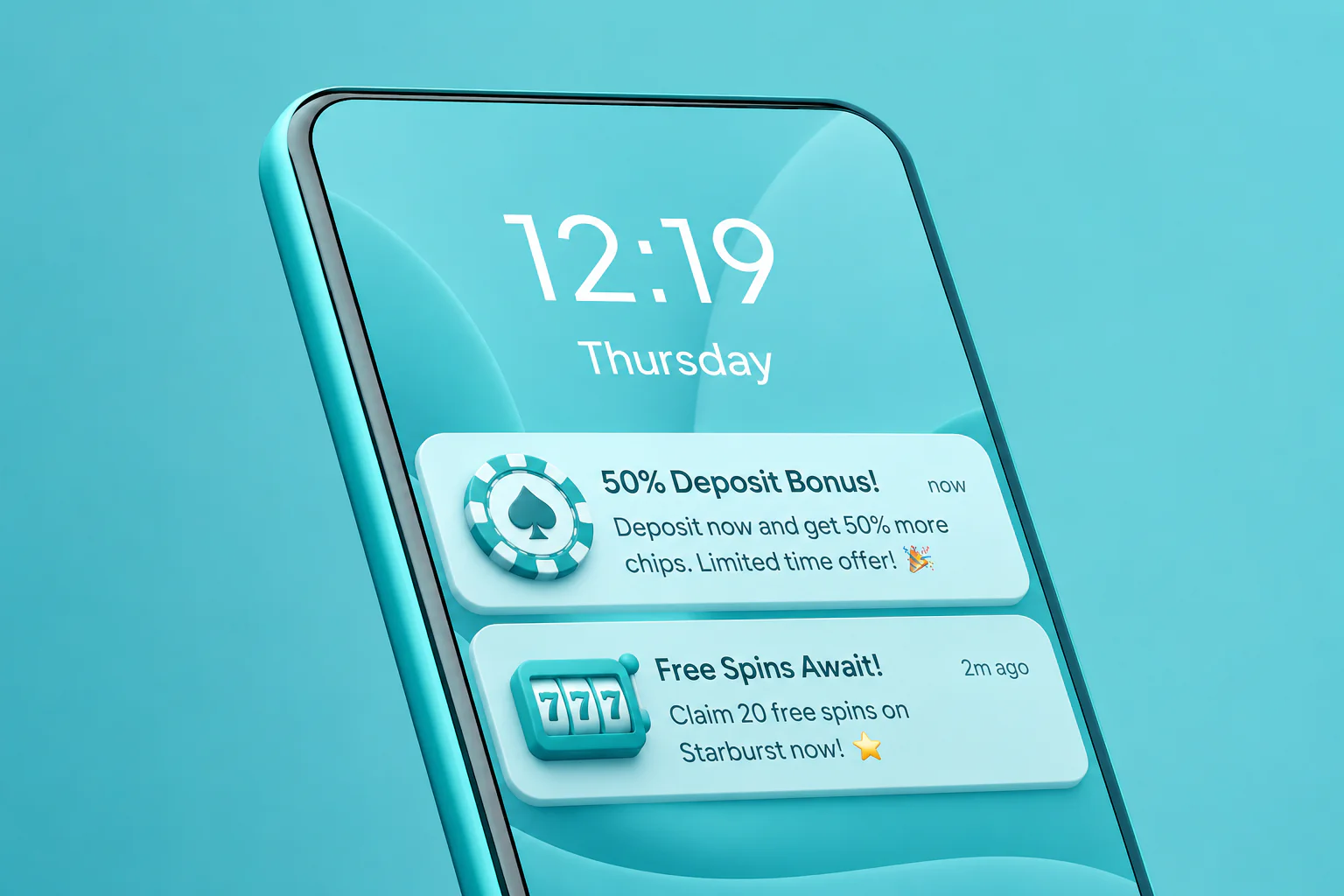
Bonus and promotion alerts still carry the most weight. Welcome offers, reload bonuses, cashback, deposit matches, limited-time drops — these are the bread and butter of casino marketing notifications, and they work because they create a reason to act now rather than later. A line like “deposit today for a 50% match” or “exclusive weekend cashback is live” does its job specifically because it’s time-bound. The catch: a generic bonus sent to your entire base will always underperform a smaller bonus matched to what that specific player actually plays. Segmentation beats size here, every time.
Free spins offers pull a similar lever but with even less friction, since they let a player try something new without risking their own balance. “20 free spins, ready now” or “your daily free spins are waiting” tend to post strong click-through because there’s nothing to think about — it’s pure upside. Pairing free spins with a new game launch is one of the more reliable ways to get fresh content actually played, instead of just sitting unnoticed in the lobby.
Tournament updates lean on a different instinct entirely — competition and standing. Leaderboard shifts, prize pool changes, registration deadlines closing, final results — these messages work because they tap into a player’s sense of where they stand relative to everyone else, which is a stickier hook than a discount ever will be. For operators running tournaments on any regular cadence, this becomes a real driver of casino customer engagement, since it gives players a reason to check back that has nothing to do with money on the table.
Reactivation messages are the hardest to get right and the most valuable when they land. Every casino loses players to inactivity — it’s unavoidable. The question is whether you can pull them back. “We miss you, here’s something waiting” or “come back today for free spins” only work if they’re built on actual behavioral data — what that player used to play, how much they used to deposit, what made them stop. A reactivation push built on guesswork reads as spam. One built on real history reads as relevant. That difference is the entire game.
Building Push Into a Real Retention System
None of this works as a standalone tactic. Push notifications earn their value when they’re wired into a broader retention setup, not fired off as isolated blasts.
The shift that’s changed the game for most operators is moving from scheduled broadcasts to behavioral trigger campaigns — messages fired by what a player actually does, not by a calendar. A player abandons registration halfway through, a deposit attempt fails, a bonus sits unclaimed, a tournament opens registration, a session goes quiet past a set threshold — each of these is a moment where a well-timed nudge has a real shot at changing the outcome, because it’s relevant to something that just happened rather than generic noise dropped at 9am on a Tuesday.
That relevance only scales through proper segmentation. High rollers, casual weekend players, sports bettors, slot loyalists — they don’t respond to the same bait, and treating them like one audience is how engagement numbers quietly erode. A solid casino notification system splits players by playing habits, deposit history, preferred game categories, location, and activity level, then builds messaging around each group instead of one-size-fits-all blasts.
VIP and loyalty players deserve their own lane entirely. Exclusive tournaments, early access to new releases, personalized offers, invite-only events — this is where casino loyalty marketing through push earns its keep, because high-value players are exactly the ones most damaged by feeling like just another name on a list.
Push also performs best as part of a wider mix rather than flying solo — paired with email, SMS, in-app messaging, and loyalty program touchpoints, it becomes one piece of a connected retention setup instead of a channel shouting into the void on its own.
One thing worth saying plainly: push only works if players actually want it. Frequency matters as much as targeting — overload a player’s notification tray and you’ll train them to mute you entirely, which kills the channel faster than bad copy ever could. The operators who get the most long-term value treat push volume the same way they treat bonus spend: with a budget, not a free-for-all.
And none of it matters without content worth pushing. New slots, crash games, live dealer tables, fresh promotional events — push notifications are how players actually find out these exist, rather than discovering them by accident three weeks later. That’s exactly where game production and retention strategy stop being separate conversations. A studio that understands both player psychology and game mechanics builds content that’s easier to market the moment it ships, because the hooks are already built in.
This is the gap Inkration’s casino game development services are built to close — production and engagement strategy designed together from day one, so the games operators launch are already shaped around how players will actually discover and return to them.
Conclusion
Push messaging for online casinos earns its place as core retention infrastructure when it’s built right. Done right, it keeps players engaged between sessions, brings back the ones who drifted off, puts new content in front of the right eyes, and reinforces loyalty among the players who matter most to the bottom line. Done lazily, it’s just noise that gets muted within a week.
The difference between the two comes down to the same fundamentals covered here: segment instead of broadcast, trigger off behavior instead of the calendar, personalize instead of guessing, and respect the player’s attention instead of spending it carelessly. Operators who treat web push notifications for casinos as part of a connected retention system — not a standalone campaign — consistently get more out of every message they send.
Strong retention tools only go as far as the content behind them. If you’re building out a game library that’s designed to perform inside exactly this kind of retention strategy, Inkration’s casino game development team can help — built for players to discover, return to, and stick with.
FAQ
What are casino push notifications?
Casino push notifications are messages sent directly to a player’s mobile device or browser to promote offers, tournaments, game launches, rewards, or account-related updates.
Why are push notifications important for online casinos?
They help improve player engagement, support retention efforts, increase session frequency, and provide a direct communication channel that often achieves higher visibility than email.
What types of casino push notifications work best?
The most effective notifications typically include bonus offers, free spins, tournament updates, VIP rewards, and personalized reactivation messages.
How do push notifications improve player retention?
They remind players about available rewards, highlight new content, encourage repeat visits, and support ongoing engagement throughout the player lifecycle.
Are web push notifications effective for casinos?
Yes. Web push notifications for casinos allow operators to reach players even when they are not actively browsing the casino website, making them a valuable retention and engagement tool.
What role does personalization play in casino push campaigns?
Personalization increases relevance. Notifications based on player preferences, behavior, and activity history generally perform better than generic mass messages.