July 15, 2026
Slots get reinvented every week. Blackjack has been running on roughly the same ruleset since the 18th century — and players still expect it to feel fresh on a phone screen in 2026. That tension is the whole challenge of casino table game design: the math is largely fixed, the rules are public knowledge, and the audience knows exactly what a fair game looks like. You can’t hide weak design behind a bonus round.
What you can do is win on everything around the core game. Pacing, interface, side bets, presentation, social features — this is where online casino table games are actually won or lost. Designing casino table games well means treating a centuries-old ruleset as a foundation, not a finished product. Below is how professional table game development actually works: the design elements that matter, the math underneath them, and the process that takes a concept from spreadsheet to certified, revenue-generating title.
Core Elements of Successful Table Game Design
Every table game — blackjack, roulette, baccarat, poker, or a custom hybrid — stands on the same handful of pillars. Get one wrong and the others can’t compensate.
| Element | Purpose | Impact on Player Experience |
| Game math (RTP, house edge, volatility) | Defines long-term economics for operator and player | Players sense unfair math fast, even without calculating it — trust lives or dies here |
| Rules and betting mechanics | Structure of decisions, bets, and payouts | Clear rules lower the entry barrier; interesting decisions keep experienced players engaged |
| Pacing and round length | Controls session rhythm and bet frequency | Too slow feels dead online, too fast feels like a slot wearing a blackjack costume |
| UI and table layout | Translates a physical table to a screen | A cluttered casino game interface kills mobile play before the first bet |
| Art, animation, and sound | Sets atmosphere and perceived quality | Premium presentation signals a premium (and trustworthy) game |
| Side bets and engagement features | Adds variance and optional excitement | Gives casual players big-win moments without touching the base game |
| Fairness and transparency | RNG certification, visible rules, honest payouts | The invisible layer that makes everything else believable |
The common thread is respect for the player’s intelligence. Table game audiences skew more experienced than slot audiences. They notice when a payout table is worse than the industry standard, and they leave quietly.
Balancing Game Math and Betting Mechanics
Casino game mathematics is where table game development starts — before art, before UX, before anything gets built. Four numbers define the economic identity of the game:
| Metric | What It Means | Typical Range for Table Games | Design Consideration |
| RTP (return to player) | Percentage of total wagers paid back to players over time | 97–99.5% for base games; lower for side bets | Table games live on thin margins — players expect high RTP and compare titles |
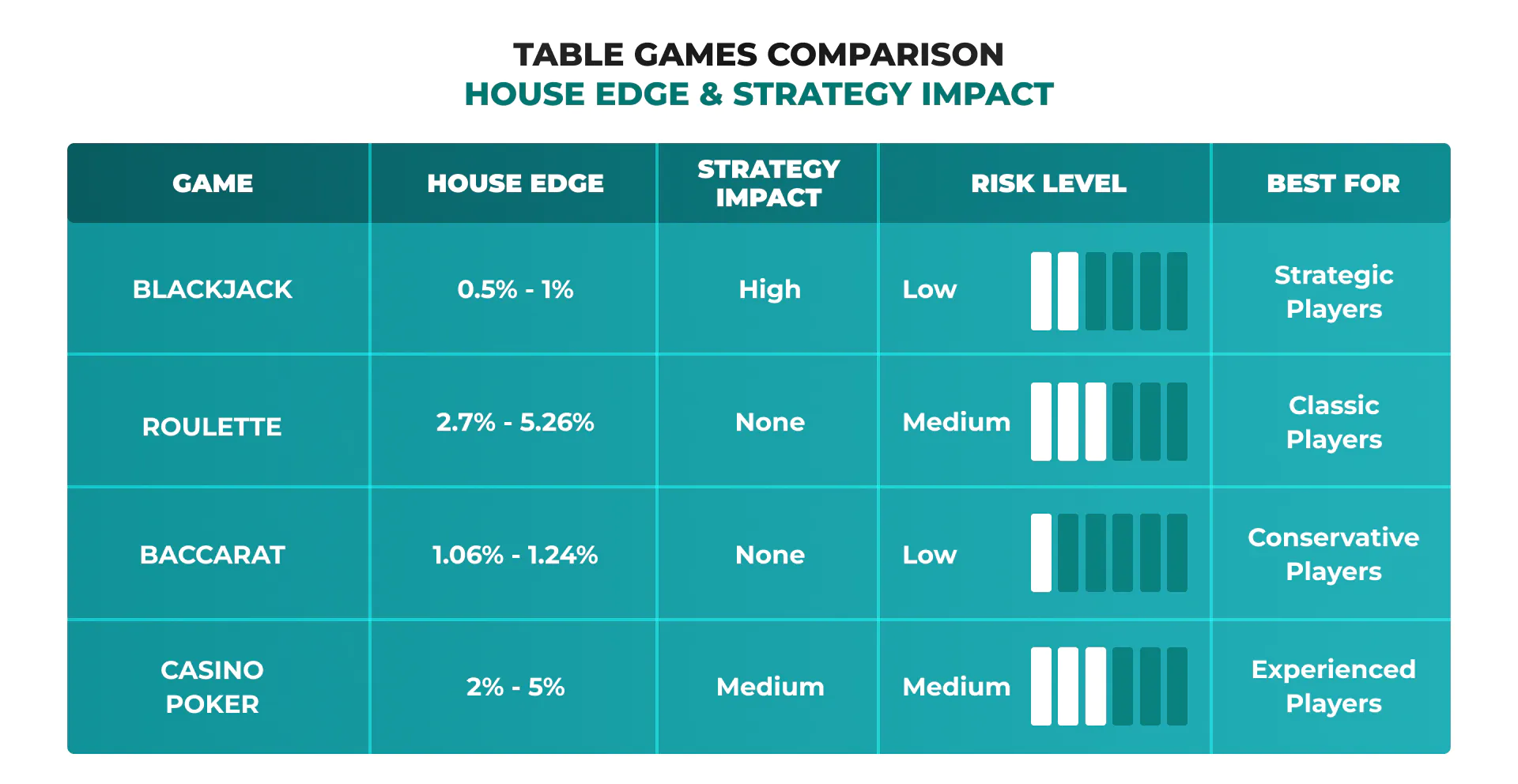
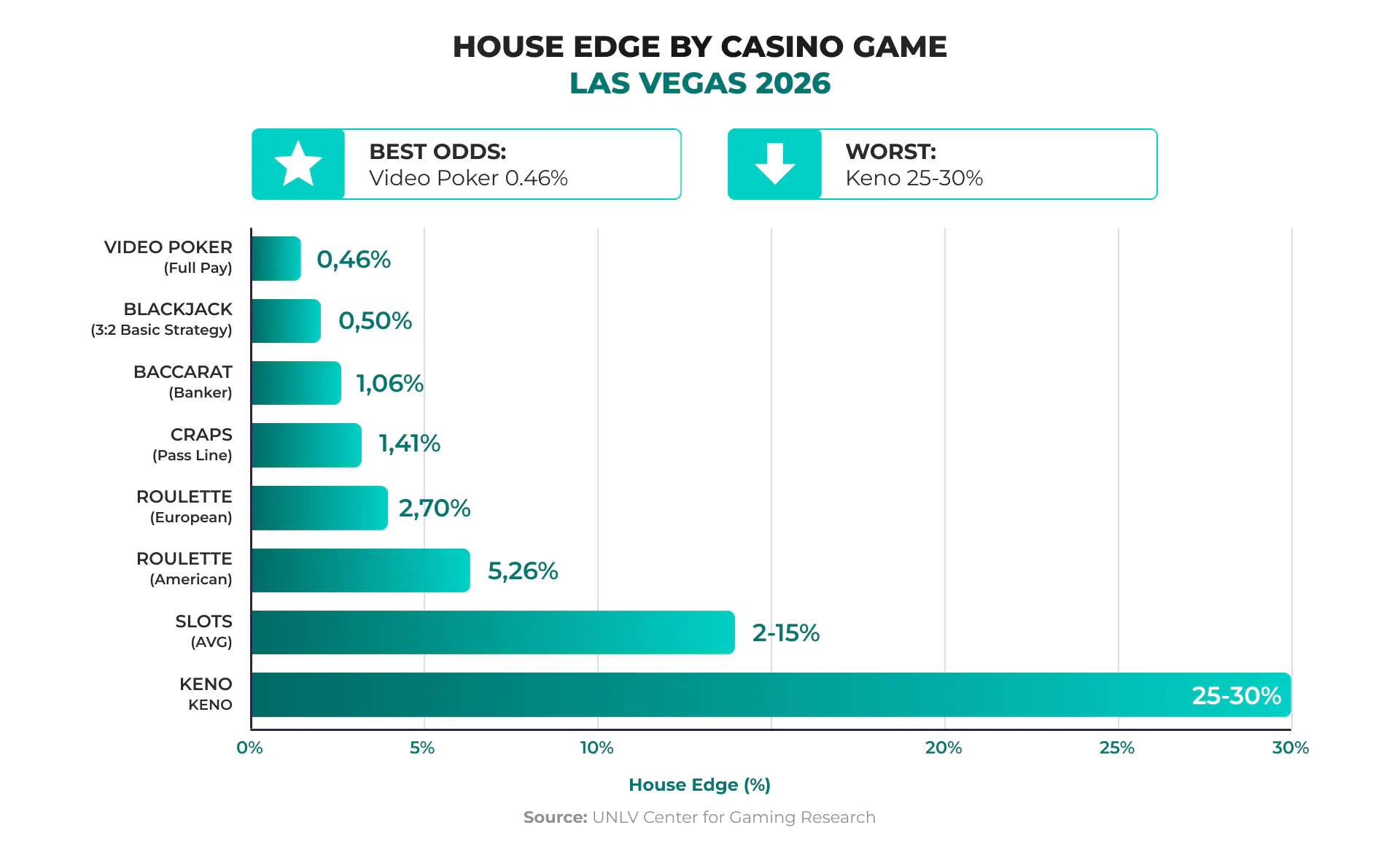
| House edge | The operator’s mathematical advantage (100% minus RTP) | 0.5% (blackjack, optimal play) to ~5% (some side bets) | The revenue engine; too aggressive and volume drops, too thin and the game isn’t viable |
| Game volatility | How much results swing around the expected value | Low for base games, medium-to-high for side bets | Base game stays steady and predictable; side bets deliver the adrenaline |
| Payout structure | The specific odds paid per outcome (3:2 blackjack, 35:1 straight-up roulette) | Standardized per game type, flexible on side bets | Deviating from standards (6:5 blackjack, for example) is instantly visible to players |
The elegant part of table game math is the division of labor. The base game runs low volatility and high RTP — that’s what keeps sessions long and players comfortable. Side bet mechanics carry the volatility: Perfect Pairs, 21+3, Dragon Bonus, progressive jackpots. A player who would never risk their bankroll on a high-variance base game will happily throw a small side bet at a 100:1 payout every hand.
Betting mechanics deserve the same rigor. Bet range, chip denominations, rebet and double functions, table limits — these decisions shape who plays the game. A table with a $1–$500 spread serves a completely different audience than a VIP baccarat room with a $100 minimum, and the interface should reflect that from the first screen.
One rule that separates professional casino table game development from amateur work: the math model gets simulated across millions of rounds before a line of production code is written. Fixing a broken payout structure after certification is expensive. Fixing it after launch is a reputation problem.
Designing Clear Rules and a Mobile-First UX
Over 60% of iGaming activity happens on mobile, and table games — designed for a physical table wider than any phone — suffer the most from lazy porting. Mobile casino UX for table games is a genuine design discipline, not a responsive-CSS afterthought.
The core problems to solve:
Layout compression. A roulette betting grid has 40+ betting zones. On a 6-inch screen, that’s a fat-finger disaster unless you redesign the interaction — zoom-on-touch areas, racetrack shortcuts, favorite-bet presets, and generous tap targets. Blackjack is easier but still needs one-thumb decisions: hit, stand, double, and split have to be reachable without regripping the phone.
Player onboarding. The paradox of table games is that everyone thinks they know the rules and half of them are wrong. Good onboarding is layered: a clean rules summary one tap away, contextual hints during the first sessions (what “insurance” actually means, why the banker bet in baccarat has a commission), and a demo mode that lets people lose fake money instead of real trust. Never gate the game behind a tutorial — table game players hate being lectured.
Decision speed. Too short a timer and new players panic; too long and multiplayer tables die of boredom. The better pattern is adaptive: comfortable defaults with a fast-play toggle for veterans.
State clarity. At any moment, one glance should answer three questions: what did I bet, what’s the game state, what happens next. If the casino game interface can’t deliver that, no amount of art fixes it.
Engagement Features for Online Table Games
The base game is table stakes — literally. Retention comes from the layer built on top.
Side bets are the workhorse. They add big-win potential, refresh a familiar game, and typically carry a higher house edge, which makes them commercially attractive as long as they’re presented honestly. The design craft is making them feel like a natural extension of the game rather than a bolted-on money extractor.
Multiplayer casino games solve the loneliness problem of digital tables. Shared tables, visible seat occupancy, chat or reaction emotes, and community features like shared results in baccarat roads turn a solo grind into something closer to a real casino floor. Poker takes this furthest — the multiplayer dynamic is the game — which is why poker game development is its own specialty, with matchmaking, table balancing, and anti-collusion systems layered on top of the core rules.
Live dealer games deserve their own paragraph. Live casino game development combines a physical studio, real-time video streaming, OCR card recognition, and a synchronized digital betting layer — and it has become the fastest-growing table segment because it answers the trust question viscerally. Players watch a human deal real cards. Game shows built on classic table game mechanics (lightning multipliers, wheel-based bonuses) have pushed this category well beyond blackjack and roulette.
Tournaments, leaderboards, and missions import proven retention mechanics from slots without touching the certified math. A weekly blackjack leaderboard scored on hands won costs nothing in RTP and adds a competitive reason to come back.
Branded casino tables work at both ends of the market: operators skin tables with their own identity for brand consistency, and entertainment IPs license themed tables to reach fans. A branded environment changes zero rules and meaningfully changes perceived value.
Art, Animation, and Sound Design
Table games have a narrow visual vocabulary — felt, cards, chips, a wheel — which means execution quality is brutally exposed. There’s nowhere to hide.
The art direction question comes first: photorealistic casino elegance, stylized and modern, or fully themed? Each is valid for different audiences, but consistency is non-negotiable. A photoreal table with cartoon chip animations reads as cheap instantly.
Animation carries more weight than most teams expect. Card dealing, chip movement, the roulette ball’s physics, win celebrations — these micro-moments are the perceived quality of the entire product. A dealt card that slides with believable weight and a satisfying flip does more for immersion than any background art. The discipline is restraint: animations must be quick enough to never slow the game, with a skip option for high-frequency players.
Sound design follows the same logic. The shuffle, the chip clink, the ball settling into a pocket — Pavlovian cues refined by land-based casinos over a century. Ambient audio should be optional; the mechanical game sounds should be so good players leave them on.
This is where a specialized art team earns its cost. At Inkration, table game art projects start with the emotion the operator wants at the table — old-money elegance, neon energy, franchise fantasy — and build every asset, animation curve, and sound cue around that single answer. Generic assets produce generic tables, and generic tables don’t retain anyone.
Fairness, RNG, and Regulatory Compliance
Everything above is worthless if players don’t trust the outcome. Fairness infrastructure is the invisible half of casino game design.
The random number generator sits at the center. Certified RNGs are tested by accredited laboratories — GLI, eCOGRA, BMM, iTech Labs — for statistical randomness, unpredictability, and non-repeatability. Card games add shuffle integrity requirements; roulette adds wheel-outcome distribution testing. Casino game certification isn’t a single stamp: each target market (MGA, UKGC, Ontario, New Jersey, and so on) has its own technical standards, and a game built without multi-jurisdiction compliance in mind gets rebuilt later at multiples of the original cost.
Compliance also shapes the visible product. Regulations dictate displayed RTP information, rule accessibility, bet limit displays, and increasingly a set of responsible gambling features baked into the game itself: session timers, loss limits, reality checks, and self-exclusion hooks that the game client must respect. Treating these as first-class design elements rather than regulatory chores produces a cleaner product — and speeds up certification.
The practical takeaway for operators and studios commissioning a game: define target jurisdictions before development starts. Compliance is an input to design, not a final exam.
Casino Table Game Development Process
A disciplined pipeline is what separates a six-month launch from an eighteen-month one. The industry-standard flow:
Concept → Math → Prototype → Design → Development → Testing → Certification → Launch
- Concept. Define the game type, target audience, jurisdictions, platform priorities, and the commercial hypothesis — why this table, for this operator, now.
- Math. Build and simulate the full mathematical model: RTP, house edge, volatility profile, payout structure, and every side bet. Millions of simulated rounds validate the economics before anything is built.
- Prototype. A playable grey-box version tests pacing, decision flow, and fun. Cheap to change now, expensive to change later.
- Design. Art direction, UI/UX for mobile and desktop, animation planning, and sound design — locked against the validated prototype.
- Development. Production code: game client, server logic, RNG integration, and platform/aggregator API compatibility.
- Testing. Functional QA, math verification against the model, device and browser coverage, load testing for multiplayer tables.
- Certification. Independent lab testing and per-jurisdiction approval. Games designed with compliance in mind pass faster.
- Launch. Aggregator or direct operator integration, monitoring, and post-launch tuning of engagement features based on real player data.
Timelines vary with scope: a polished single-player blackjack variant might take 3–5 months; a live dealer product or multiplayer poker platform is a different order of magnitude.
Why Work With a Table Game Development Company?
Building in-house looks attractive until you list what the project actually requires: a mathematician who can model and defend the game economics to a testing lab, engineers fluent in RNG certification requirements, artists who understand casino visual language, QA with real iGaming compliance experience, and someone who has shipped through GLI before. Assembling that team for one or two titles rarely makes financial sense.
A specialized casino game development company brings the pipeline pre-built. The math libraries exist, the certification relationships exist, the mobile UX patterns have been battle-tested across previous titles. Custom table game development through a studio typically means faster time to market, predictable certification, and — bluntly — fewer expensive surprises.
Specialization within table games matters too. Blackjack game development is a different discipline from roulette game development or baccarat game development: different math structures, different player psychology, different UX conventions. Studios that have shipped across these verticals bring pattern knowledge a generalist team simply doesn’t have — which side bets convert, which onboarding flows reduce drop-off, which animation timings players tolerate at hand 500 of a session.
Inkration works across this spectrum — full-cycle table game development as well as art and animation outsourcing for teams that have engineering covered but need casino-grade visual production. We’ve had the pleasure of working on titles across card, table, and crash verticals for B2B clients, which is exactly the cross-vertical experience that keeps a new table game from repeating someone else’s mistakes.
Conclusion
Table games reward discipline more than novelty. The winning formula hasn’t changed: mathematically honest base games, volatility delivered through well-designed side bets, an interface built for phones rather than adapted to them, presentation that signals quality, and fairness infrastructure that survives regulatory scrutiny in every target market. The games that top operator lobbies aren’t the ones that reinvented blackjack — they’re the ones that executed every layer around it better than the competition.
For operators and platforms, the practical decision is usually not whether to add table games but how — and partnering with a team that has already walked the concept-to-certification road is the shortest path to a table players actually return to. If that’s the conversation you’re having internally, Inkration is happy to have it with you.
FAQ
What makes a casino table game engaging?
A trustworthy, high-RTP base game combined with optional excitement layers: side bets for volatility, multiplayer and live dealer features for social presence, and a mobile-first interface that makes every decision effortless. Engagement in table games comes from polish and pacing, not rule complexity.
How long does casino table game development take?
A standard single-player table game (blackjack, roulette, baccarat) typically takes 3–6 months from concept to certified launch. Live dealer products, multiplayer poker platforms, or heavily customized titles can take 9–18 months depending on jurisdictions and feature scope.
What is the typical RTP for online table games?
Base table games usually run 97–99.5% RTP — blackjack with optimal strategy sits around 99.5%, European roulette at 97.3%, baccarat banker bets near 98.9%. Side bets run lower, often 90–96%, in exchange for much larger potential payouts.
Do table games need certification?
Yes, in every regulated market. The RNG and game logic must be tested by an accredited lab (GLI, eCOGRA, iTech Labs), and each jurisdiction has its own technical standards covering fairness, displayed information, and responsible gambling features.
Can table games be branded or customized?
Fully. Custom table game development covers everything from operator-branded tables (custom felts, chips, environments) to entirely new rule variants and side bets — as long as the modified math passes certification for the target markets.