June 4, 2026
When players and operators talk about slot volatility, they’re not talking about how generous a game is — they’re talking about how it pays. Same RTP, completely different experience. Understanding that distinction is what separates a smart slot choice from a frustrating one, and a well-targeted game from one that bleeds its audience dry.
This guide breaks down high volatility slots and low volatility slots: what defines each, who they’re built for, and why the distinction matters whether you’re spinning the reels or building the product.

What Is Slot Volatility?
Slot volatility (also called slot machine variance) describes the relationship between how often a slot pays and how much it pays when it does.
High-volatility slots hit less often but can deliver substantial rewards when they do.
Low-volatility slots pay out more regularly, but those payouts tend to be smaller.
Most players feel the difference within a few sessions even if they’ve never seen the term defined.
One thing volatility does not tell you: how much the game returns overall. That’s what RTP is for.
RTP vs Volatility: What’s the Difference?
This is the most common misconception in online casino slot volatility discussions, and it’s worth addressing directly.
| RTP | Volatility | |
| What it measures | Expected long-term return | Payout frequency and size distribution |
| Expressed as | A percentage | Low / Medium / High |
| Timeframe | Millions of spins | Individual sessions |
| Short-term impact | Minimal | Significant |
Two slots can share a 96% RTP and feel completely different. One might credit small wins on every third spin. The other might go 200 spins between features — then pay 5,000x. Same theoretical return, opposite experiences. That’s RTP vs volatility in practice.
High-Volatility Slots Explained
High variance slots are built around concentrated value: rare events that pay big. Long dry runs are part of the design, not a flaw. The math is structured so that when wins land — especially bonus rounds — they can be significant.
These games tend to feature multipliers that scale aggressively, jackpot or near-jackpot mechanics, bonus rounds with high ceilings, and extended dead spins in base gameplay.
What works for players: The tension is real, and so is the upside on a good session. For players who are genuinely chasing a big moment rather than just filling time, high risk high reward slots deliver that loop.
What doesn’t: Bankroll pressure is genuine. Without solid bankroll management for slots, a high-volatility session can end fast and feel unrewarding — especially if the features never trigger.
Popular High-Volatility Slots
| Game | Why it’s considered high volatility |
| Book of Love (Inkration) | Feature-heavy bonus with expanding symbols and strong multiplier potential |
| Riches of Zeus (Inkration) | Mythological theme with big win ceiling and infrequent but rewarding bonus triggers |
| Dead or Alive 2 | Sticky wilds and multipliers that compound into rare, massive payouts |
| Money Train 3 | One of the highest win ceilings in commercially available slots |
| Bonanza Megaways | Cascading wins with unlimited multipliers in the free spins feature |
Book of Love and Riches of Zeus are both developed by Inkration and sit comfortably in the best high volatility slots category, built with the kind of math model and feature design that keeps bonus-chasers coming back.
Low-Volatility Slots Explained
Low variance slots work differently: wins come often, the hit rate is high, and sessions tend to last longer on the same budget. The tradeoff is a lower ceiling — massive payouts are uncommon, and bonus rounds are modest by design.
For recreational players, this is often the better fit. Frequent payout slots create a steadier entertainment loop, reduce the psychological sting of losing streaks, and make smaller budgets last.
What works for players: Predictability. More engagement per euro spent. Low risk slot games are well-suited to casual sessions where the goal is entertainment rather than chasing a life-changing number.
What doesn’t: If a player is actively hunting for a big moment, the experience can feel flat. Low-volatility titles rarely produce the kind of sessions worth screenshotting.
Popular Low-Volatility Slots
| Game | Why it’s considered low volatility |
| Starburst | High hit rate, consistent small wins, minimal variance |
| Blood Suckers | Strong base game return with stable payout frequency |
| Joker Pro | Clean mechanics with reliable low-level wins |
| Double Diamond | Classic structure with predictable, even payout behavior |
High-Volatility vs Low-Volatility Slots: Key Differences
The easiest way to understand high volatility vs low volatility slots is through a direct comparison.
| Factor | High Volatility | Low Volatility |
| Win frequency | Lower | Higher |
| Win size | Larger | Smaller |
| Bankroll requirement | Higher | Lower |
| Session length | Often shorter | Often longer |
| Bonus potential | Very high | Moderate |
| Best for | Jackpot chasers, bonus hunters | Casual players, budget sessions |
Worth noting: most modern slot portfolios also include a medium volatility tier — a blend of the two that’s become the most common release category. Neither extreme suits every player, and medium-volatility games give studios a wider audience target.
Which Volatility Model Fits Different Player Segments?
This is where it gets interesting for operators and developers.
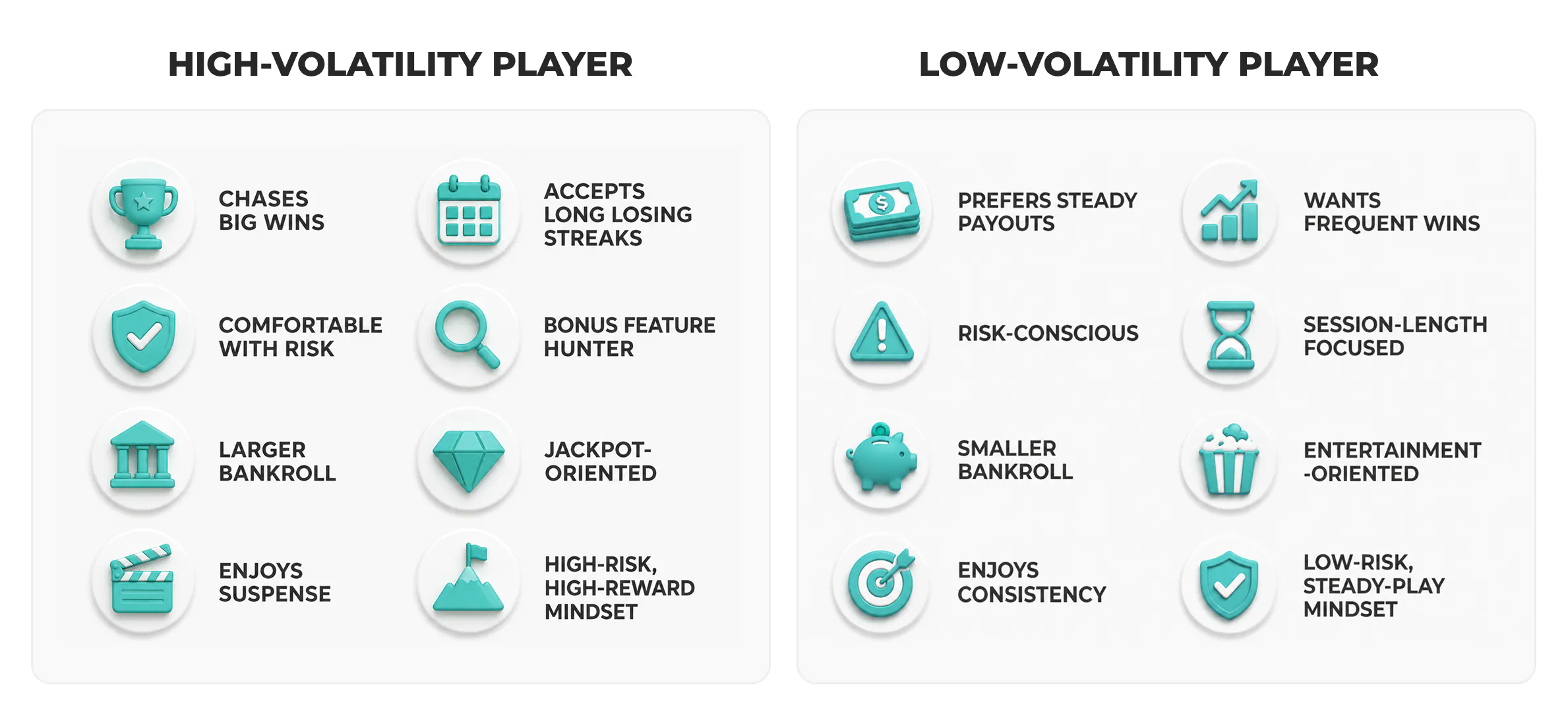
Slot volatility isn’t just a player-facing variable. It’s a product and portfolio design decision with direct implications for acquisition, retention, and lifetime value.
High-volatility titles are natural vehicles for progressive jackpots, big-win promotions, and bonus buy features. They attract a specific type of engaged, high-intent player and generate strong moments for social proof (screenshot wins, streamer content). The downside is that these players also churn faster when variance doesn’t go their way.
Low-volatility titles generate more stable session data and tend to retain casual players longer per visit. They’re often undervalued in promotional planning, but they carry audiences that are less susceptible to frustration churn.
A well-structured slot portfolio uses both — not by accident, but by design. The question for any studio or operator isn’t “which volatility type is better?” It’s “which volatility mix serves this specific audience?”
That design question involves math modeling, feature architecture, and a clear read on player behavior. Getting it right is the difference between a game that converts and one that gets abandoned after two sessions.
This is one reason specialized partners such as Inkration place significant emphasis on gameplay mathematics, player psychology, and audience targeting during the slot game development process.
Which Volatility Type Is Right for You?
If you’re a player:
- Limited budget or recreational play → start with low-volatility slots
- Chasing a feature or a big win, comfortable with variance → high-volatility slots are your game
- Somewhere in between → medium volatility is worth exploring
If you’re a developer or operator:
- Know your audience before locking in a math model
- High volatility ≠ premium; low volatility ≠ low-effort
- A portfolio without both is leaving player segments uncovered
Popular Examples of High- and Low-Volatility Slots
While volatility classifications can vary slightly between providers, the following titles are widely recognized examples.
Popular High Volatility Slots
| Game | Why It’s Considered High Volatility |
| Dead or Alive 2 | Large multipliers and rare but substantial wins |
| Book of Dead | High-value bonus rounds |
| Bonanza Megaways | Significant multiplier potential |
| Extra Chilli Megaways | Strong feature-driven volatility |
| Money Train 3 | Extremely large win ceiling |
These are often considered among the best high volatility slots available online.
Popular Low Volatility Slots
| Game | Why It’s Considered Low Volatility |
| Starburst | Frequent small wins |
| Blood Suckers | Stable payout structure |
| Joker Pro | Consistent base game payouts |
| Reel Rush | Regular winning combinations |
| Double Diamond | Straightforward, predictable gameplay |
These titles are commonly listed among the best low volatility slots for recreational players.
Conclusion
High volatility slots and low volatility slots aren’t competing products — they serve different needs. The better question is always which one fits the context: the player’s budget and goals, or the operator’s audience and retention strategy.
For studios building casino content, getting the volatility model right from the start is one of the highest-leverage decisions in the entire production process.
At Inkration, we design slot games with volatility as a first-principles decision — not a setting applied at the end. Our titles like Book of Love and Riches of Zeus reflect that approach: built around specific player profiles, with math models that back the experience up.
If you’re developing a slot or looking to strengthen your portfolio, let’s talk about how volatility strategy fits into your roadmap.
FAQ
What is slot volatility?
It’s a measure of how wins are distributed in a slot game — how often they occur and how large they tend to be. High volatility means fewer, bigger wins. Low volatility means more frequent but smaller ones.
Are high-volatility slots better?
Not objectively. They offer higher upside, but also more risk and longer losing streaks. The right choice depends on what you’re looking for from a session.
What’s the difference between high variance and high volatility slots?
Nothing — the terms are interchangeable. High variance slots and high-volatility slots describe the same payout structure.
How do I know a slot’s volatility before playing?
Reputable providers publish volatility ratings in their game documentation. You can also infer it from hit rate data, bonus trigger frequency, and the win ceiling relative to the base bet.
Is RTP more important than volatility?
They answer different questions. RTP tells you the theoretical long-term return. Volatility tells you what a real session is likely to feel like. Both matter — neither is more important in isolation.
What is medium volatility?
A middle-ground design that balances win frequency and win size. It’s become the most common tier in modern slot development and suits a broad range of player types.
More Article