June 26, 2026
Not every card game rewards patience. Most rummy variants hand you an objective, let you chase it, and end the round. The Carioca card game works differently — it makes you earn your victories one contract at a time, across a series of increasingly demanding rounds that test your ability to adapt, read opponents, and manage a hand that’s rarely quite right.
Popular across Brazil, Argentina, Uruguay, and beyond, Carioca works equally well as a family card game at the kitchen table and a deeply competitive strategic card game between experienced players. The rules are easy enough to explain in five minutes, but the decision-making compounds across every round. That combination — accessible entry, genuine strategic ceiling — is exactly why this traditional card game has held its ground for generations.
This guide covers the full picture: Carioca card game rules, how the contracts work, scoring, strategies that actually improve your game, and how Carioca compares to standard Rummy.
History and Origins of Carioca
The name gives you the first clue. “Carioca” is what you call someone from Rio de Janeiro — which points strongly toward Brazilian origins, even if the exact history is harder to pin down. The carioca game is generally traced to South America in the early 20th century, most likely evolving from traditional Rummy as local players layered in the contract-based structure that defines it today.
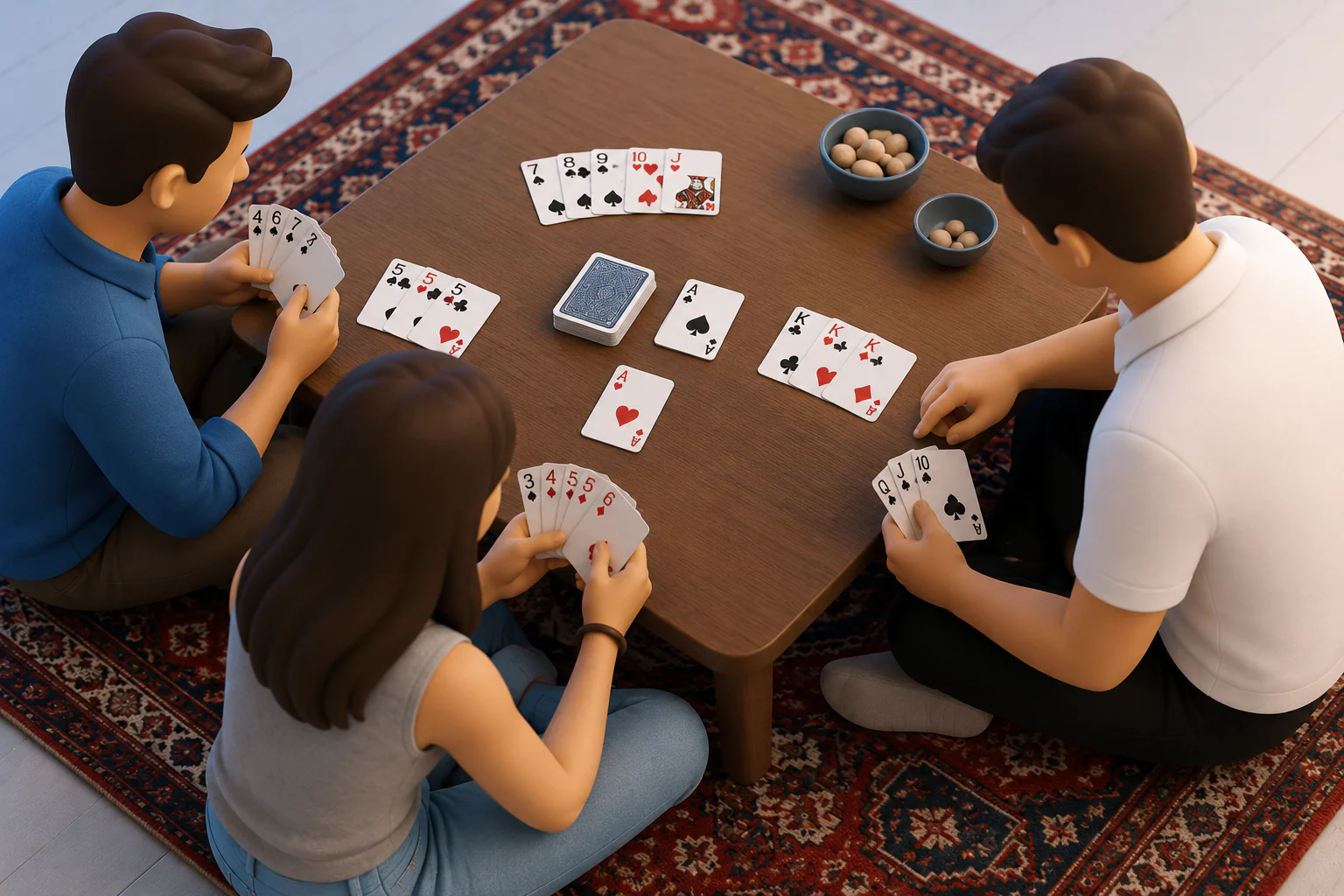
From Brazil, the game spread across the continent — Argentina, Chile, Paraguay, and Uruguay all developed their own flavors. Like most folk card games, Carioca grew through house rules rather than any official governing body, which is why regional variations still exist. The core DNA, however, stays consistent everywhere:
- Players complete a fixed sequence of card contracts in order
- Each contract specifies different sets and runs requirements
- Melds are built from matching cards and sequences of cards
- The winner is whoever finishes all contracts with the lowest cumulative score
That framework — structured progression, variable demands, and a scoring system that punishes dead cards in your hand — is what separates Carioca from ordinary rummy variants and what gives it staying power as a multiplayer card game that scales from two players to six.
How to Play Carioca
If you’ve played Gin Rummy or Canasta, the mechanics here will feel familiar. The meaningful difference is the contracts.
Card Game Objective
The card game objective is straightforward: complete every contract before your opponents do, while keeping penalty points as low as possible. Each contract defines specific card combinations you must build — usually a mix of sets (three or more cards of the same rank) and runs (three or more consecutive cards of the same suit). Finish first, score zero for that round. Everyone else counts what’s left in their hand.
Number of Players and Setup
The Carioca card game works with 2 to 6 players, with four being the most common format. The game uses two standard 52-card decks plus jokers — the double deck makes certain card combinations realistically achievable and creates more competition for the same cards.
Dealing cards gives each player 11 or 12 cards depending on local rules. The rest forms the draw pile, with one card flipped to start the discard pile. Play moves clockwise.
Turn Structure
Every turn follows the same sequence:
- Draw one card from either the draw pile or the discard pile
- Lay down or extend melds if you’ve satisfied the current contract
- Discard one card to end your turn
Players keep refining their hands until someone completes their contract and plays off their final card. That ends the round.
Card Contracts
This is the engine of the whole game. Rather than chasing the same objective every round, players work through a fixed sequence of card contracts, each one demanding a different configuration of sets and runs. A standard progression looks like this:
| Round | Contract |
| 1 | Two sets of three |
| 2 | One set and one run |
| 3 | Two runs |
| 4 | Three sets |
| 5 | Two runs and one set |
| 6 | Three runs |
| 7 | Two sets and two runs |
House rules may add extra rounds or reorder the sequence — this is normal for a game with Carioca’s folk history.
Wild Cards and Joker Rules
Most versions treat both jokers and twos as wild cards, meaning they can substitute for any missing card in a meld. Standard joker rules apply a couple of limits: each meld must contain at least one natural card, and some house rules cap the number of wilds per meld. Because wild cards can unlock contracts that would otherwise be impossible, experienced players guard them carefully rather than spending them at the first opportunity.
Scoring System
The Carioca card game scoring system is simple but consequential. When a player goes out, everyone else counts the value of cards still in their hand:
| Card | Points |
| Joker | 50 |
| Two (wild) | 20 |
| Ace | 15 |
| Face cards (J, Q, K) | 10 |
| 3–10 | Face value |
The player who finishes scores zero. Everyone else adds their remaining totals to a running cumulative score. After all contracts are completed, the lowest overall score wins.
This card game scoring structure does something interesting: it makes holding jokers and twos a calculated risk. They’re your most powerful tools, but if you’re still holding them when someone else goes out, they’re also your biggest liabilities. That tension drives a lot of the game’s best decisions.
Winning Strategies
Carioca rewards players who think in multiple time horizons — not just what you need right now, but what your opponents are building, what cards are no longer in play, and whether finishing this contract quickly is actually worth tipping your hand. A strong Carioca card game strategy combines information management, flexibility, and timing.

Watch the Discard Pile
The discard pile is a free information stream. If an opponent has picked up three hearts in a row, they’re almost certainly building a run — which tells you what not to give them and lets you estimate what else they need. Conversely, when a player ignores face cards across multiple turns, those matching cards are probably safe to shed. Strong card game tactics start with paying attention to what everyone else is doing, not just managing your own hand.
Don’t Reveal Your Plan Too Early
When you consistently pull from the discard pile, you’re essentially announcing your contract to the table. Sometimes the smarter move is drawing blind from the draw pile — even when the discard offers something useful — just to keep opponents guessing. The information you protect can be as valuable as the card you’d gain.
Keep Your Hand Flexible
Committing too early to one arrangement is one of the most common mistakes in Carioca. Many hands have multiple viable paths — what looks like the foundation of two sets might also become a run with one different card. The later contracts in particular reward players who’ve kept their options open rather than forcing a single configuration. A sequence of cards you’ve half-built isn’t always better than a more flexible assortment that adapts to what the draw pile delivers. Card combinations that serve two possible contracts are worth more than ones that lock you into one.
Use Wild Cards Wisely
New players burn through wild cards fast. Experienced ones sit on them. The real value isn’t filling an early gap — it’s completing a difficult contract when the natural card you need simply isn’t coming, or going out a round before an opponent who’s nearly there. In close games, proper wild card management is often the margin between winning and second place.
Count Opponents’ Needs
Pay attention to which suits disappear quickly, which ranks nobody seems to want, and when an opponent’s pace suddenly shifts. A player who’s been discarding slowly and suddenly goes quiet is probably close to finishing. These card game tactics — tracking what others need rather than just managing your own card combinations — improve both offensive and defensive decisions simultaneously.
Think Beyond the Current Contract
Every card you discard is potentially a card you’re handing to the next round’s version of the game. Experienced players occasionally hold inconvenient cards not because they need them, but because giving them away would accelerate an opponent’s position. Balancing short-term efficiency against longer-term control is the defining skill of strong Carioca card game strategy.
Carioca vs Rummy
Since Carioca belongs to the Rummy family, newcomers often wonder how the two actually compare — and the answer is more than a surface-level one.
Traditional Rummy is a single-objective race: build your melds, empty your hand, win the round. It’s faster, more self-contained, and the strategic depth is real but relatively contained. Carioca extends that framework across an evolving campaign of card contracts, each one demanding something different. The game you’re playing in Round 3 is fundamentally different from the one in Round 6 — which means the best Carioca players aren’t just good at managing sets and runs, they’re good at adapting to a moving target.
| Feature | Carioca | Traditional Rummy |
| Goal | Complete sequential contracts | Form melds and empty hand |
| Multiple rounds | Yes | Usually no |
| Contract progression | Required | Not applicable |
| Wild cards | Common | Depends on variant |
| Game length | Longer | Shorter |
| Strategic depth | High | Moderate to high |
Players who enjoy planning several rounds ahead often find the carioca game more rewarding than standard Rummy. If you prefer tighter, faster games, standard Rummy delivers. If you want something that builds across the table — where early decisions echo into later rounds — Carioca is the better fit.
Conclusion
The Carioca card game has lasted as long as it has because it does something most card games don’t: it keeps changing the terms. The card contracts, the wild card calculus, the card game scoring pressure, the need to track opponents while managing your own sets and runs — none of it is complicated in isolation, but combined across seven rounds it produces real depth. That’s as true at the kitchen table as it is on a digital platform.
Whether you’re picking up Carioca card game rules for the first time or sharpening your Carioca card game strategy, the skills that matter most are contract planning and reading opponents. Get those right, and the rest follows.
For studios and publishers thinking about bringing games like this to digital audiences, the systems that make Carioca work — contract progression, multiplayer pacing, card game scoring tension — translate directly into the kind of engagement loops that keep players coming back online. Inkration’s card game development team covers the full production cycle, from game design and UX through multiplayer infrastructure and platform delivery, helping traditional card game concepts find new audiences without losing what made them worth playing in the first place.
FAQ
What is the Carioca card game?
The Carioca card game is a rummy-style multiplayer card game where players complete a fixed sequence of card contracts using sets and runs, trying to finish each round with as few penalty points as possible. It works equally well as a family card game or a competitive strategic card game.
How do you play the Carioca card game?
On each turn in the how to play Carioca card game flow: draw one card from the draw pile or discard pile, lay down melds that satisfy your current contract if you can, then discard one card. The round ends when someone completes their contract and plays their last card.
How is Carioca scored?
Carioca card game scoring is based on the card values remaining in each player’s hand when someone goes out. The player who goes out scores zero; everyone else adds to their cumulative total. Lowest score after all card contracts are completed wins.
Are jokers wild in Carioca?
Yes. Most versions of the Carioca rules treat jokers and twos as wild cards. Standard joker rules require at least one natural card per meld, and some house rules limit how many wilds a single meld can contain.
Is Carioca the same as Rummy?
No — though they share the same family of mechanics. Carioca rules add a progressive contract system played across multiple rounds, which makes it longer, more adaptive, and generally more demanding than a standard Rummy hand.